NFT utility is what holding the token lets you do or receive: enter a venue, use a service, prove a certificate or claim a physical item. The token only identifies the holder. The benefit comes from a person or company, so it is as reliable as the written terms that name who provides it and how it can change.
What does NFT utility mean?
NFT utility means a benefit that comes with holding the token, such as access to a service, a membership, a certificate or a claim to a physical item.
Regulators use the word in a similar sense. The EU Markets in Crypto-Assets Regulation defines a utility token as a crypto-asset "only intended to provide access to a good or a service supplied by its issuer" (Regulation (EU) 2023/1114, Article 3(1), point (9), checked 3 October 2026). The Financial Conduct Authority's 2019 guidance describes utility tokens as granting holders access to a current or prospective product or service, and compares their rights to those of pre-payment vouchers (FCA PS19/22, paragraph 2.21, checked 3 October 2026).
The mechanism is simple. The blockchain records who holds the token. A service, a door system or a member of staff checks that record, then looks at the terms to see what the holder is entitled to, and provides it. Every step after the first one happens off the blockchain and depends on someone doing it.
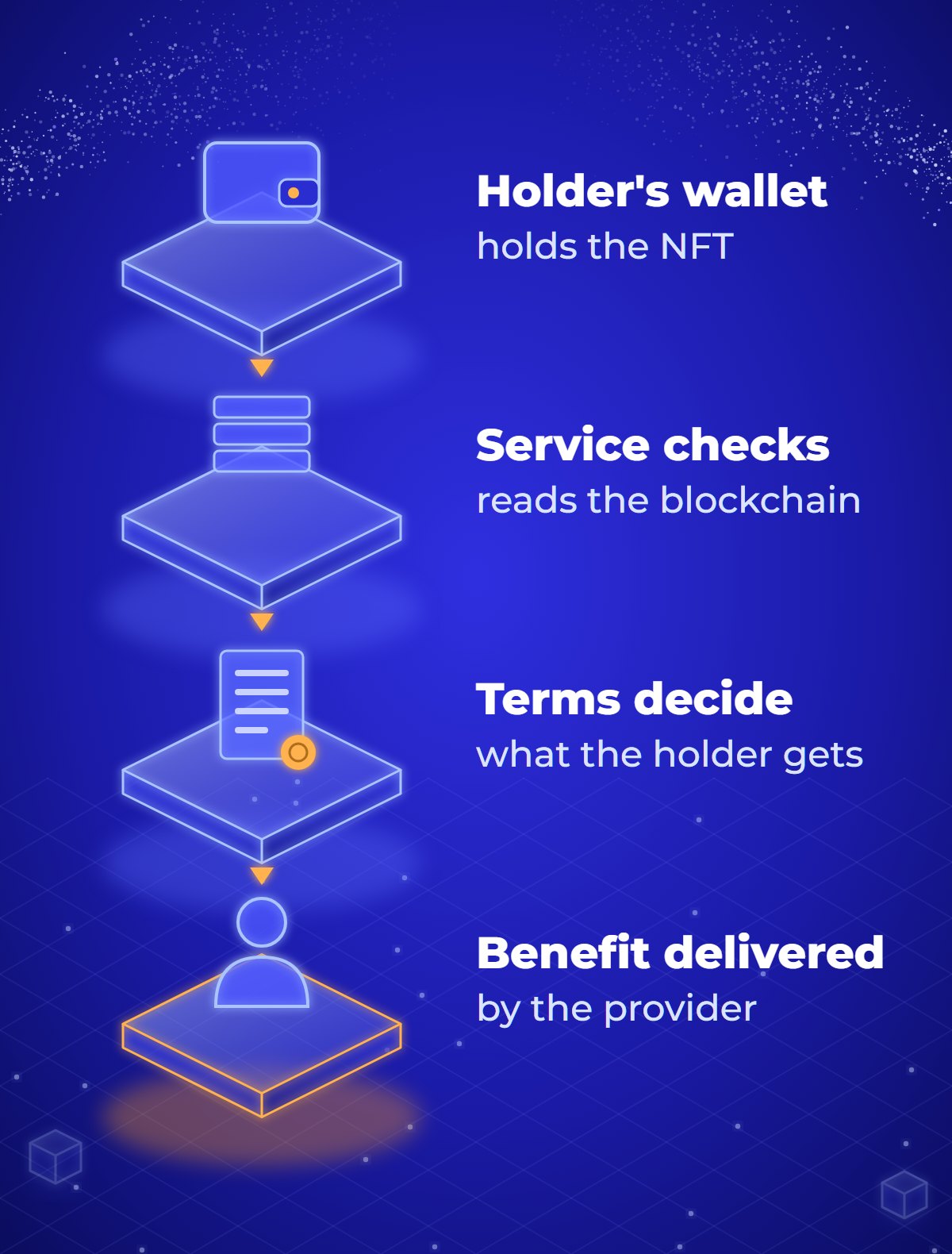
Utility starts with a check of the blockchain and ends with someone providing the benefit.
If you are new to the token itself, What is an NFT? explains what is stored on the blockchain and what sits elsewhere.
Four kinds of NFT utility, with examples
NFT utility falls into four practical kinds: access, membership, certificates and records of physical items.
Access. The token opens something specific: an event, a members' area of a website, a software feature. The service checks the holder's wallet each time. The Law Commission noted in 2023 that a project could give access rights or privileges only to the legal title holder of a particular NFT, and that this would be a valid structure (Law Commission, Digital Assets: Final Report, paragraph 6.112).
Membership. An ongoing programme, where the benefits are described in terms and can develop over time. Trusty Digital's key collections, such as the Trusty Access Key and the Trusty Creator Gate Pass, are membership NFTs on Algorand MainNet. Each names its own benefits terms: holder benefits of the Access Key are provided by Trusty Digital under the Trusty Access Key Benefits terms, with up to 80 keys to be issued. The Creator Gate Pass follows the same pattern, with up to 40.
Certificates. The token proves an achievement or a qualification. It can be issued so that it cannot be transferred, because the certificate belongs to one person. In a 2024 pilot listed on Trusty Digital's Discovery page, a sports organisation issued each achievement certificate as a non-transferable NFT under its own control, which anyone could verify without contacting the issuer.
Records of physical items. The token stands for one identified object. Gold Passport pairs each token with one bar of 999.9 fine gold from The Royal Mint or PAMP, kept in a dedicated safe at a secure location in the United Kingdom and delivered on request. The collection page states that ownership of the bar passes with the token. Utility can also link collections: the first Gold Passport collection is open to holders of Trusty keys, and every key brings free storage.
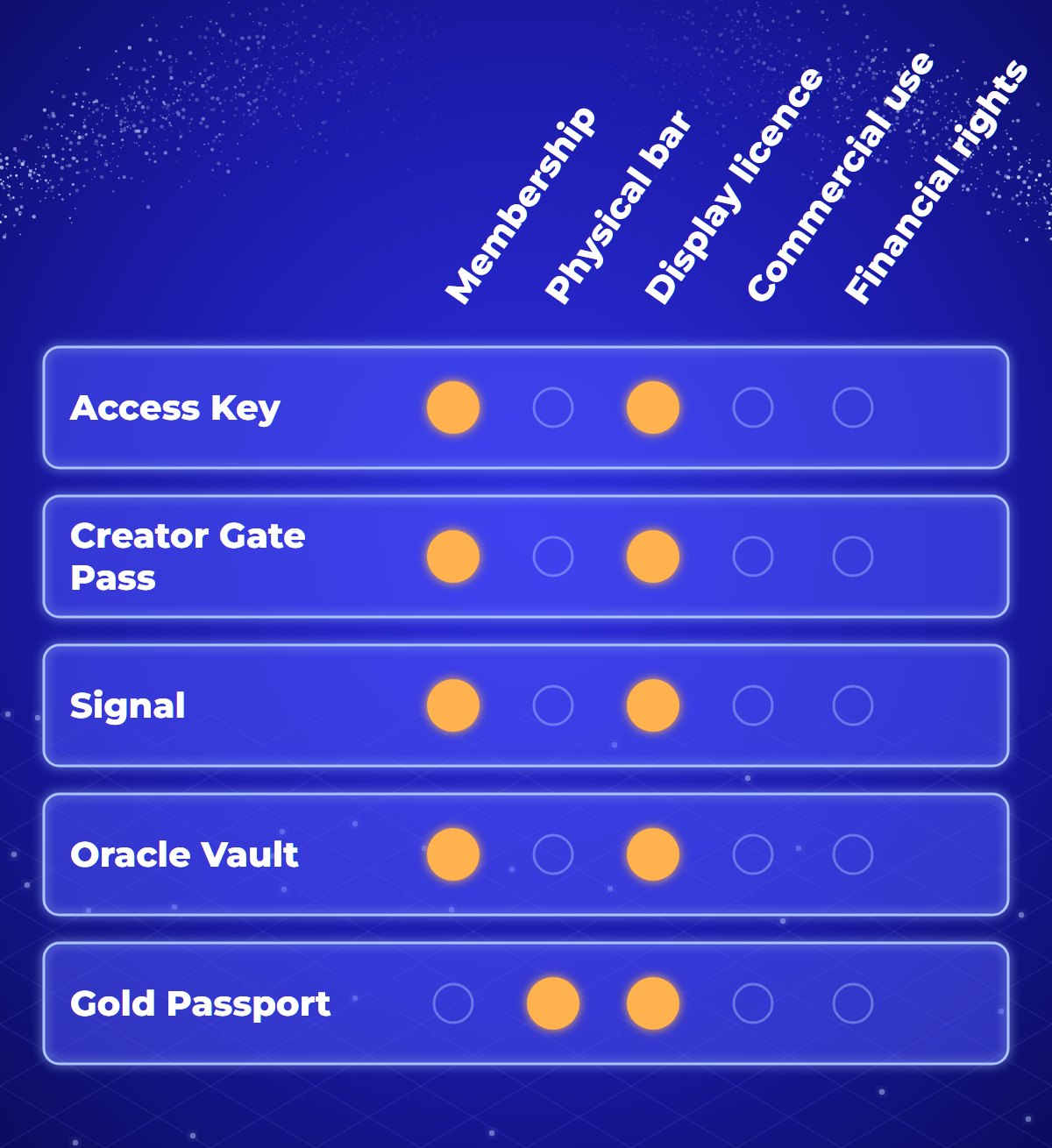
What each Trusty collection's public page says it includes. Commercial use and financial rights are stated as not included for all five.
Tokenisation use cases beyond raising money places these uses alongside settlement, registers and product passports.
How to tell real NFT utility from marketing
Utility is real when you can point to a written term, a named provider and a way to hold that provider to it.
Five questions do most of the work, and you can ask them before buying.
- Is the benefit written down? A line on a launch page is weaker than terms you can read and keep.
- Who has to provide it? Look for a named company with an address. "The community" or "the project" cannot be held to anything.
- Can it change, and how? Terms that let the provider change or end benefits at its discretion give the holder little to rely on.
- Does it pass to the next holder? Some benefits are personal and stop on transfer; some pass with the token.
- What happens if the provider stops? The token stays on the blockchain. The benefit continues only if someone keeps providing it.
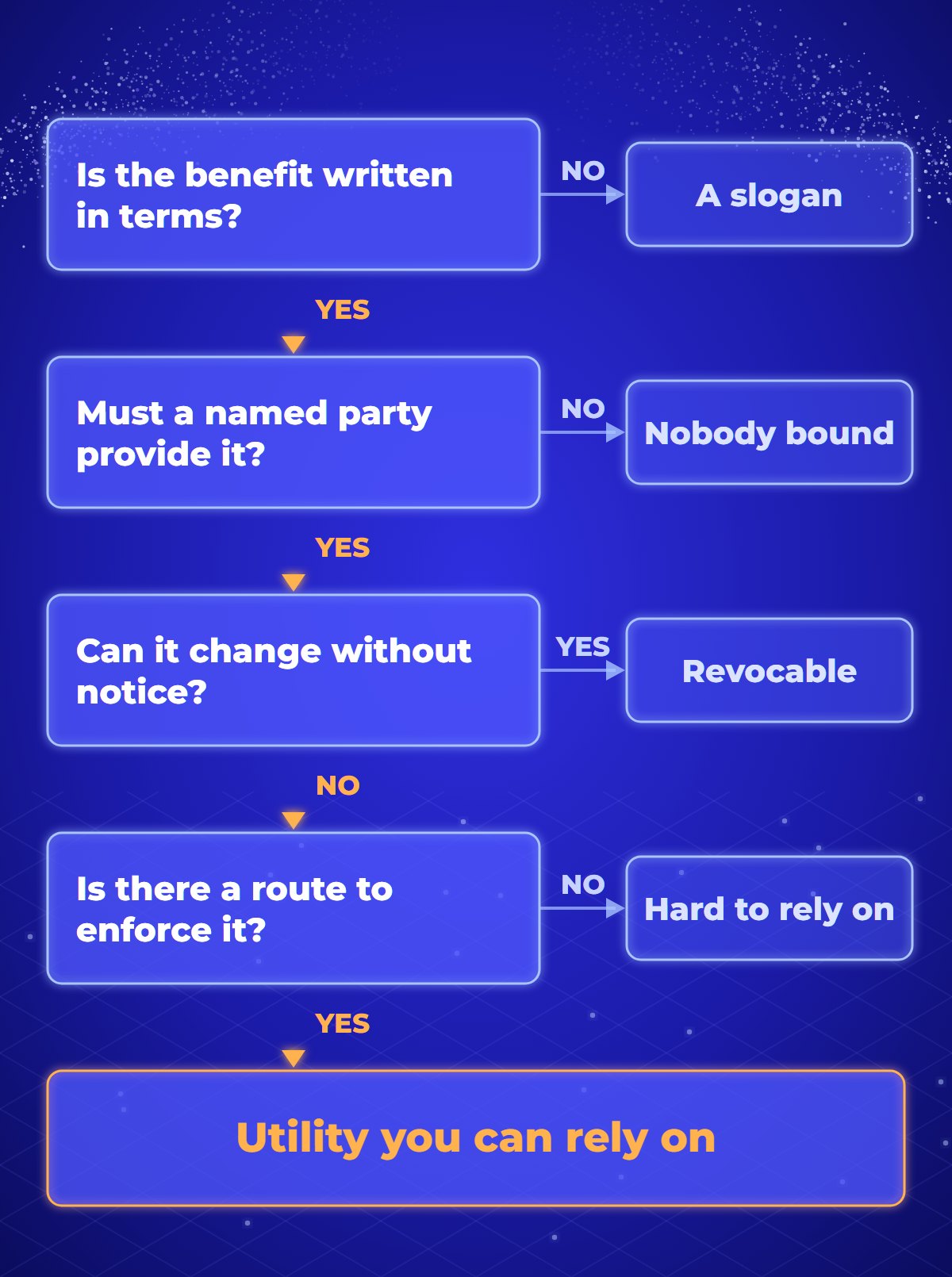
Four questions that separate written, enforceable utility from a description.
An illustrative example. A gym operator sells 500 "founder" NFTs promising "lifetime perks". The terms, two clicks from the sales page, give a 10% discount on monthly fees at participating sites, allow the operator to change or withdraw the programme at its discretion, and end all benefits if the programme closes. Against the five questions, the benefit is written down and has a named provider, yet the operator can change or end it at will. (The operator and figures are invented for illustration.)
What can an NFT holder actually enforce?
A holder can enforce the benefits against whoever promised them, under the terms and the general law of contract. The blockchain does not enforce them.
The Law Commission described two ways to link an obligation to a token. In one, the obligation travels with the token, like a bearer instrument. In the other, the token functions as "a mere record of obligations" and the obligation itself does not pass when the token moves (Law Commission report, paragraphs 6.110 and 6.111). Which one applies depends on how the arrangement is structured and what the parties intended.
Trusty Digital's collection pages say this directly: rights are limited to those described on the page "and are enforced by the issuer, not by the platform". A marketplace shows the token; the promise comes from the issuer.
Consumer law can add to the written terms. Where a trader supplies a service to a consumer, the Consumer Rights Act 2015 treats what the trader said or wrote about the service as a term of the contract, if the consumer took it into account when deciding to buy (Consumer Rights Act 2015, s.50, checked 3 October 2026). Digital content supplied under a contract must match the trader's description of it (s.36). Whether these sections apply to a particular NFT and its benefits depends on the facts: who sold it, to whom, and what was supplied. A business buyer does not have these consumer rights.
The token itself is different. In England and Wales, the Property (Digital Assets etc) Act 2025 confirms that a digital thing can be personal property, so the holder can own the token even when the benefits fall away. What you own when you buy an NFT explains how the token, the copyright and the licence fit together.
When does utility make an NFT a regulated product?
Utility becomes a regulatory question when the benefits start to look like financial rights, such as a share of earnings or a promise of repayment.
The label does not decide it. In its 2019 guidance the FCA said that "the regulatory treatment of these tokens does not change depending on their label" (FCA PS19/22, chapter 4). Its own case study describes a loyalty token that lets the holder claim rewards and cannot be sold, which it treats as unregulated. When the same firm changes the token so that holders also share in its earnings in proportion to their holding, the FCA says it is likely to be a security token.
EU law takes a similar approach. The Markets in Crypto-Assets Regulation excludes crypto-assets that are unique and not fungible (Article 2(3)). Recital 11 adds that NFTs issued in a large series or collection may indicate fungibility, and that fractional parts of an NFT are not unique.
Trusty Digital's membership collections state on their public pages that they are not investments and give no right to revenue, equity or governance. When is an NFT a cryptoasset? sets out where the current UK and EU rules draw the line.
What should you check before relying on NFT utility?
Read the terms, find the provider, and assume the benefit lasts only as long as that provider keeps it going.
Questions people also ask
What is a utility NFT? An NFT that gives its holder a benefit beyond owning the token, such as access to a service, membership, a certificate or a claim to a physical item. The benefit is described in the issuer's terms.
Does NFT utility transfer when the NFT is sold? Only if the terms say so. Some benefits pass to the new holder automatically; some are personal and need the new holder to register; a certificate may not be transferable at all.
What happens to NFT utility if the company closes? The token stays on the blockchain and can still be held and checked. Benefits that depended on the company's service end with it, unless the terms provide for someone else to take them over.
The short version
NFT utility is a promise attached to a token, delivered by a person or a company. Judge it as you would any promise: is it written down, who made it, can they change it, and what can you do if they do not keep it. A well-drafted collection states each of these on its public page, including the rights it does not grant.
To see how a membership NFT works as a key, and what happens when its benefits change, read How NFT membership keys work.
This article is general information, not legal, tax or investment advice.




 10 min read