When you buy an NFT you own the token, which the law of England and Wales treats as personal property. You do not get the copyright in the artwork unless a signed written assignment says so. What you may do with the image, and any item or benefit linked to the token, comes from the licence and the terms.
What do you own when you buy an NFT?
You own the token itself. The image, the copyright and anything the token refers to are separate things, each with its own rules.
The token is property. Section 1 of the Property (Digital Assets etc) Act 2025 provides that a thing, including one that is digital or electronic, is not prevented from being the object of personal property rights merely because it is neither a thing in possession nor a thing in action (Property (Digital Assets etc) Act 2025, s.1, checked 3 October 2026). The section came into force on Royal Assent, on 2 December 2025, and extends to England and Wales and Northern Ireland. In practice the holder of an NFT can be its owner in the full legal sense, with the court remedies that come with ownership.
The image is different. The Law Commission's 2023 report, which led to the Act, concluded that digital files are not, in general, things to which personal property rights can relate (Law Commission, Digital Assets: Final Report, paragraph 4.87). The token usually points to the image file; it does not turn the file into property you own. What is an NFT? explains where the token, the metadata and the image are stored.
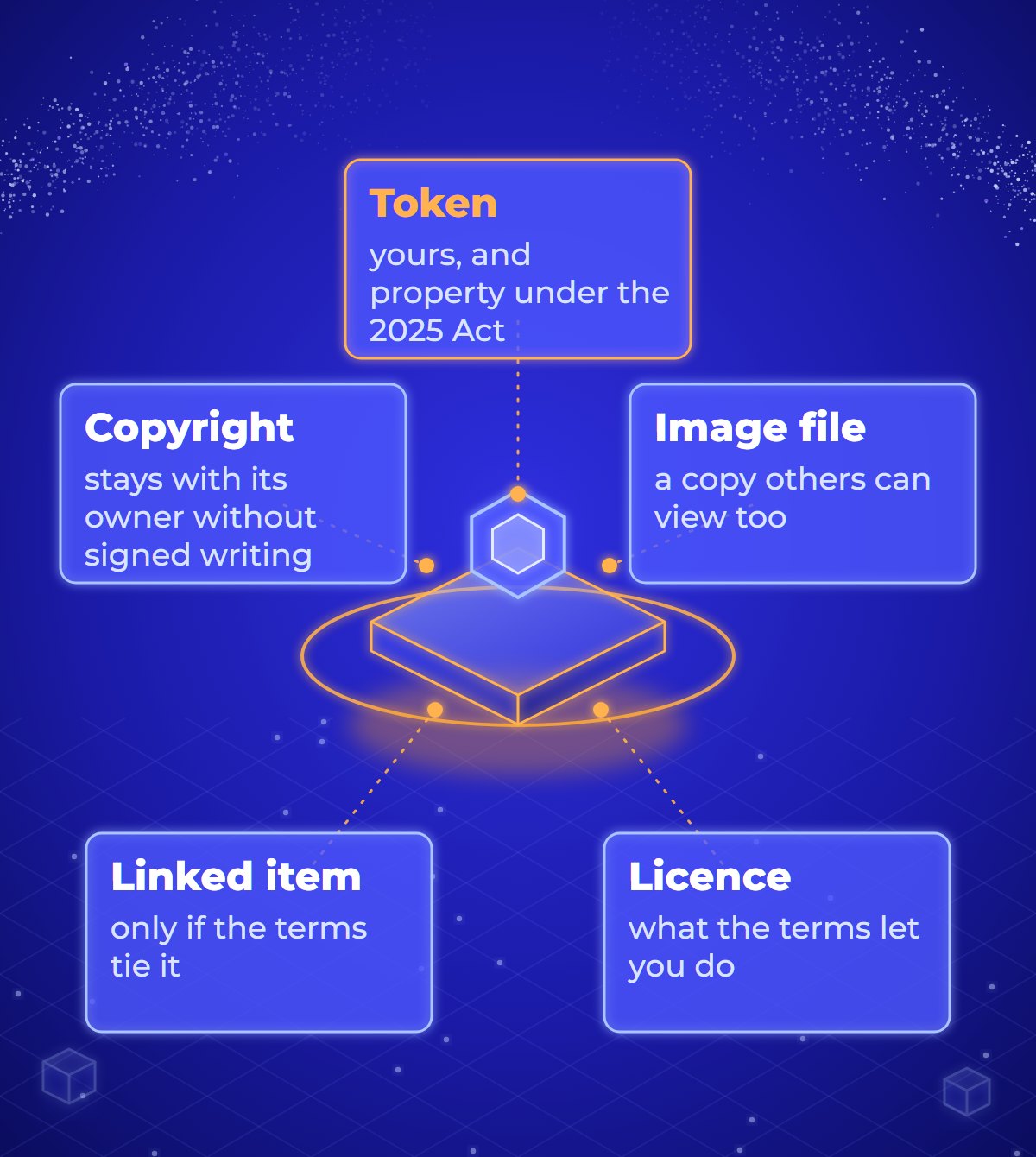
Five things around one token. Only the token passes automatically when you buy.
Does buying an NFT give you the copyright?
No. Copyright in the artwork stays with its owner unless they assign it in writing, signed by them or on their behalf.
Copyright is its own property right in an original work, such as a drawing, a photograph or a piece of music (Copyright, Designs and Patents Act 1988, s.1). The copyright owner has the exclusive right to copy the work, issue copies to the public, communicate it to the public and adapt it, and anyone who does those things without a licence infringes the copyright (s.16).
The Act sets a formal requirement for moving copyright: "An assignment of copyright is not effective unless it is in writing signed by or on behalf of the assignor" (s.90(3), checked 3 October 2026). A transfer of a token on a blockchain is a transaction signed with a private key, between accounts. On its own it is not a signed written assignment of copyright. An exclusive licence has the same requirement of signed writing (s.92).
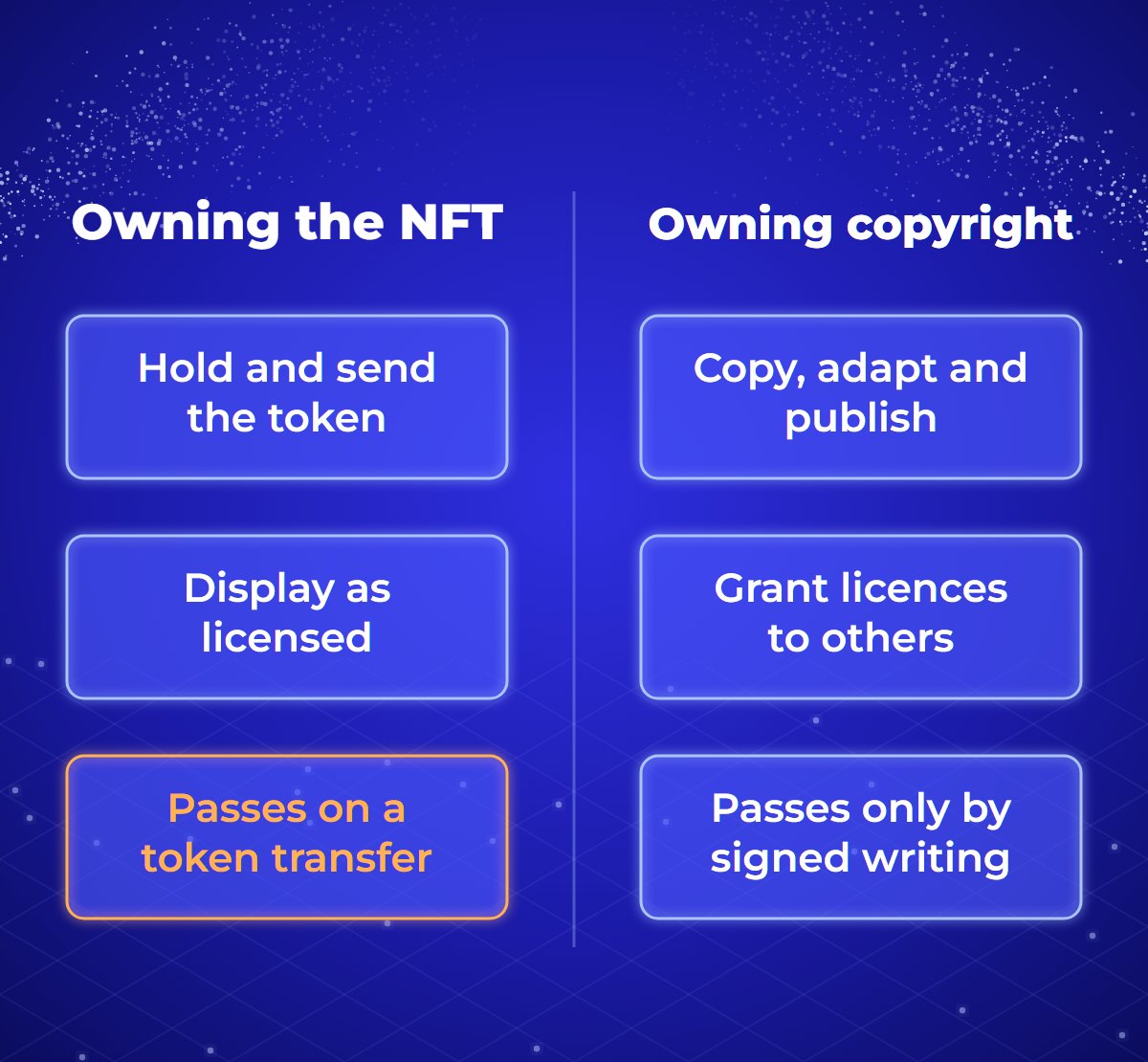
Two different kinds of property. A token transfer moves only the first.
Some collections do assign copyright, or grant broad rights, in their terms. That is a choice of the creator, and it works only if the terms meet the legal requirements. Without such terms, the buyer has the token and whatever licence the terms grant.
What does an NFT licence let you do?
The licence is the creator's permission to use the image in stated ways. Anything outside it is, in principle, an act that only the copyright owner may do.
Licences attached to NFTs vary in four ways that matter: personal display or commercial use; whether the licence ends when you sell the token; whether you may adapt the image; and whether it covers merchandise or advertising. Where the terms say nothing about a use, a cautious reader treats it as not granted.
One rule protects licensees. A licence granted by a copyright owner binds later owners of the copyright, except a purchaser in good faith, for value and without notice of the licence (s.90(4)). If a creator later sells the copyright, a licence they granted to NFT holders does not automatically disappear.
An illustrative example. A restaurant group buys an NFT of a digital illustration and wants to print it on its menus and shopfront. The collection terms grant "personal, non-commercial display while you hold the token". Printing menus is likely to involve copying the work and issuing copies to the public for a business, which the licence does not cover. The group can either agree a separate commercial licence with the artist, in writing, or use the image only as the terms allow. (The restaurant group and the terms are invented for illustration.)
Linked items and benefits: what the terms must say
A physical item, a membership or any other benefit comes with an NFT only if the terms make that link, and only on the terms' conditions.
The Law Commission described two ways to tie a right to a token. The right can be structured to pass whenever the token moves, or the token can act as "a mere record of obligations" that does not carry the right with it (Law Commission report, paragraphs 6.110 and 6.111). What passes on a transfer depends on the nature of the link, the applicable law and the intention of the parties (paragraph 6.109).
Trusty Digital's Gold Passport shows a link written into the terms, the same idea that underlies asset tokenisation. Its collection page states that the holder owns the token "and, through it, the physical gold bar the token records", and that ownership of the bar passes with the token. Membership NFTs work differently: the benefit is a promise by the issuer under its terms, explained in NFT utility explained and How NFT membership keys work.
How Trusty Digital states rights for each collection
Trusty Digital's marketplace prints five rights categories on every collection and asset page, including the categories in which nothing is granted.
The five categories are ownership of the token, licence to the media, commercial use, participation and governance, and financial and economic rights. Each asset page lists every category, including those in which the creator granted nothing, so a right the holder does not have is stated on the page instead of being left out.
Two examples from the public pages. The Trusty Access Key page includes ownership of the token, states that it does not transfer copyright, trademark or other intellectual property, and grants a licence to display the media for personal, non-commercial purposes while the holder holds the NFT. Commercial use, governance and financial rights are listed as not included. The Gold Passport page includes ownership of the token and of the physical bar it records; the artwork stays owned by Trusty Digital and may be displayed for personal, non-commercial purposes, including in wallets and on marketplaces.
The pages add that rights "are enforced by the issuer, not by the platform". A marketplace shows the terms. The issuer is the party that grants them and answers for them.
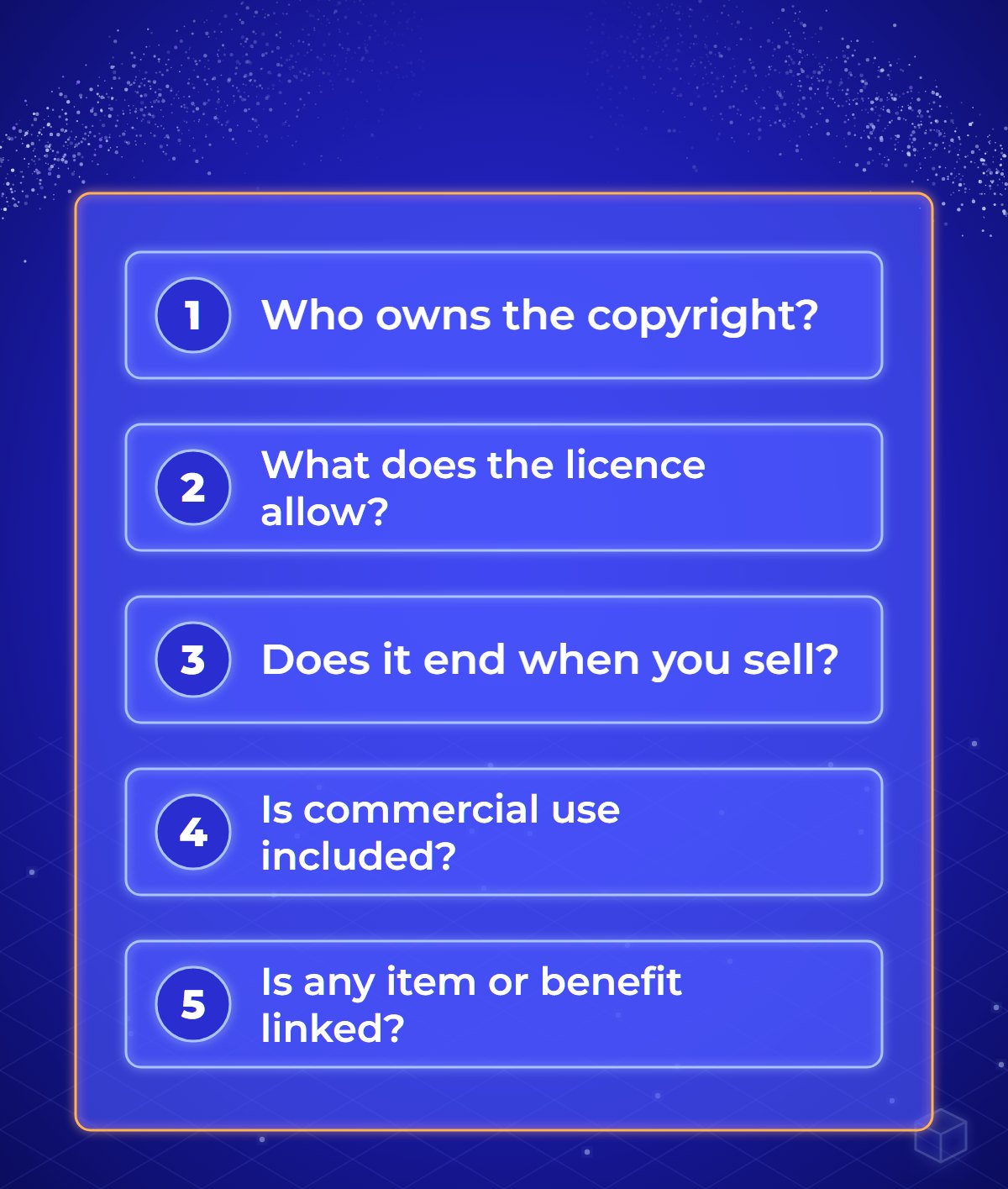
Five questions for any set of NFT terms.
NFT ownership in short
Buying an NFT gives you the token; the terms give you everything else.
Questions people also ask
Does buying an NFT give you the copyright? Not by itself. Under the Copyright, Designs and Patents Act 1988, an assignment of copyright must be in writing signed by or on behalf of the assignor. A collection's terms can include an assignment or a broad licence, but the token transfer alone does not move copyright.
Can I use my NFT image commercially? Only if the licence allows commercial use. Some collections, including Trusty Digital's membership collections, grant personal, non-commercial display only. Check the terms for merchandise, advertising and adaptation before any business use.
Is an NFT legally property in the UK? In England and Wales and in Northern Ireland, the Property (Digital Assets etc) Act 2025 confirms that a digital thing can be an object of personal property rights. The token can be owned and passed on, and a court can protect it as property. Scotland has its own property law, and the Act does not extend there.
The short version
An NFT purchase moves one thing automatically: the token. Copyright moves only by signed writing. Use of the image depends on the licence, and any linked item or benefit depends on how the terms tie it to the token. Read the rights before you buy, and treat anything the terms leave out as not included.
To see rights stated category by category, including what is not granted, browse Trusty NFT collections.
This article is general information, not legal, tax or investment advice.




 10 min read