Tokenisation is mostly used to keep one record that several parties can trust. Examples are a certificate anyone can check, a token that follows a gold bar, a membership key and a fund register. Raising money is one use among several. The record cannot be quietly changed, runs its own rules and costs little to keep.
What does a blockchain record do that a database does not?
A blockchain record has five useful properties. Once written, it cannot be quietly changed. Anyone with access can check it. No single company runs it. It can enforce rules by itself, and keeping it costs very little.
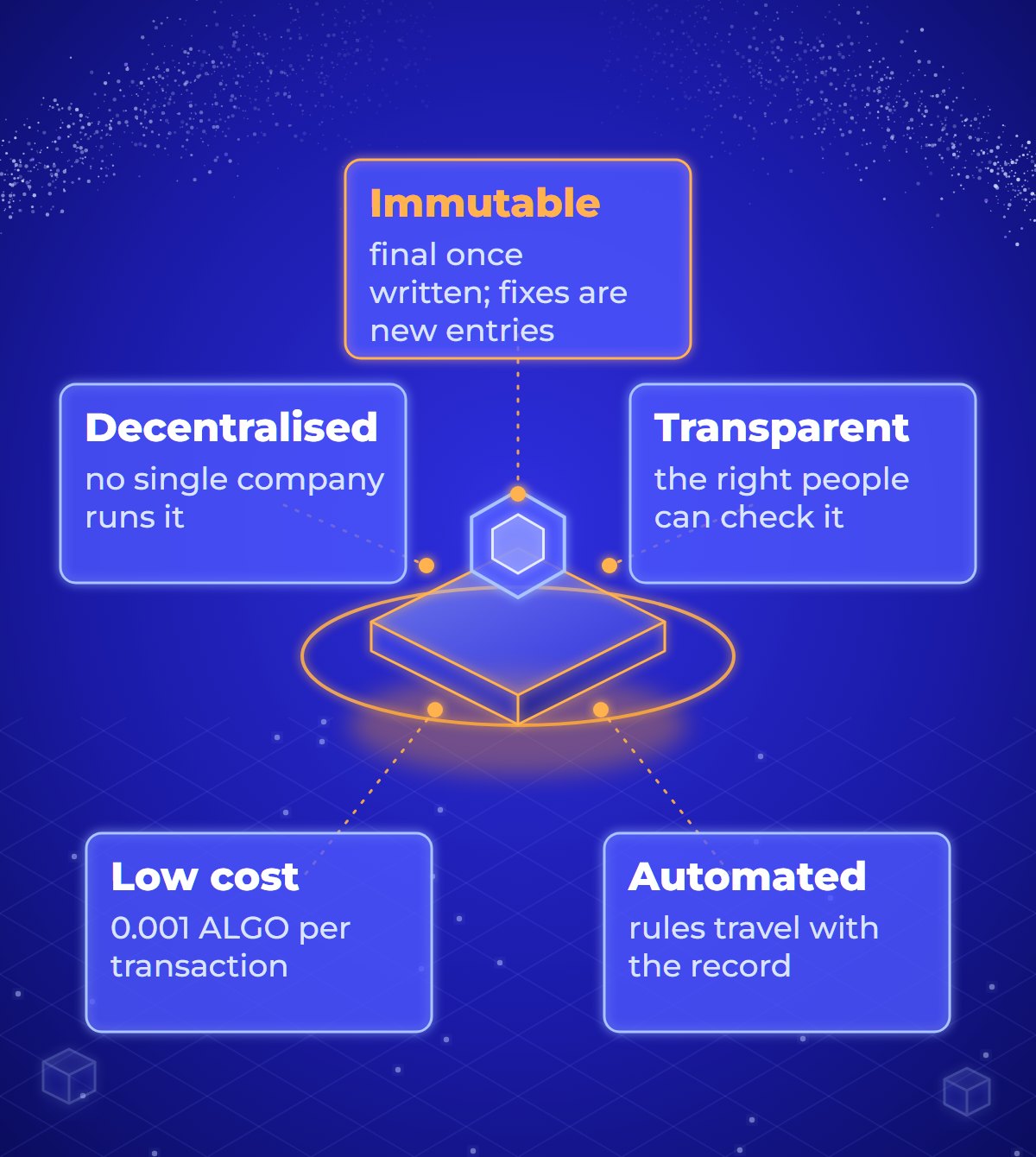
Five properties. Every use case in this article relies on at least two of them.
Immutable. On Algorand a block is final once it is certified, with no waiting for confirmations, as Why Trusty Digital uses Algorand explains. Mistakes can still be corrected. In its April 2026 policy statement on tokenised funds, the FCA says the person responsible for a fund's register must keep authority over it, "including to process decisions of a court or to resolve consumer issues" (FCA PS26/7, checked 3 October 2026). A correction is a new, visible entry; the old one stays on the record.
Transparent. Anyone with the right access can check what happened and when, without asking the operator. That has privacy consequences, which Is a blockchain private? sets out.
Decentralised. The record is kept by many independent computers, so no single company can rewrite it or switch it off.
Automated. The record can carry rules about who may hold a token and when it may move. It can also settle both sides of an exchange together or not at all, as in Atomic transfers on Algorand explained.
Low cost. The minimum Algorand transaction fee is 0.001 ALGO, so the cost of the record itself is tiny compared with the cost of the people who run the process.
Certificates and credentials: proof without a phone call
A certificate recorded on a blockchain can be checked by anyone it is shown to, without contacting the body that issued it, and cannot be edited after issue.
In October 2017 the Massachusetts Institute of Technology gave 111 graduates a digital version of their diploma. MIT described the verification portal as using "the blockchain as a notary": it finds the record, checks the keys and confirms that nothing has changed since it was added (MIT News, 17 October 2017, checked 3 October 2026).
Trusty Digital ran the same pattern in 2024 for a sports organisation, published on our Discovery page: each achievement certificate was issued as a non-transferable NFT under the issuer's control, with the holder's consent for access and public verification without contacting the issuer. The certificates record achievements and have no investment value.
The record proves who issued the certificate and when. Whether its content is true still depends on the issuer's own checks.
Physical goods: a token that follows the item
A token can act as the record of one specific physical item, so the item's identity, history and owner can be checked in one place, and the record stays with the owner when the item moves.
Trusty Digital's Gold Passport collection works this way. Each token stands for one identified bar of 999.9 fine gold from The Royal Mint or PAMP, bought when it is ordered and kept in a dedicated safe in the United Kingdom. When the bar arrives, its serial number and a photograph of that bar replace the artwork on the token. The holder can ask for the bar at any time and it is sent by Royal Mail Special Delivery; the token stays with them as the bar's record. The collection page states that the token pays no income and that Gold Passport is not an investment.
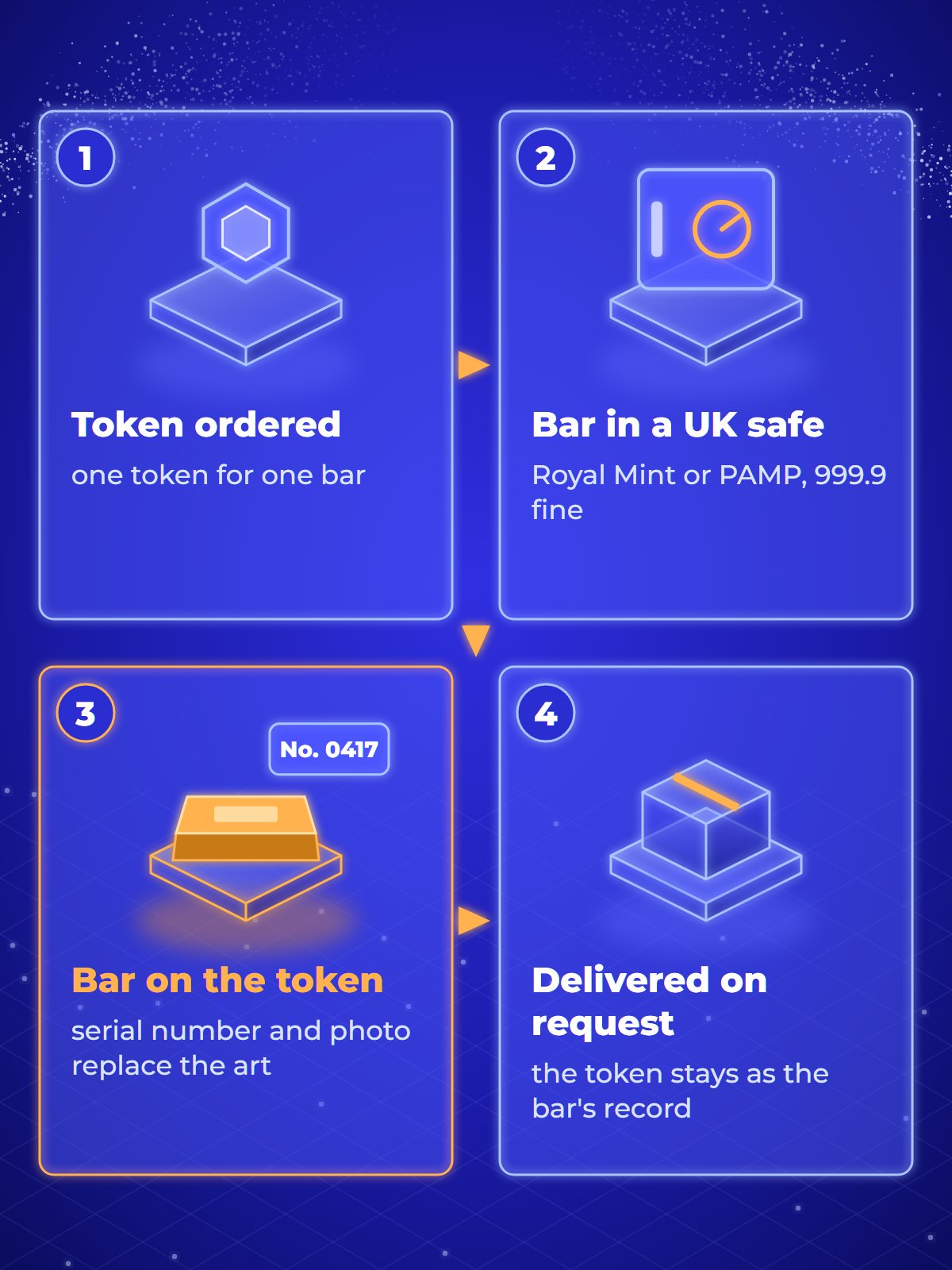
One token, one identified bar, from order to delivery.
Our 2024 commodities pilot used the same principle for physical coins held by an independent vault, one token per coin, each traceable to its vault record.
Regulators are moving in the same direction for other goods. From 18 February 2027, each electric vehicle battery, light means of transport battery and industrial battery over 2 kWh placed on the EU market must have an electronic record called a battery passport (Regulation (EU) 2023/1542, Article 77(1), checked 3 October 2026). The regulation does not require a blockchain. It requires a record that follows one battery through manufacturers, repairers and recyclers, and a shared record that nobody can quietly edit is one way to keep it.
Membership and access: a token as a key
A token can work as a key. A service checks whether a person holds it and then opens a door, applies a discount or turns on a feature. There is no password list to maintain and no card to reissue.
The Trusty Access Key is a membership NFT on Algorand. No more than 80 will be issued, holder benefits are set out in published terms, and the token gives no right to profit, revenue, equity or a vote. Keys also work across products: the first Gold Passport collection is open to key holders, and every key brings free storage of the bar.
Anyone can check who holds a key. A partner can honour the same key without access to Trusty's database, and a holder can prove membership from their own wallet. If the terms allow the key to be transferred, the membership moves with it, with no paperwork.
Settlement, collateral and registers in financial markets
In financial markets, regulators and firms see the main use of tokenisation in settling trades, moving collateral and keeping registers of who owns what.
When the FCA and the Bank of England asked the market where tokenisation would help most, they received 123 responses, and collateral "was by far the most frequently mentioned use case" (FCA and Bank of England, FS26/1, 14 September 2026). Collateral that moves faster and at any hour can be used more efficiently, which saves money for the firms involved.
Fund registers are the other example. The FCA authorised the first tokenised UK UCITS fund, with its register of unitholders kept on a blockchain, in January 2025, and its April 2026 policy statement records that firms may use public networks so long as they have appropriate controls in place (FCA PS26/7).
Company registers work the same way at a smaller scale. A token can mirror the register of members so that transfers settle in seconds, while the statutory register remains the legal record, as Redeemable shares explained shows.
When a blockchain is the wrong tool
If one organisation writes the record and everyone who relies on it already trusts that organisation, an ordinary database is faster, cheaper and easier to correct.
Karl Wüst and Arthur Gervais set out the test in their paper "Do you need a Blockchain?", presented at the 2018 Crypto Valley Conference (IACR ePrint 2017/375). Simplified, it asks four questions in order.
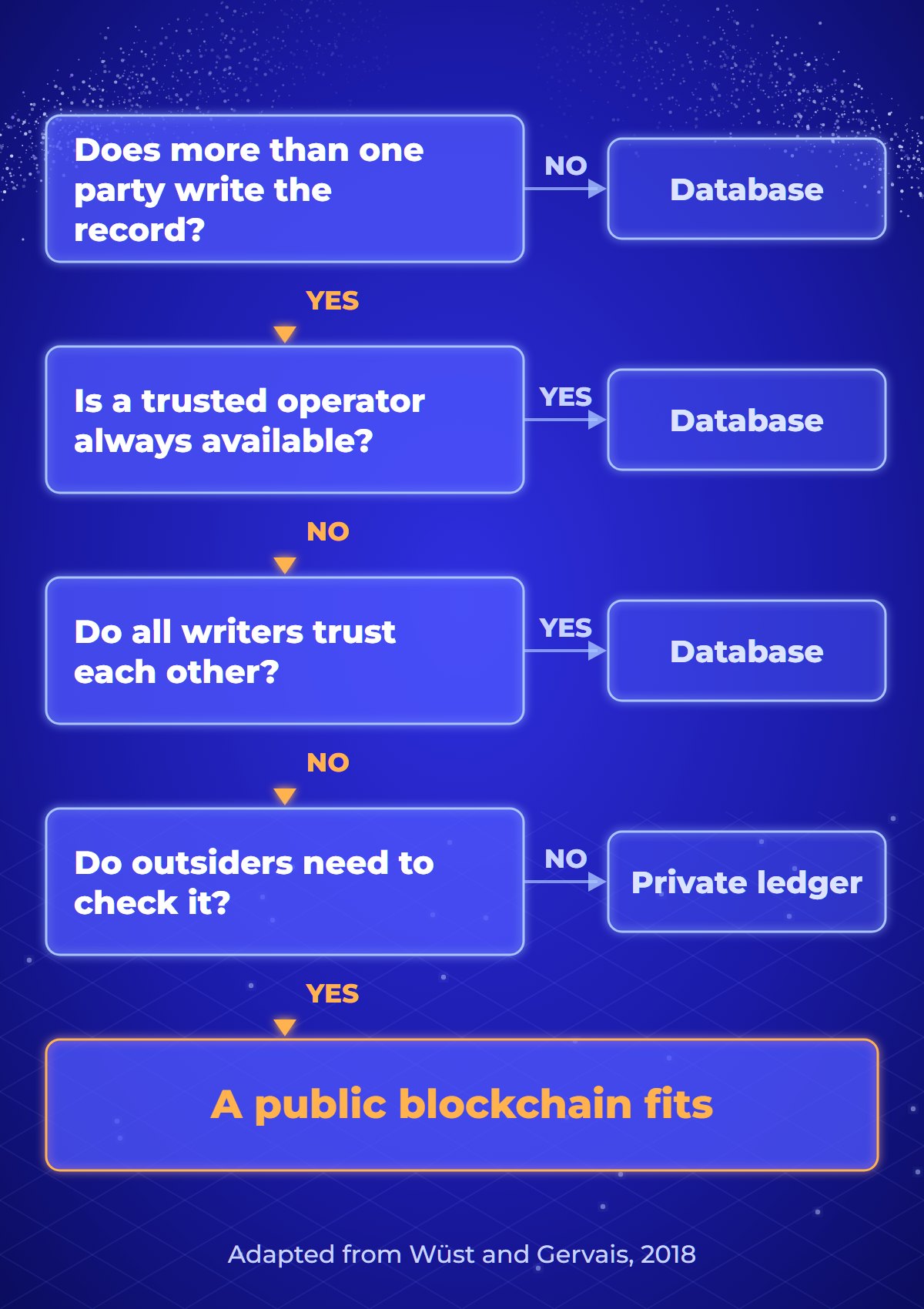
Adapted from Wüst and Gervais, 2018.
A single company keeping its own customer records fails the first question and gains nothing from a blockchain. The use cases above pass because several parties rely on the same record. For a certificate, they are the issuer and every employer who checks it. For a gold bar, they are the vault and every later owner. For a fund, they are the manager and every unitholder.
How to choose a use case
Start from a record that several parties already reconcile by hand or dispute. Then ask which of the five properties would remove that work.
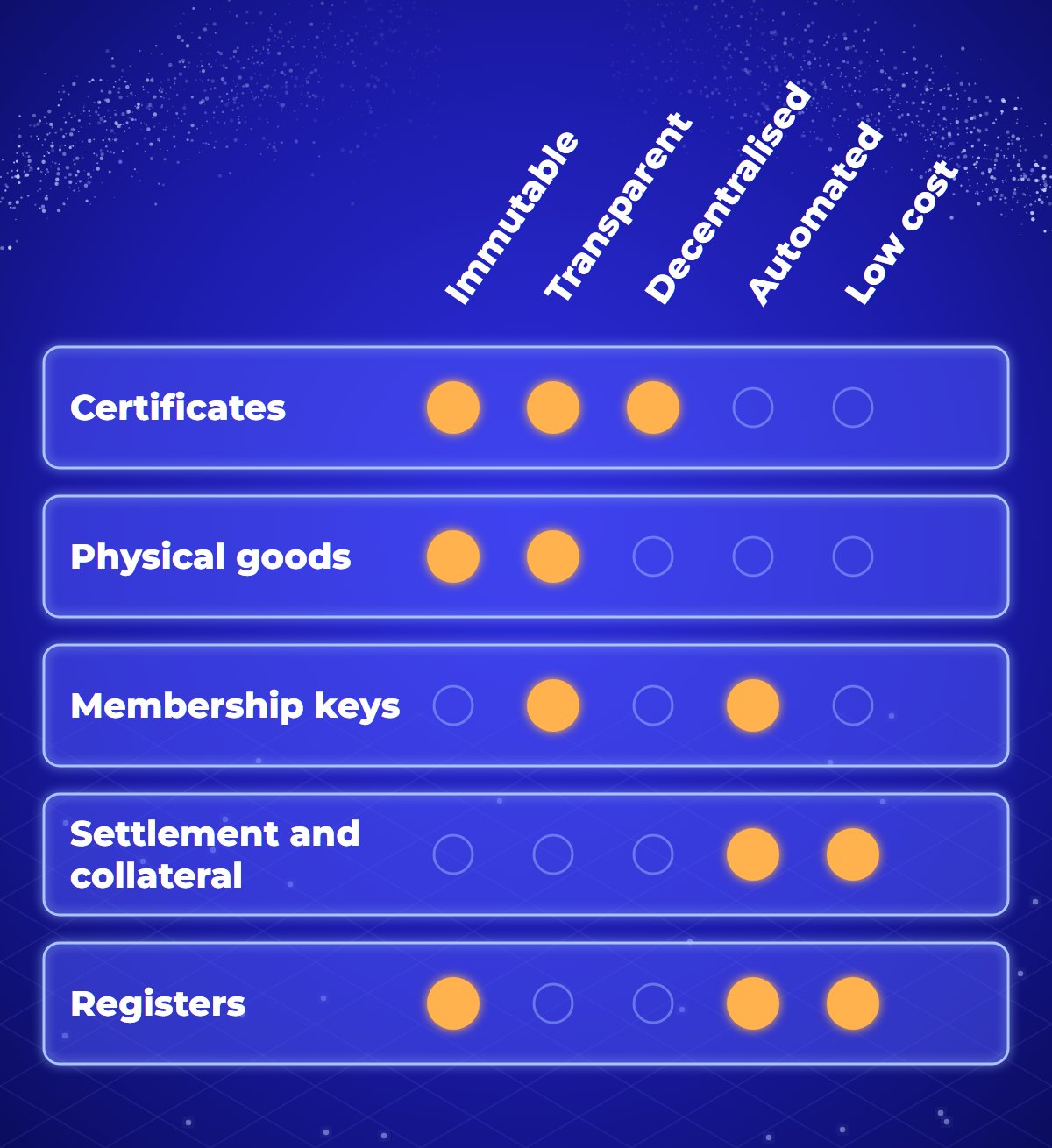
Which property does the work in each use case.
If none of them removes a real cost or a real dispute, the project does not need a blockchain.
Questions people also ask
What is tokenisation used for besides raising money? Verifiable certificates, records that follow physical items, membership and access keys, settlement and collateral, and registers of ownership. Each relies on a record several parties can trust without a single operator.
Is an NFT just a picture? No. An NFT is a unique token on a blockchain; the picture is often only its label. The token itself can record a certificate, a gold bar or a membership.
Does every use case need a smart contract? No. Many rely only on the blockchain's built-in controls, as Do you need a smart contract? explains.
The short version
Tokenisation is a way to keep one record that many parties can trust. Raising money is one use; proving a certificate, following a physical item, acting as a key, settling trades and keeping registers are others, and several already run on public blockchains. If one trusted party keeps the record, a database is enough. If several parties need to rely on the same record, a blockchain is worth considering.
To see these use cases by industry, including the three pilots Trusty Digital delivered in 2023 and 2024, visit the Discovery page. To check whether your own asset suits tokenisation, read Is my asset suitable for tokenisation?.
This article is general information, not legal, tax or investment advice.




 10 min read