An NFT is a cryptoasset in the broad UK legal sense, but the main UK and EU crypto rules apply only to fungible tokens, so a truly unique NFT sits outside them. An NFT can come back into scope when it is one of a large interchangeable series, when it is split into fractions, or when it carries financial rights.
Is an NFT a cryptoasset under UK law?
Yes, in the broad sense: an NFT usually meets the UK statutory definition of a cryptoasset. The regulated categories are narrower, and they require the token to be fungible.
The Financial Services and Markets Act 2000 defines a cryptoasset as "any cryptographically secured digital representation of value or contractual rights" that can be transferred, stored or traded electronically and uses technology such as a distributed ledger (FSMA 2000, s.417(1), checked 3 October 2026). An NFT recorded on a public blockchain fits those words.
The rules that impose obligations use a narrower term, the qualifying cryptoasset. For financial promotions, a qualifying cryptoasset is any cryptoasset which is "fungible" and "transferable", with exclusions for e-money, existing investments and some closed-loop tokens (Financial Promotion Order 2005, Schedule 1, paragraph 26F, checked 3 October 2026). The new regime for cryptoasset activities uses the same two tests and adds that the token must not be "solely a record of value or contractual rights" (article 88F of the Regulated Activities Order, inserted by S.I. 2026/102). Those activity rules come into force on 25 October 2027 (S.I. 2026/102, regulation 1), and the FCA published its policy statements for the regime in June 2026 (FCA, cryptoasset regime, checked 3 October 2026).
A token that is genuinely not fungible therefore falls outside both definitions of a qualifying cryptoasset. Whether a particular NFT is genuinely not fungible is a question of fact, which the rest of this article covers. If the token itself is new to you, What is an NFT? explains what it records.
How does the UK decide whether an NFT is fungible?
The UK looks at how the token is used and what rights it carries. The name "NFT" decides nothing.
HM Treasury set out its view in its October 2023 response on the future regime. It said that NFTs of themselves are generally "more akin to" digital collectibles or artwork than a financial services product, and that its focus would be on how a token is used. How a token "describes itself" would not decide the question (HM Treasury, Future financial services regulatory regime for cryptoassets: response, October 2023, paragraph 4.46). It gave an example. A large class of NFTs, technically unique but largely indistinguishable, bought without any preference for one over another, could be treated as an exchange token, so that a platform trading them falls under the regime (paragraph 4.48).
The FCA took the same line in its 2019 guidance: "the regulatory treatment of these tokens does not change depending on their label" (FCA PS19/22, checked 3 October 2026). A token that gives rights like those of a share or a debt instrument is a security token and is regulated as that investment, whatever it is called. The FCA's case study describes a loyalty token that becomes a likely security token once holders are entitled to a share of the firm's earnings.
The definition of transferable also reaches marketing. For financial promotions, a token is treated as transferable where a communication about it "describes it as being transferable" (paragraph 26F(2)(b)). A website that advertises an easy resale can affect the analysis.
Pooling is a separate route into regulation. Where holders share in income from property that is managed as a whole on their behalf, and they do not have day-to-day control of it, an arrangement can be a collective investment scheme (FSMA 2000, s.235), whatever token records the holdings.
Where does EU law draw the line for NFTs?
EU law excludes unique, non-fungible crypto-assets from the Markets in Crypto-Assets Regulation, and tests uniqueness by substance.
Article 2(3) of the Markets in Crypto-Assets Regulation states that it "does not apply to crypto-assets that are unique and not fungible with other crypto-assets" (Regulation (EU) 2023/1114, checked 3 October 2026). Recital 10 gives digital art and collectibles as examples, along with unique tokens for services or physical assets, "such as product guarantees or real estate". Recital 11 sets the limits. The fractional parts of an NFT are not unique. Issuing NFTs "in a large series or collection" is an indicator of fungibility. And "the mere attribution of a unique identifier" does not make a token unique.
Excluded from MiCA does not mean unregulated. Under Article 2(4), MiCA also does not apply to crypto-assets that qualify as financial instruments, because those fall under the EU's securities rules.
The European Securities and Markets Authority's guidelines of 19 March 2025 explain how supervisors should judge uniqueness (ESMA guidelines on the qualification of crypto-assets as financial instruments, Guideline 8, checked 3 October 2026). Three points matter most for issuers:
- A unique identifier or a technical standard is not enough on its own (paragraph 67).
- Supervisors may apply an "interdependent value test". A common trading price across a series suggests that each token has no value of its own (paragraph 70).
- Fractionalised NFTs should not automatically be treated as unique, especially where the fractions can be recombined into the whole (paragraphs 72 and 73).
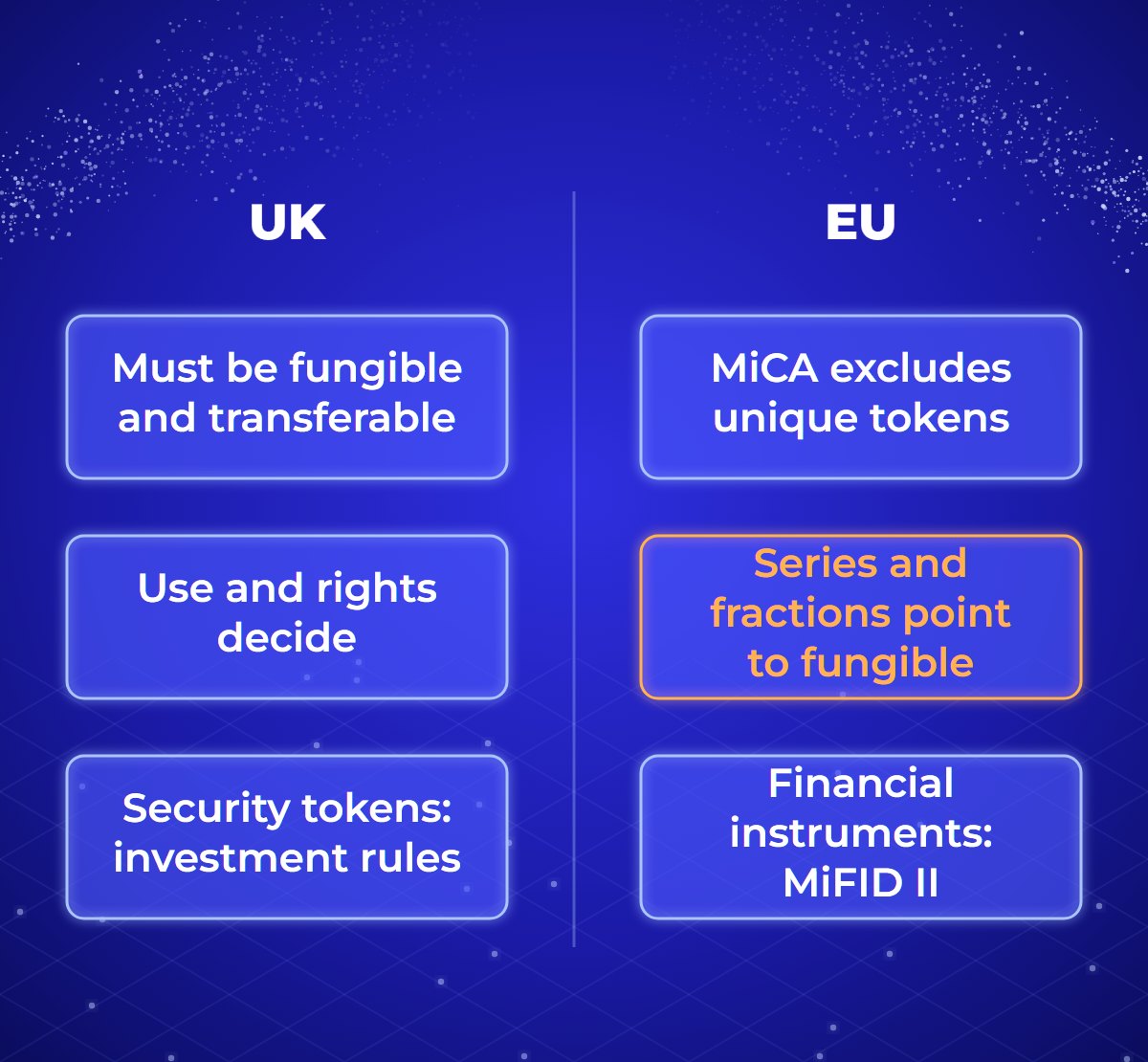
The UK and the EU reach similar answers by different routes.
What brings an NFT back into scope?
Four features bring an NFT back into scope: interchangeable series, fractions, financial rights, and marketing that presents the token as tradeable value.
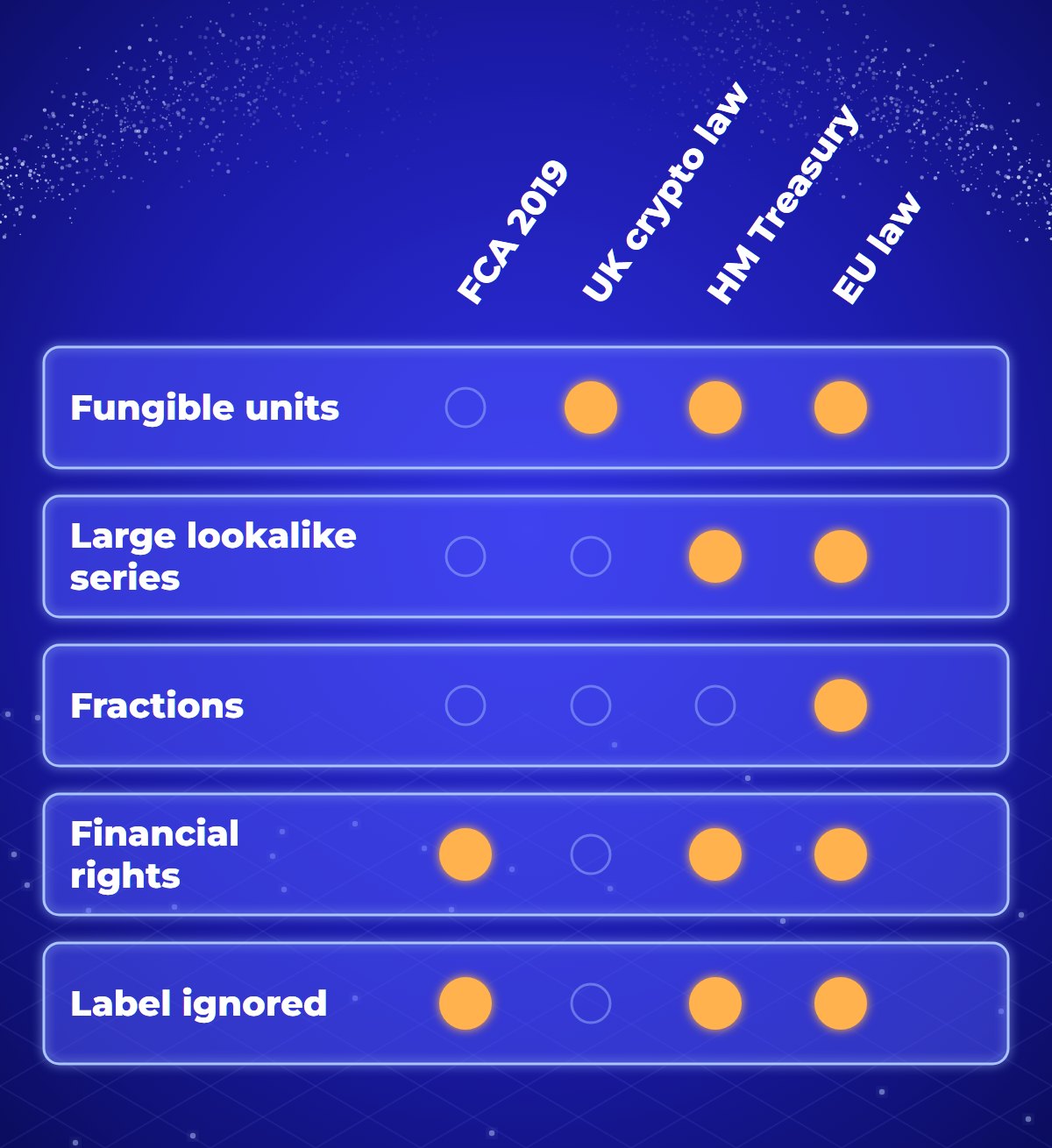
Which source names each feature. A mark means the source addresses it directly.
Interchangeable series. Ten thousand tokens with the same rights, the same artwork style and one common price behave like units of one asset. Both HM Treasury and ESMA point to this pattern.
Fractions. Splitting one NFT into many identical parts creates fungible units, even if the original was unique. Recital 11 of MiCA says this directly.
Financial rights. A share of income or a promise of repayment can turn a token into a security or a financial instrument, under UK and EU law alike.
How it is sold. A token described as transferable value, with emphasis on resale, invites the regulator to look past the label.
An illustrative example. A sports club plans 5,000 "founders' pass" NFTs, all with the same design, the same lounge access and the same price. In the EU, that may be a large series of interchangeable tokens, which recital 11 treats as an indicator of fungibility. In the UK, if the passes are bought without preference for one over another, HM Treasury's example suggests they could be treated like exchange tokens. If the club then adds a share of sponsorship income, the pass may also carry rights like those of a security. (The club and figures are invented for illustration.)
What should an issuer check before launching an NFT?
Four facts decide the analysis before launch: fungibility, the rights the token carries, fractions and the way it is marketed.
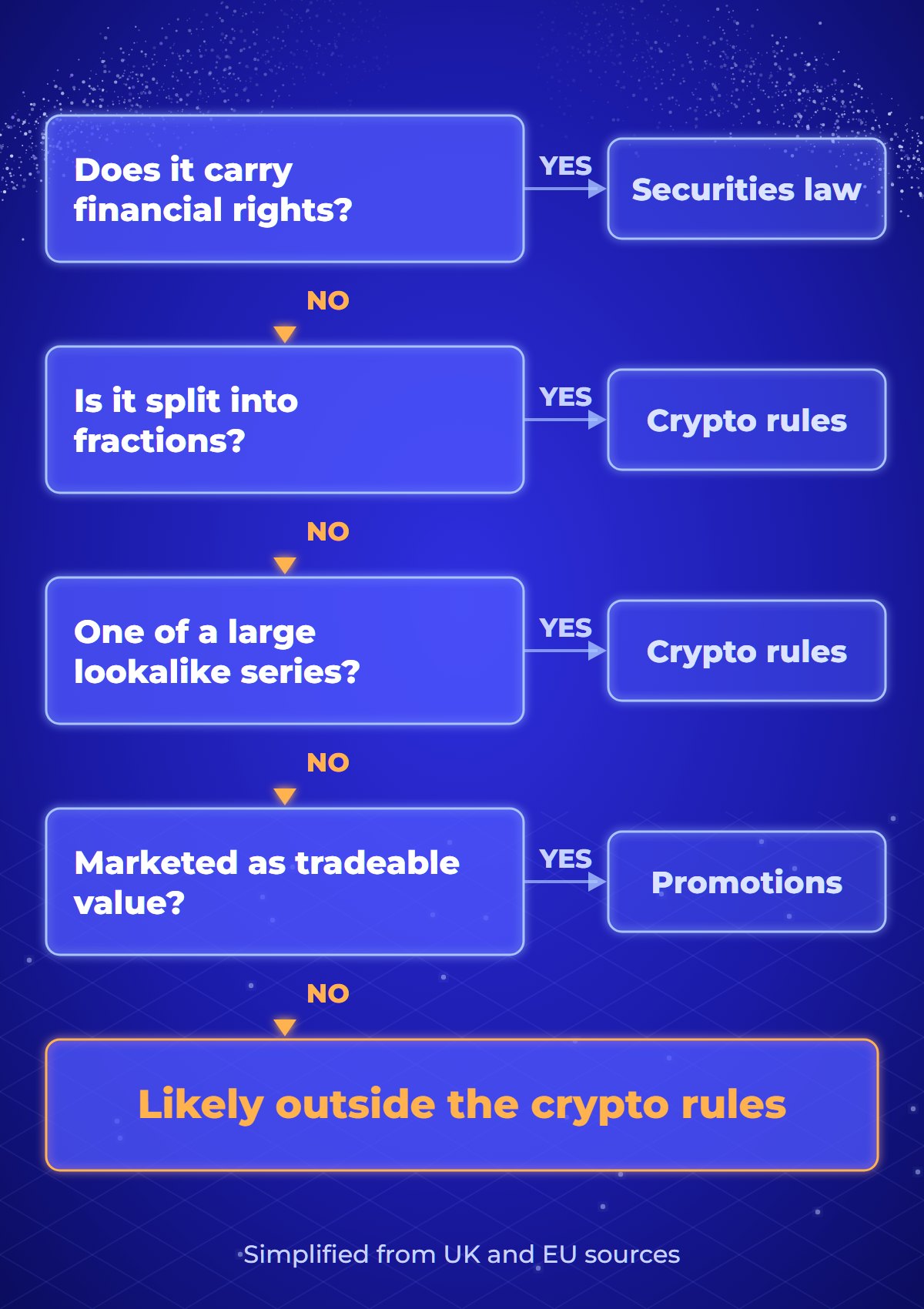
A simplified sequence of checks. The facts of each token decide the answer.
Classification also affects what an issuer may say about a token. If an NFT is a qualifying cryptoasset, communicating an invitation or inducement to engage in investment activity in relation to it falls under the financial promotion restriction in section 21 of the Financial Services and Markets Act 2000. Can you advertise a token in the UK? covers those rules, and The UK cryptoasset regime from 2027 covers the authorisation regime.
For governance tokens, the same tests appear in DAO legal status and member liability. For tokens that represent an asset such as property or shares, What is asset tokenisation? is the starting point.
NFTs and crypto regulation: the short version
A unique NFT usually sits outside the UK and EU crypto rules; a series, fractions or financial rights can bring it back in.
Questions people also ask
Are NFTs regulated in the UK? A genuinely unique NFT is outside the UK definitions of a qualifying cryptoasset, which require fungibility. An NFT can still be regulated if it carries rights like a security, forms part of a collective investment scheme, or is in practice interchangeable with others.
Does MiCA apply to NFTs? Not to crypto-assets that are unique and not fungible (Article 2(3)). MiCA can apply to NFTs issued in a large interchangeable series and to fractions of an NFT.
Is an NFT a security? Only if it gives rights like those of a share, a debt instrument or another investment. Calling it an NFT does not change that.
The short version
UK and EU rules regulate tokens that behave like interchangeable units of value, and both look at substance. A single artwork, a certificate or a record of one physical item is likely to sit outside the crypto rules. A series of identical tokens, fractions of one token, or any right to income moves it towards regulation. Where a token sits close to that line, a lawyer qualified in the relevant country can confirm the classification.
For what a buyer actually owns once the regulatory question is settled, read What you own when you buy an NFT.
This article is general information, not legal, tax or investment advice.




 10 min read