Trusty Digital issues tokens on Algorand MainNet because of three documented properties: a certified block is final and cannot be reversed, the base fee is fixed at 0.001 ALGO while the network is not congested, and tokens are part of the protocol rather than contract code each issuer deploys. Algorand is our default, not our only option.
Why finality matters more than speed
For a register of ownership, what matters is the moment a transfer can no longer be undone, and on Algorand that moment is the certification of its block.
On many blockchains a transaction that appears confirmed is only probably confirmed. The network can reorganise (a competing version of recent history wins), and a transaction that looked settled disappears, so users wait for more blocks before treating anything as done.
Algorand's documentation states that once a block is certified through the soft vote and the certify vote, "its transactions are final and cannot be reversed", and that blocks are confirmed every 2.82 seconds on average (Algorand Developer Portal, Blocks, checked 3 October 2026). Ethereum also finalises blocks, but at checkpoints: its time runs in 12-second slots grouped into 32-slot epochs, and a block becomes final once checkpoints are linked by votes from at least two thirds of staked ETH, which takes minutes rather than seconds (ethereum.org, Proof-of-stake, checked 3 October 2026).
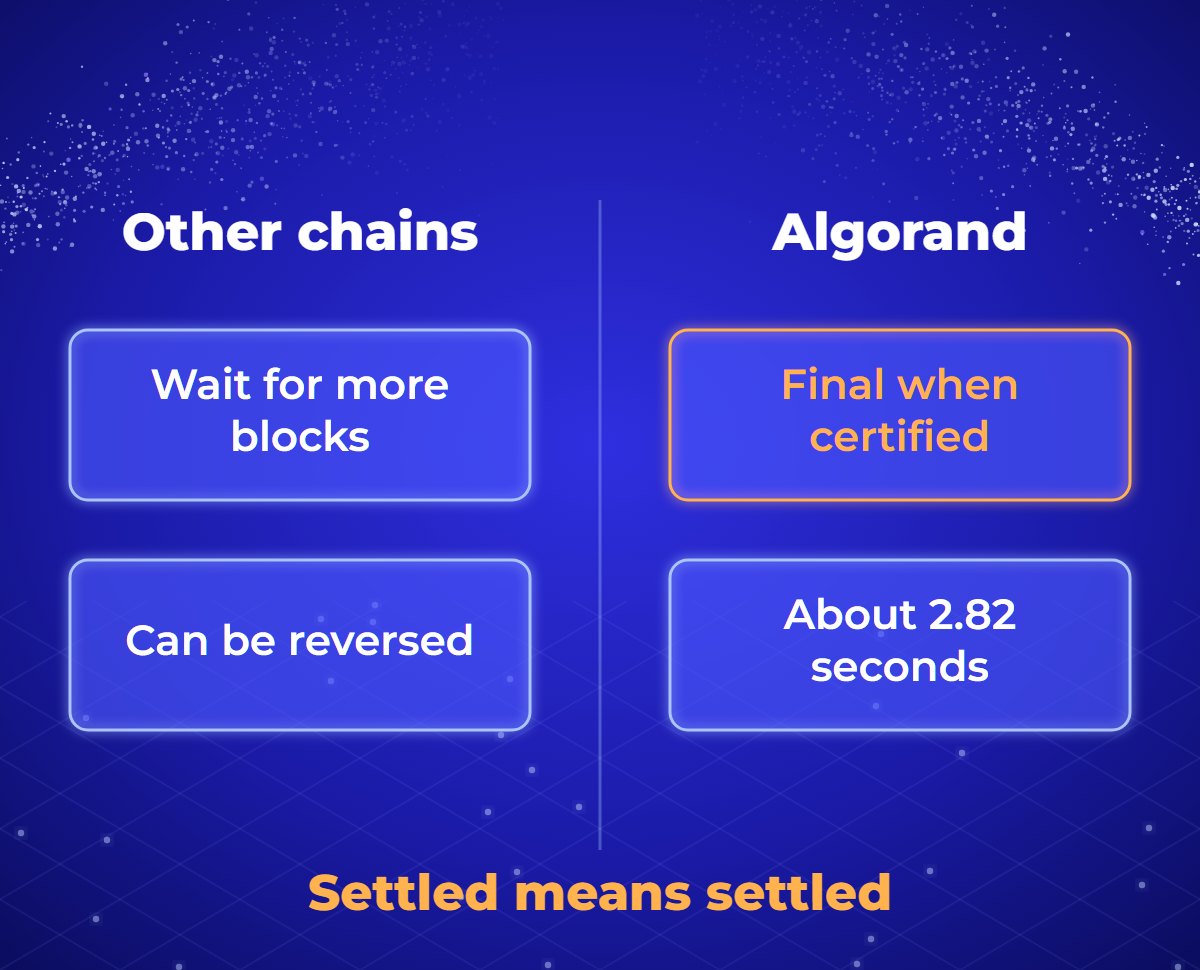
Waiting for confirmations, against finality at certification.
For asset ownership this is the difference between a register you can act on and one you have to wait on. If a token records who holds a share, and that record could be reversed twenty minutes later, every process downstream (distributions, reporting, transfer restrictions) has to allow for it.
Finality has a precondition. The consensus protocol tolerates dishonest participants "as long as a supermajority of the stake is in non-malicious hands", and if a certify vote does not reach quorum in time, the network enters a recovery mode (Algorand Developer Portal, Consensus overview). A failed vote shows up as a delay rather than as a second version of history.
Why the fee has to be small and predictable
A register that moves small holdings many times needs a transfer cost that is negligible and known in advance, and Algorand's base fee is both in normal conditions.
The base fee is 1,000 microAlgo, or 0.001 ALGO, "fixed to this amount when the network is not congested". The formula is fee = max(current_fee_per_byte × transaction size, min_fee); without congestion the per-byte rate is zero and the minimum applies. Under congestion the fee can rise, so "fixed" describes normal conditions only (Algorand Developer Portal, Transaction Fees, checked 3 October 2026).
Small units become workable. Dividing an asset only makes sense if moving a small holding does not cost a large share of it.
Operating costs can be forecast. An illustrative example: an issuer sending a quarterly distribution to 300 holders submits 300 transfers, which at the minimum fee is 0.3 ALGO in network fees. The issuer can also carry its holders' fees, because the protocol supports "pooled fees, where one transaction can pay the fees of other transactions within the same atomic group".
The fee is not the only cost a holder sees. Every Algorand account keeps a minimum balance of 0.1 ALGO, and each asset it opts in to raises that minimum by another 0.1 ALGO (Algorand protocol parameters, checked 3 October 2026). The amount stays in the holder's account rather than being spent, but an account without it cannot receive the asset, which is the first thing to plan for when onboarding people new to blockchain.
Assets built into the protocol
On Algorand a token is a native object of the network, called an Algorand Standard Asset, so issuing one needs no contract code of its own.
Every Algorand Standard Asset has eight parameters fixed at creation that "cannot be modified for the lifetime of the asset", among them the asset name (up to 32 bytes), the unit name (up to 8 bytes), the total supply, the decimal places (0 to 19) and whether holdings start frozen (Algorand Developer Portal, Algorand Standard Assets, checked 3 October 2026). Total supply cannot be changed later, so the number of units is decided before issue.
Algorand's own migration guide puts the contrast with Ethereum in two sentences: "On Ethereum, tokens are contracts. On Algorand, they are part of the protocol" (From Ethereum to Algorand). An Algorand asset behaves the same way for every issuer, with no bespoke transfer logic to audit. The fair counterpoint is that a contract can express rules the built-in controls cannot: Ethereum's regulated-token standard ERC-3643 includes identity checks, freezing, forced transfers and recovery of lost wallets as contract functions (ERC-3643, status Final, checked 3 October 2026). On Algorand, rules beyond the built-in controls are written as a smart contract, and most issuers need less custom code than they expect.
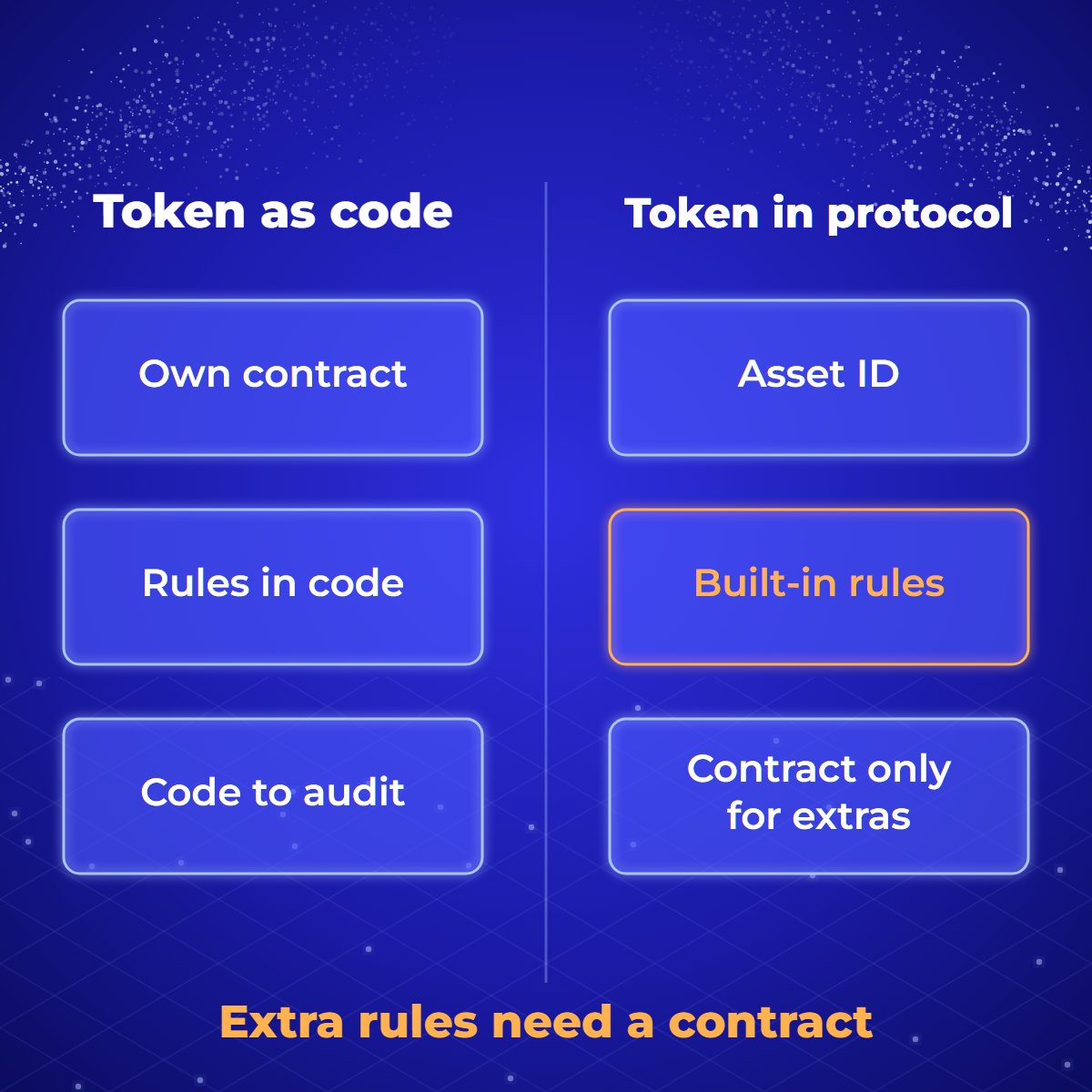
A token as a contract, and a token as part of the protocol.
Two behaviours surprise people. An account must opt in before it can receive an asset: "Before an account can receive an ASA, it must explicitly opt in to hold that asset" (Asset Operations). Nobody joins a register without an act of their own, which helps when you have to show who agreed to hold what. And names are not unique: an asset is identified by its numeric asset ID, and anyone can create an asset called anything. Check the ID, not the name.
The four addresses an issuer must decide about
Each Algorand asset has four control addresses (manager, reserve, freeze and clawback), and together they decide what anyone other than the holder can do to a holding.
Manager can change the other three addresses and can destroy the asset, although only once the creator holds every unit again.
Reserve holds units not yet in circulation. The documentation calls it "an informational designation" that is "not a protocol-enforced supply control mechanism". It gives no power over anyone's holding.
Freeze can freeze a specific account's holding. A frozen account cannot send or receive the asset until the freeze is lifted.
Clawback can move units from one account to another without the holder signing, provided both accounts have opted in.
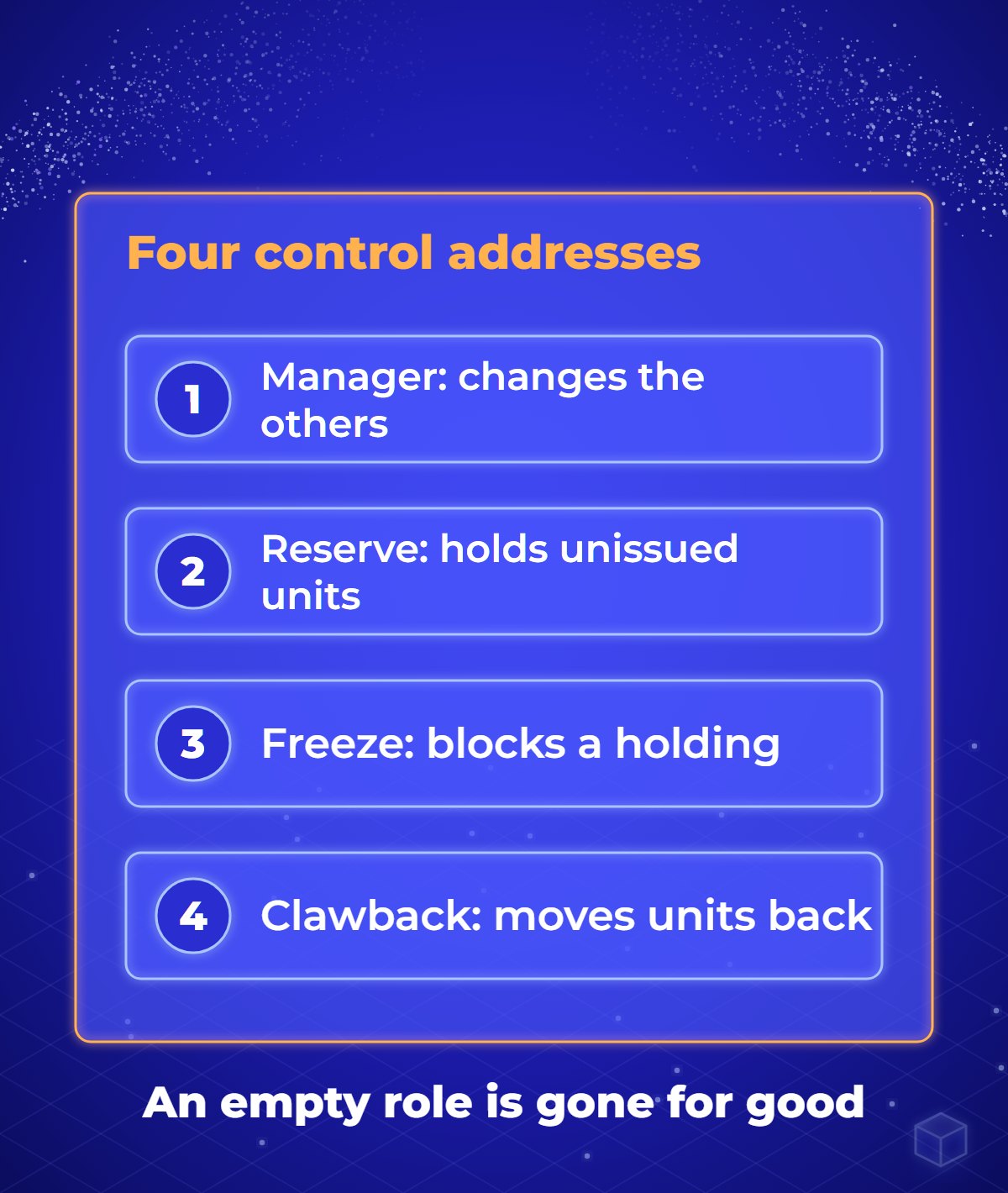
What each control address can do to a holding. Clearing an address removes that power for good.
Any of the four can be cleared, and clearing is permanent: an empty address "permanently removes that capability" (Algorand Standard Assets). Holdings can also start frozen, so that each account must be unfrozen before it can move the asset; the documentation gives approval after identity checks as a typical use.
Freeze and clawback are the consequential ones. An issuer that must enforce a transfer restriction or act on a court order may need them. An issuer that sets them without deciding to, or without telling holders, has created a power over other people's property that nobody agreed to. Our 2024 pilot of sports certificates issued as non-transferable NFTs shows the first case: a certificate meant to stay with its holder needs transfers blocked, and on Algorand that is a decision about these settings, made before issue.
The configuration is public and anyone can read it from the ledger, as can the holdings themselves (see is a blockchain private?). Our view is that these powers belong to the issuer and that setting them should be a deliberate, disclosed decision. If a technology supplier proposes holding your clawback address, ask why, and ask how you would take it back.
Atomic groups: both sides settle or neither
Algorand can bind up to 16 transactions into one group that the network confirms in full or not at all, so payment and delivery can settle together.
Payment in one direction and delivery in the other can be a single atomic group, so neither party can end up having performed while the other has not. Each party still signs only its own transaction. A group holds at most 16 transactions, and a transaction is valid for at most 1,000 rounds, which the Blocks page translates as "approximately one hour". If one transaction in a group fails, they all fail, and the migration guide states that no fee is charged for any of them. The developer reference is the Atomic Transaction Groups page.
Atomicity guarantees that the movements happen together; it does not tell you what you are receiving. Before signing a group, check the asset ID rather than the name, the quantities in every transaction rather than only your own, that nothing is in the group you did not expect, and the destination addresses. A wallet that shows one transaction and asks for a signature on a group is not showing you the whole exchange.
What Algorand does not solve
Algorand records who holds what and settles transfers; it does not make an instrument lawful, prove that an asset exists or bring counterparties to the network.
It does not make an instrument lawful. Whether a token may be offered, to whom and with what disclosure is a question of law in each jurisdiction. The legal structure does the load-bearing work, as what is asset tokenisation? explains.
It does not verify anything off the chain. In our 2023 pilot for a 300-house residential project, the ledger recorded who held which unit; whether the houses, titles and contracts behind those units were sound was established off the chain, as in any real estate tokenisation. Our 2024 pilot of physical coins issued one for one against vault records worked the same way: the token is only as good as the vault record it mirrors, and because total supply is fixed at creation, the link between the two has to be designed before issue.
It does not bring an ecosystem with it. On 3 October 2026, RWA.xyz listed Algorand 21st of 39 networks by distributed real-world asset value, with one tracked asset worth about $62 million, against about $16.6 billion on Ethereum (RWA.xyz, Networks). The tracker does not see every issuance, but the gap is real: fewer of your counterparties' wallets and service providers may already support Algorand assets. Check that before choosing it.
It does not undo mistakes. A transfer to a wrong address is final in the same way a correct one is, and only a clawback address, if one was kept, can move it back.
It does not reach other networks by itself. Moving value between blockchains needs a bridge with its own risks (see cross-chain bridges explained). Another network, or a permissioned environment, may suit a particular structure better.
How to check these figures yourself
Every protocol figure in this article comes from Algorand's own developer documentation, and each can be checked there in a few minutes.
Block time and finality are on the Blocks page, the fee on Transaction Fees, group size and minimum balances on Protocol Parameters, and the fixed parameters and control addresses on Algorand Standard Assets, all checked on 3 October 2026. Protocol upgrades change values, so check the date on any figure, including ours.
Throughput claims deserve more scepticism. Preparing this article we found three figures for Algorand's transactions per second: a claimed maximum of around 10,000, an observed peak of 5,716 and an independent estimate of 9,384. We cite none of them. For a register throughput is almost never the constraint: a few hundred transfers a quarter is not a throughput problem on any current network.
Questions people also ask
Is Algorand proof of stake? Yes. Algorand uses what it calls pure proof of stake: accounts are chosen at random to propose and vote on blocks, weighted by the ALGO they have online. Selection uses a verifiable random function, so anyone can check that it was genuine.
Do holders need ALGO to hold an Algorand asset? Yes, a small amount. Each account keeps a minimum balance of 0.1 ALGO plus 0.1 ALGO for every asset it opts in to. An issuer can pay transaction fees for its holders within a group, but the minimum balance has to sit in the holder's own account.
Is Algorand better than Ethereum for tokenisation? Neither is better in general. Algorand offers protocol-level assets, finality in seconds and a flat base fee; Ethereum offers by far the largest base of tokenised assets, wallets and service providers, and mature standards for regulated tokens. The choice depends on the controls the asset needs and where its holders already are.
Can an Algorand transaction be reversed? Not once its block is certified. A mistake is corrected with a new transaction, which needs the recipient's signature or, if the asset has one, its clawback address.
The short version
Trusty uses Algorand by default because a certified block is final, the base fee is fixed at 0.001 ALGO in normal conditions, and assets are part of the protocol. The decision that matters most for an issuer is how to set the four control addresses, which settle who can freeze or move a holding and cannot be restored once cleared. Algorand does not make an instrument lawful or verify an asset, and its ecosystem is far smaller than Ethereum's.
To see where the choice of network sits in a full project, read what is asset tokenisation?.
This article is general information, not legal, tax or investment advice.



 10 min read