A redeemable share is a share issued on terms that the company will, or may, buy it back and cancel it, at the option of the company or the holder. Under the Companies Act 2006 this needs authority in the articles, fully paid shares, a lawful source of money and notice to Companies House within one month of redemption.
Redeemable shares vs ordinary shares
The difference is one feature: a redeemable share carries terms under which the company will, or may, buy it back and cancel it, while an ordinary share has no such terms and can be taken back only through a separate buy-back or a reduction of capital.
Section 684 of the Companies Act 2006 allows a limited company with a share capital to issue shares that "are to be redeemed or are liable to be redeemed at the option of the company or the shareholder" (Companies Act 2006, s.684, checked 3 October 2026). That gives three designs: redemption on a fixed date or event, at the company's choice, or at the holder's demand. The choice decides who controls the timing, and how much pressure the company's cash will be under.
Redeemability settles nothing else. Votes, dividends and ranking on a winding up come from the articles and the terms of issue. A redeemable share can be a preference share, or identical to an ordinary share except that it can be cancelled.
One limit applies from the start: no redeemable shares may be issued when the company has no issued shares that are not redeemable (s.684(4)). A company can never consist only of redeemable shares.
The accounts may also see the share differently from the articles. A share the company must redeem on a fixed date for a fixed amount behaves like borrowing, and accounting standards may present it as a liability. Settle that with the company's accountant before the terms are drafted.
How to issue redeemable shares
A company issues redeemable shares by checking that its articles permit them, fixing the terms of redemption before allotment, making sure the directors have authority to allot, and filing a return of allotment within one month.
The articles. A private company may issue redeemable shares unless its articles exclude or restrict them; a public company may do so only if its articles authorise it (s.684(2) and (3)). A private company on the unamended model articles already has the power, and article 22(2) lets the directors set the terms (Companies (Model Articles) Regulations 2008, Schedule 1, article 22). Many companies have bespoke articles, so read the ones actually filed.
The terms. The terms, conditions and manner of redemption are written into the articles or set by the directors, if the articles or a resolution authorise them; an ordinary resolution is enough even though it amends the articles. Directors must set the terms before the shares are allotted, and the terms then form part of the rights in the statement of capital (s.685). They should state the date or trigger, whose option it is, any notice period, the amount including any premium, when payment is made, and what happens if the company cannot lawfully pay.
Authority to allot. The power in section 550 covers only a private company with one class of shares allotting more of that class. Redeemable shares are usually a separate class, so the directors normally need authority under section 551, stating a maximum number of shares and an expiry no more than five years ahead (s.551).
The filing. Within one month of allotment the company delivers a return of allotment (form SH01) with a statement of capital to Companies House (s.555), and enters the new holders in its register of members.
An illustrative example, used through the rest of this article: a private company building a block of flats raises £200,000 by issuing 200,000 redeemable shares of £1 each at par, to be redeemed at £1 each within 30 days of the last sale and by 30 June 2030 at the latest. A fixed-term asset is where redeemable shares fit best, as real estate tokenisation explained shows for property structures.
Where the money for a redemption can come from
A redemption can only be paid from distributable profits, from the proceeds of a fresh issue of shares made for the purpose, or, for a private company, partly from capital under a separate procedure (s.687).
The shares must first be fully paid (s.686(1)), and the company pays for them on redemption unless the terms allow a later date agreed with the holder.
Distributable profits are the usual source. When shares are redeemed wholly out of profits, their nominal value is transferred to a capital redemption reserve (s.733), which the law treats like share capital, so creditors keep the protection the cancelled shares gave them.
A fresh issue replaces one set of shareholders' money with another, and must be made for the purpose of the redemption.
A premium above nominal value must come from distributable profits, except that for shares originally issued at a premium, part of it may come from a fresh issue, up to the lower of the premiums originally received and the current share premium account.
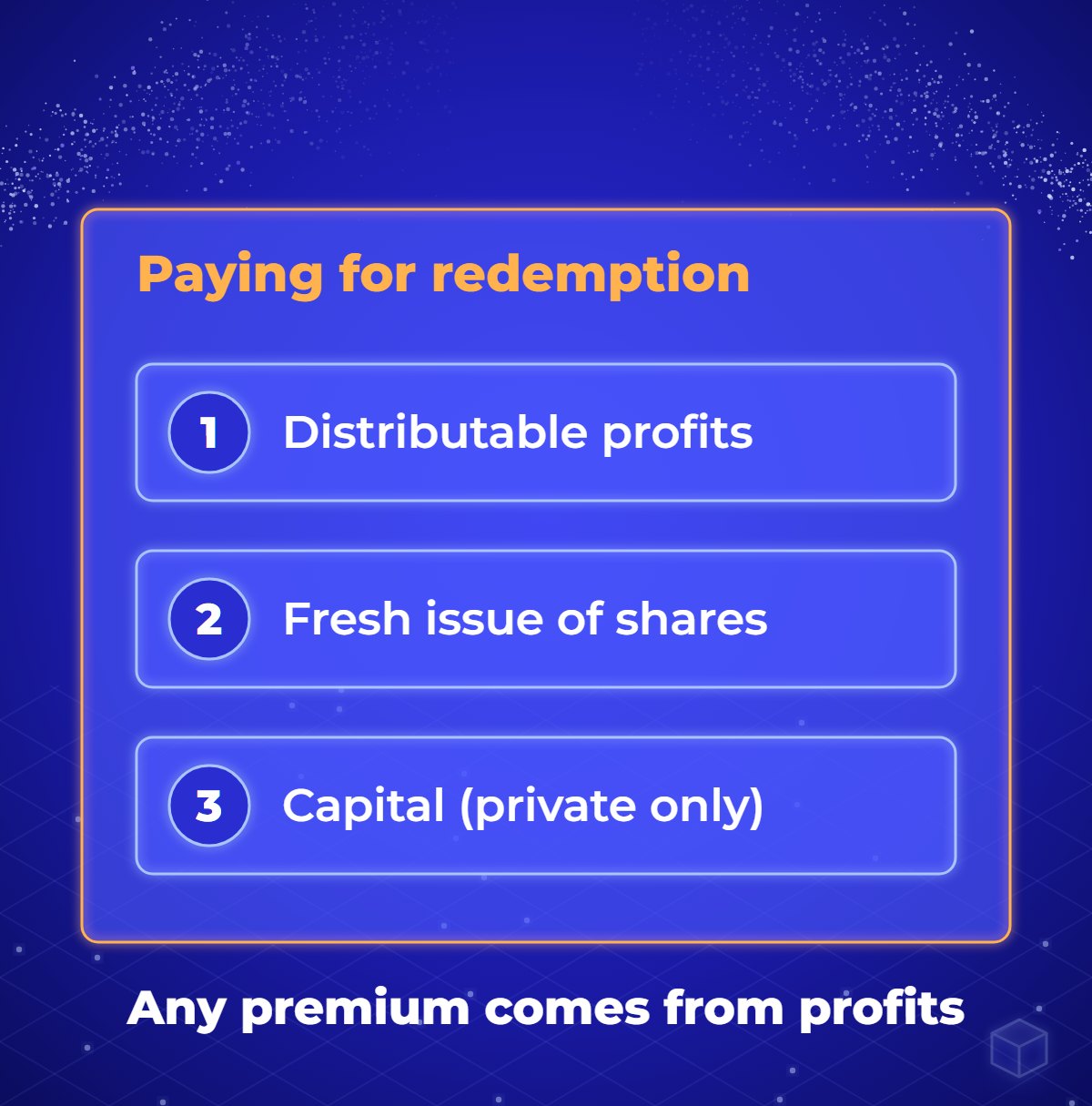
Three lawful sources of money for a redemption. Only a private company can use capital.
In the illustrative example, if the company has £200,000 of distributable profits after the sales, it redeems from profits and transfers £200,000 to the capital redemption reserve. If profits reach only £150,000, the other £50,000 must come from a fresh issue or through the capital procedure.
Redemption out of capital: the private company procedure
A private limited company may use capital only to cover the shortfall left after available profits and any fresh issue, and only after a solvency statement, an auditor's report, a special resolution, public notice and a five-week window for objections (Companies Act 2006, Part 18, Chapter 5). A public company has no such route.
The amount. The "permissible capital payment" is what remains of the price after applying available profits and the proceeds of any fresh issue (s.710). The articles may restrict or prohibit the route (s.709).
The directors' statement. After "full inquiry into the affairs and prospects of the company", the directors state that there will be no grounds on which the company could be found unable to pay its debts immediately after the payment, and that it will carry on as a going concern and pay its debts as they fall due for the following year, counting contingent and prospective liabilities. The company's auditor reports on the statement (s.714), so a company without an auditor has to appoint one. A statement made without reasonable grounds is an offence carrying up to two years' imprisonment (s.715).
Resolution and notice. The members pass a special resolution on the day of the statement or within the following week (s.716). Within a week of the resolution the company publishes a notice in the Gazette and either a national newspaper or a written notice to every creditor, and delivers the statement and report to Companies House no later than the first notice (s.719). Both documents stay open for inspection until five weeks after the resolution (s.720).
Objections and timing. Any creditor, and any member who did not vote for the resolution, may apply to court within five weeks to cancel it (s.721). The payment is made no earlier than five weeks and no later than seven weeks after the resolution (s.723), so the procedure must start well before a fixed redemption date.
The redemption step by step, and the filing
On the redemption date the company pays the holder, the shares are treated as cancelled, the register of members is updated, and within one month the company files form SH02 with a new statement of capital.
1. Confirm the terms. Check the trigger has occurred and any notice the terms require has been given.
2. Confirm the money. Check the shares are fully paid and the board has identified the lawful source by reference to the company's accounts.
3. Pay. Pay the holder on redemption, unless the terms allow a later agreed date.
4. Cancel. Redeemed shares are treated as cancelled and issued share capital falls by their nominal value (s.688), with any transfer to the capital redemption reserve.
5. Update the register. The register of members shows the shares each member holds and the date anyone ceases to be a member (s.113).
6. File SH02. Within one month, notify the registrar of the shares redeemed, with a statement of capital as it stands immediately afterwards (s.689). The form is SH02, uploaded online (Companies House, form SH02, checked 3 October 2026). Missing the deadline is an offence by the company and every officer in default.
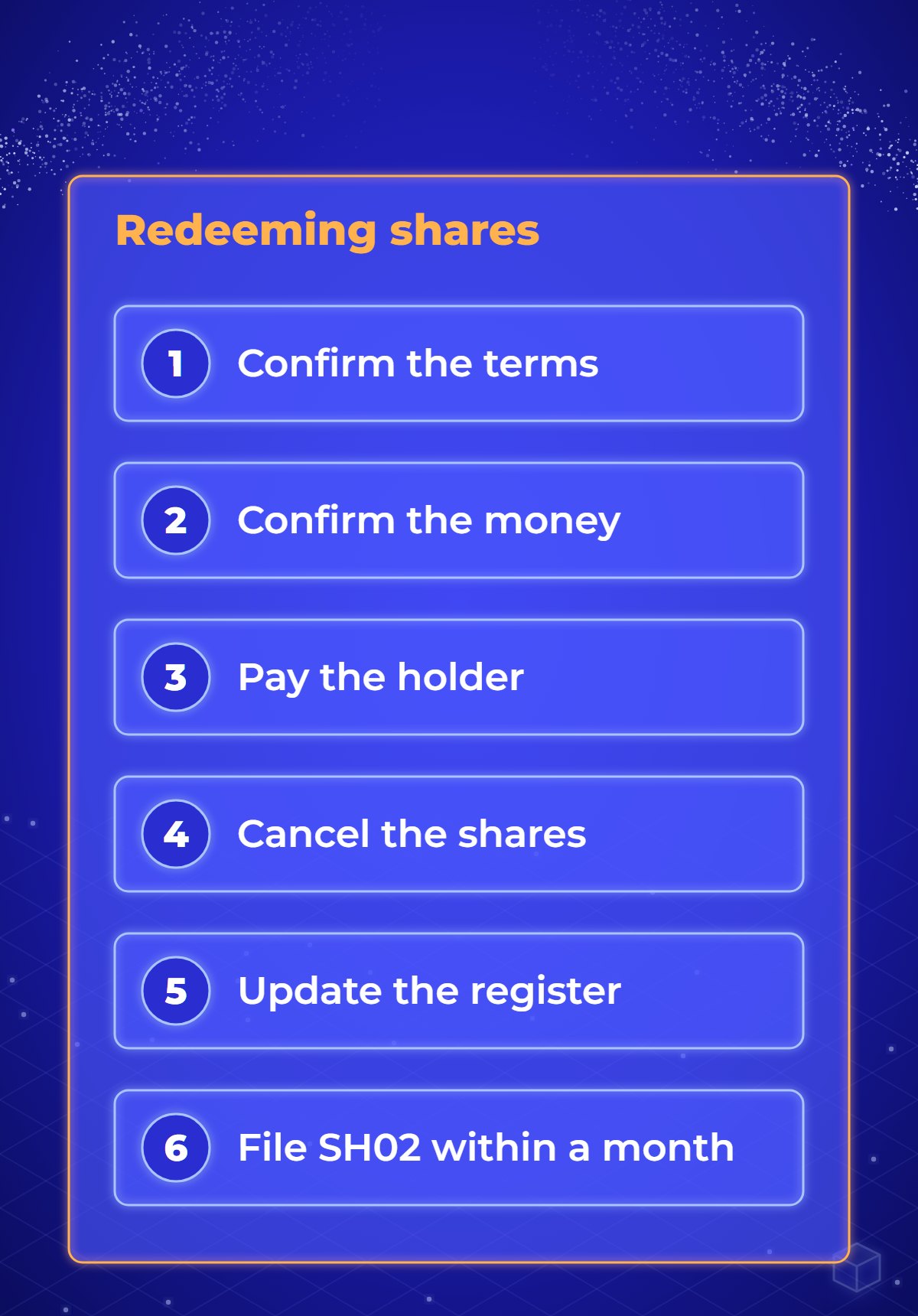
A redemption is complete only when the register is updated and form SH02 is filed.
Tokenised redeemable shares: keeping the register and the token in step
When redeemable shares are also recorded as tokens, the statutory register of members stays the legal record, so every redemption has to be mirrored on the blockchain on the same day by taking the redeemed tokens out of circulation.
The register is "prima facie evidence" of what the Act requires it to contain (s.127). A token records a position in that register and does not replace it, as What is asset tokenisation? explains. If the register shows shares cancelled while the tokens sit in holders' accounts, the token record is wrong.
On Algorand, the blockchain Trusty Digital uses, a token's total number of units "cannot be changed after creation", so redeemed units cannot simply be deleted. They are moved to the reserve address, which "holds non-circulating units", by the clawback address, which "can revoke or reassign asset holdings" (Algorand Developer Portal, Assets overview, checked 3 October 2026). Clawback is only the mechanism; the authority to use it comes from the terms of issue and the register.
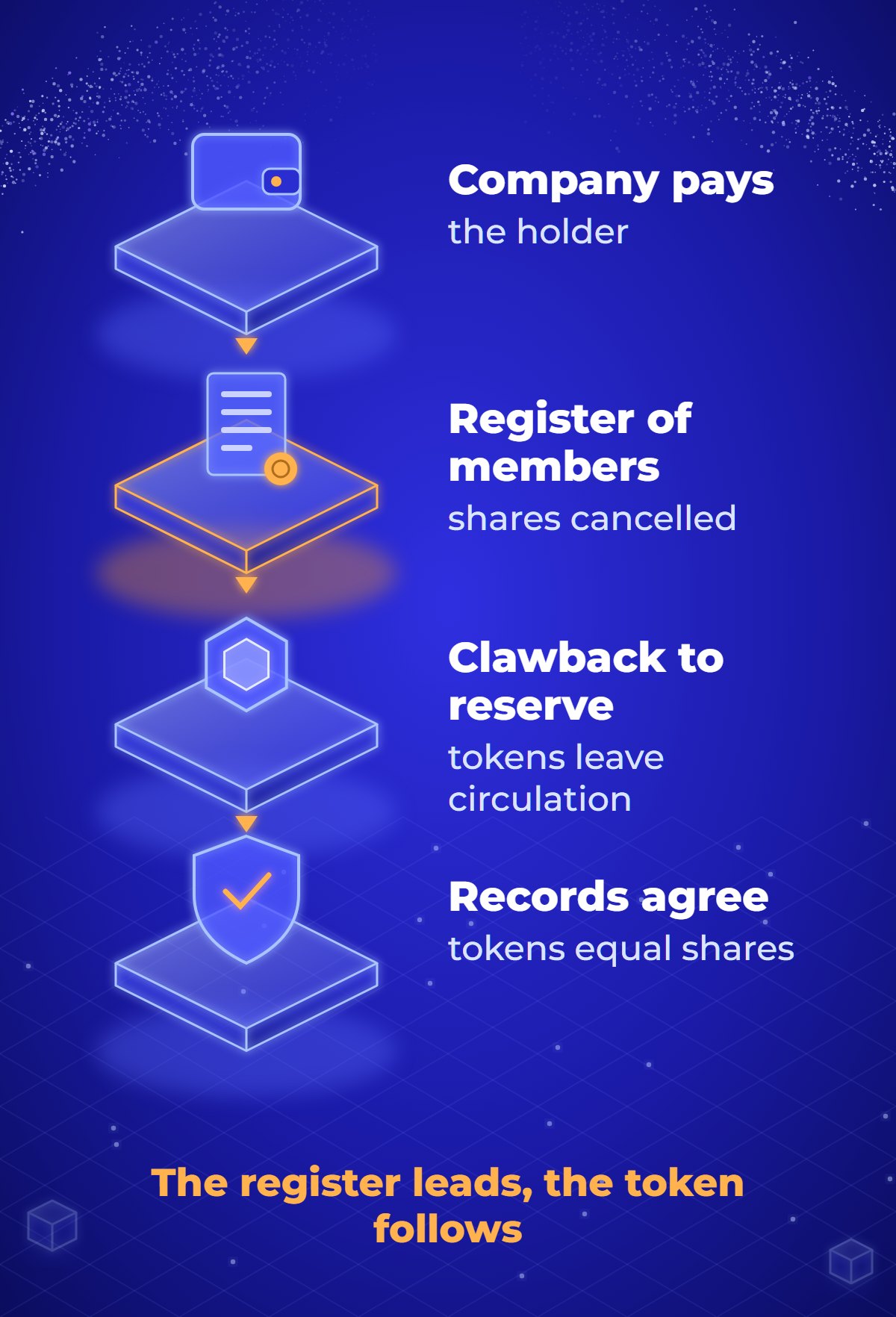
The register changes first; the token record follows on the same day.
Configure it at creation. The clawback address is set when the token is created. It can be cleared later, but clearing it removes the capability permanently, and a token without clawback can only be retired with each holder's cooperation.
Keep one order of events. Pay the holder, update the register, move the tokens to the reserve, then reconcile: units in circulation must equal the shares of that class in the register. Where they differ, the register governs and the token record is corrected.
Disclose the power. A clawback moves tokens without the holder's signature, so the terms of issue should say who controls it for the company and when it is used. A smart contract can enforce the sequence, but for most issuers a written procedure is enough, as Do you need a smart contract? explains.
Where redemptions go wrong
Most failures surface on the redemption date, when the company cannot lawfully pay or finds its paperwork never allowed the redemption it promised.
Articles that exclude it. Shares issued as redeemable under articles that restrict them.
Terms fixed too late. A date or price agreed in correspondence after allotment, contrary to s.685(3).
No lawful money on the date. The company "is not liable in damages" for failing to redeem, and a court will not order redemption if the company shows it cannot pay out of distributable profits (s.735). The holder waits, which is why redemption should never be described as assured.
The capital route started late. Five to seven weeks must pass between the resolution and the payment.
SH02 forgotten, or tokens left in circulation. The register, Companies House and the token record then tell three different stories.
Questions people also ask
Can a public company redeem shares out of capital? No. The capital procedure in Chapter 5 of Part 18 is available only to private limited companies. A public company redeems out of distributable profits or a fresh issue.
How is a redemption different from a share buy-back? A redemption follows terms fixed before the shares were issued. A buy-back is a separate agreement under Chapter 4 of Part 18, with its own approval and filing rules.
Can redeemed shares be issued again? No. Redeemed shares are treated as cancelled and the issued share capital falls by their nominal value. Any new shares are a fresh allotment, needing authority to allot and a new return of allotment.
The short version
Redeemable shares are ordinary company law with one added term, and the law is strict about it: authority in the articles, terms fixed before allotment, fully paid shares, a lawful source of money and form SH02 within one month. For a private company the capital route exists, but it takes at least five weeks and a solvency statement the directors answer for personally. Where the shares are tokenised, the register leads and the token follows, which works only if clawback was configured at creation and disclosed.
To see where a share register fits in a wider tokenisation project, read What is asset tokenisation?.
This article is general information, not legal, tax or investment advice.



 10 min read