An NFT membership key works because a service checks the blockchain: if your account holds the token, you receive the benefits set out in the membership terms. The token proves who holds it. Everything else, including what happens when the benefits change or the key is sold, is decided by the issuer's terms and the token's settings.
How does an NFT membership key work?
An NFT membership key works in two steps: you prove that you control an account, and the service reads the blockchain to see whether that account holds the key.
Typing in an address proves nothing, because anyone can copy an address. (If the token itself is new to you, What is an NFT? starts there.) The proof is a signature. The member connects a wallet and signs a message or a transaction with that account's private key, and the service checks the signature against the address.
On Algorand there is a step before the key can arrive at all. An account must opt in to an asset before it can receive it, and an opt-in is a zero-amount transfer from the account to itself (Algorand asset operations, checked 3 October 2026). Each asset an account holds raises its minimum balance by 0.1 Algo (Algorand Standard Assets, checked 3 October 2026), which is why a wallet asks for a small balance before it accepts a new token.
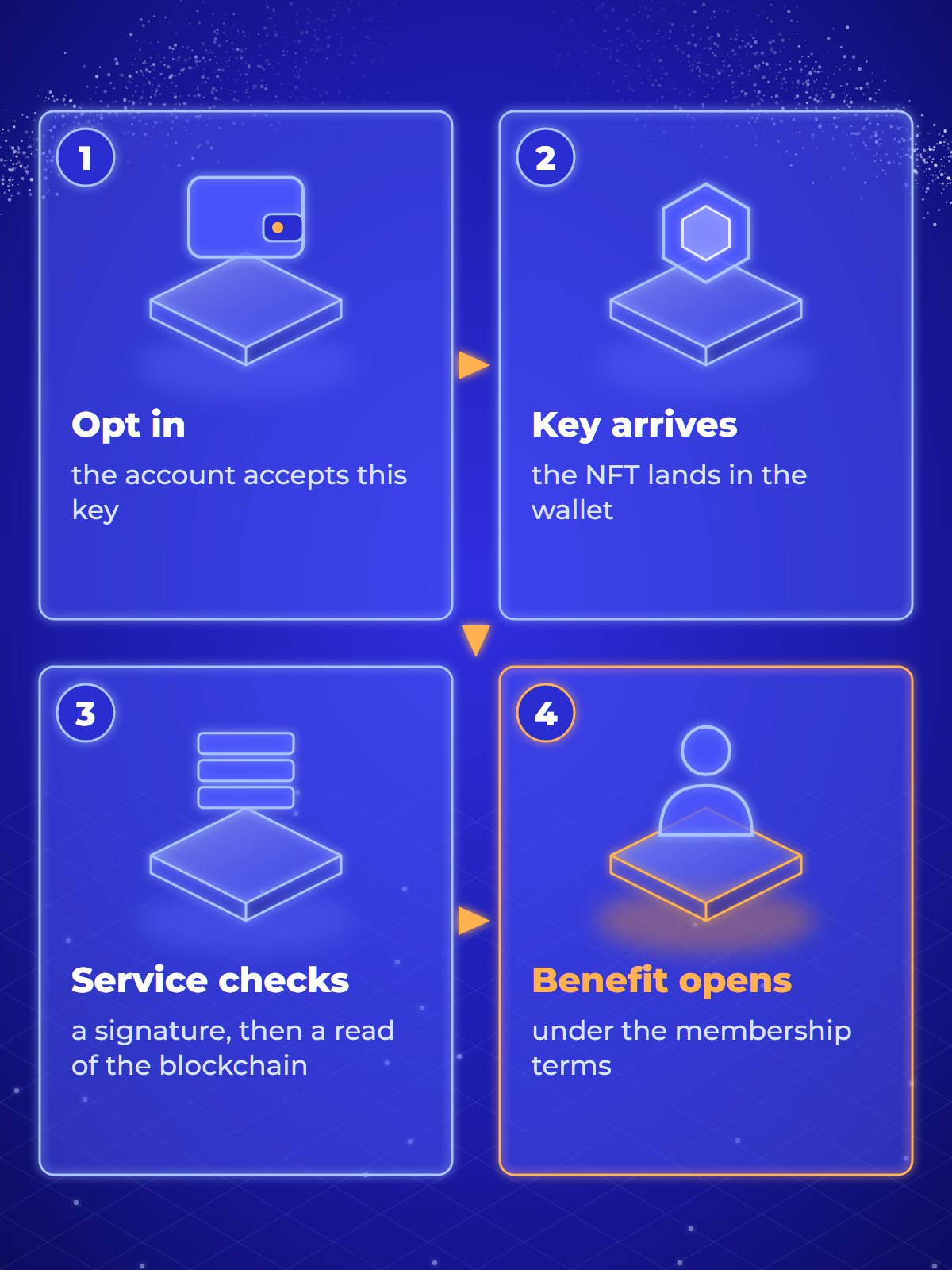
From opt-in to benefit: the four steps of an NFT membership key.
After that, the key works like any membership card that can be checked by anyone with the right software. NFT utility explained covers the other kinds of benefit an NFT can carry.
What does the service check?
A careful service checks five things: who controls the account, which token it holds, whether the holding is usable, what the terms grant, and whether anything has changed since the last check.
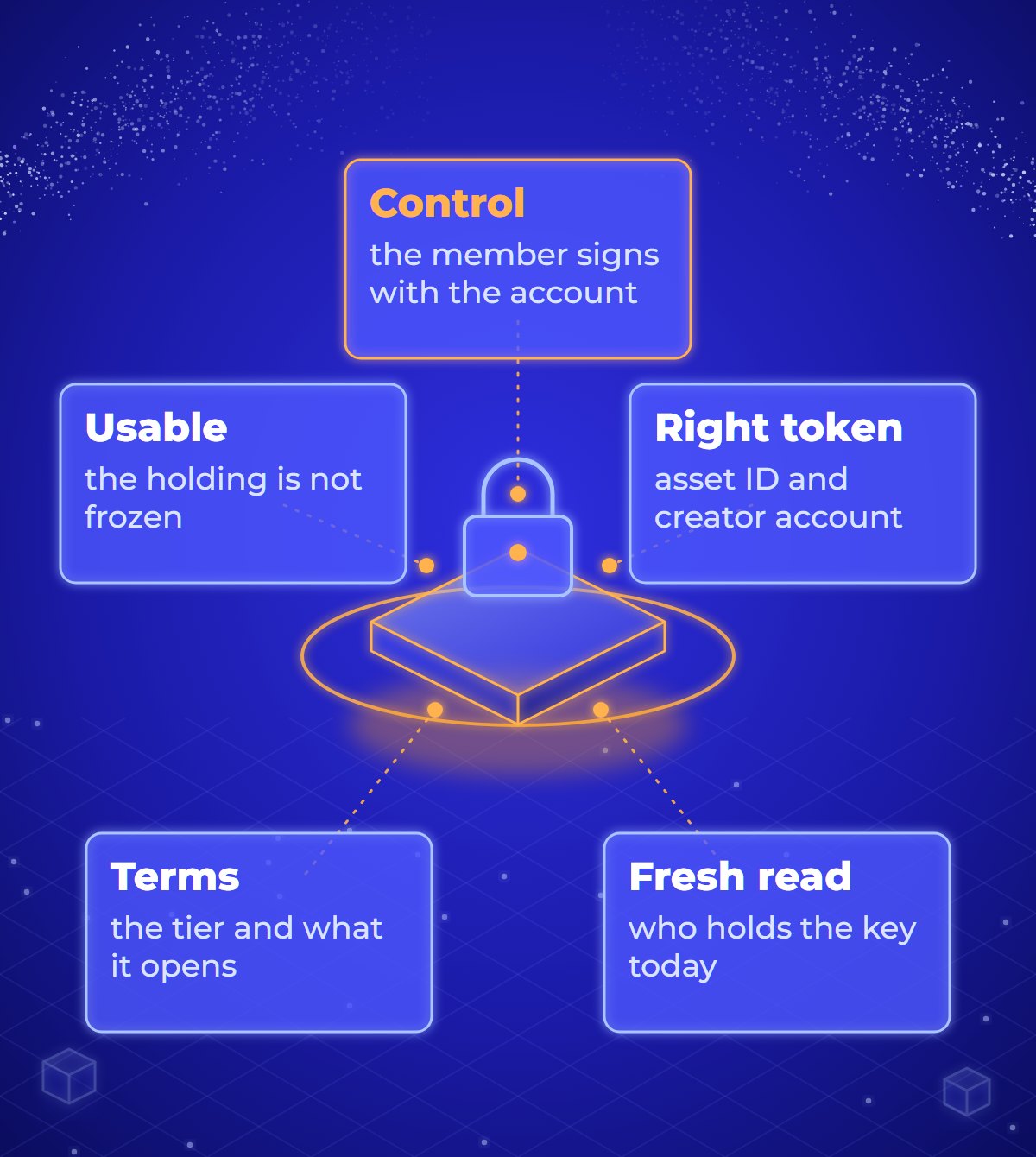
Five checks a service can run before it opens a benefit.
The right token. Names and pictures can be copied. The service should check the asset ID and the account that created it, and ignore lookalikes.
A usable holding. On Algorand a holding can be frozen; a frozen account cannot send or receive that asset (Algorand Standard Assets). Whether a frozen key still opens benefits is a choice for the terms.
A fresh read. Keys move. A check made last month says nothing about who holds the key today, so the service reads the blockchain each time it matters. Because that record is public, anyone can also see which accounts hold the key; Is a blockchain private? explains what that reveals about members.
An illustrative example. A professional association issues 300 membership NFTs. Its event site asks a member to connect a wallet and sign a short message, then reads the blockchain for the association's asset IDs. A member who sold their key in March and tries to book in April signs successfully, because they still control the account, but the read shows no key, so the booking is refused. The new holder signs from their own account and books. (The association and figures are invented for illustration.)
Can an NFT membership key be sold or passed on?
A key can be passed on if its settings and terms allow it. The blockchain settings decide whether the token can move; the terms decide whether the membership moves with it.
Algorand gives the issuer three controls. If a token is created as default frozen, every holding starts frozen and must be unfrozen before the holder can transfer it. A freeze account can freeze or unfreeze a particular holding. A clawback account can move the token from one account to another, provided both have opted in (Algorand Standard Assets). Clearing any of these addresses removes that power permanently. These controls are part of the token itself and need no smart contract, as Do you need a smart contract? explains.
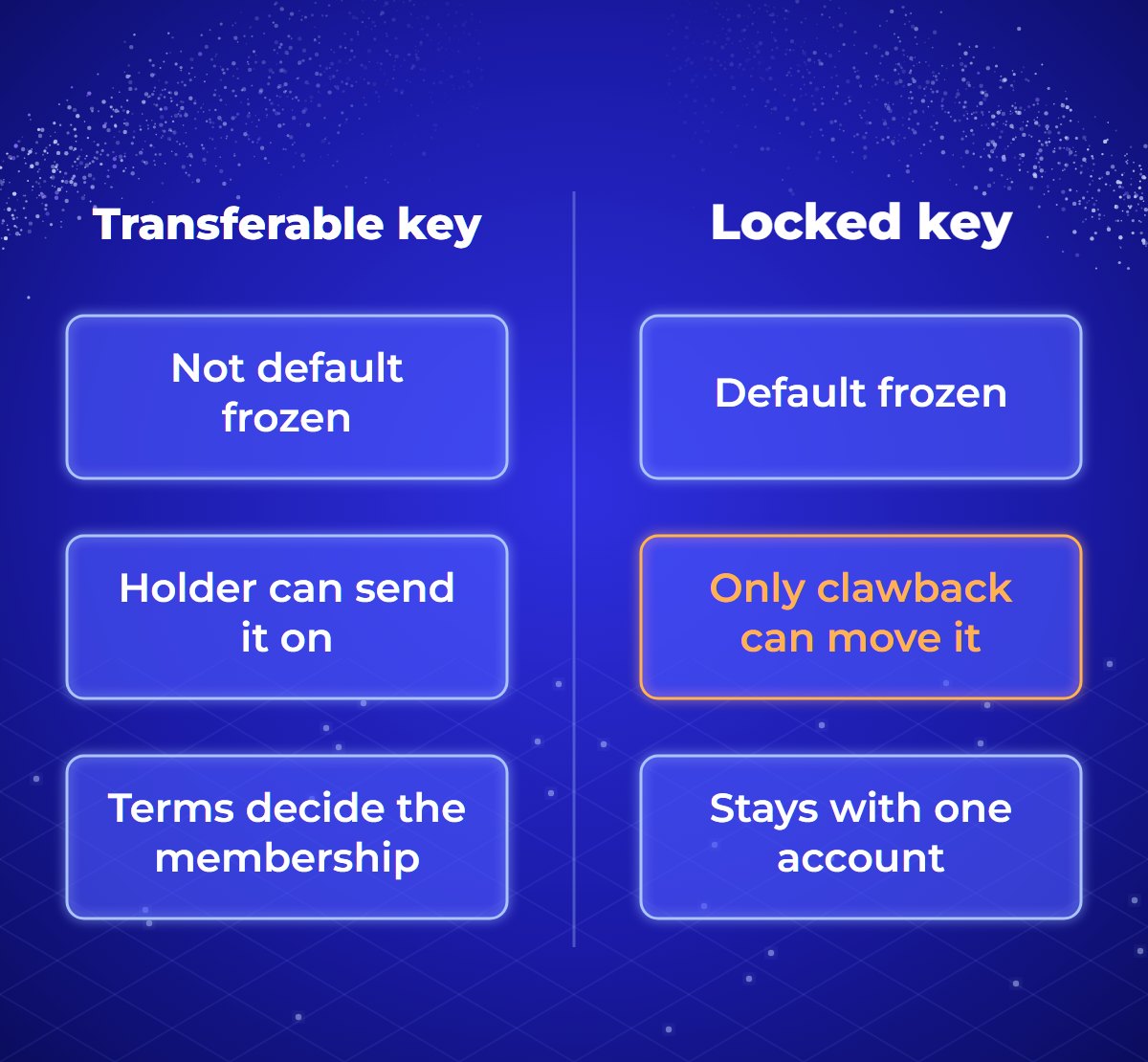
The same kind of token, configured two ways.
Trusty Digital's keys are set up as transferable tokens. The item pages of the Trusty Access Key and the Trusty Creator Gate Pass show that neither is default frozen, so a holding is usable from the moment it arrives. Trusty Digital does not restrict which wallets hold or receive its NFTs, and a Pera wallet can opt in to a key like any other Algorand asset. Whether benefits follow a key to a new holder is a matter for each collection's benefits terms.
Stolen keys raise a separate question. The Law Commission concluded that the courts can develop a rule under which a good faith buyer who pays for a token without notice of a problem takes a fresh title to it. That rule would apply to the token itself; what happens to a linked membership depends on the link, the law and the parties' intentions (Law Commission, Digital Assets: Final Report, 2023, paragraphs 6.107 and 6.109).
What happens when the membership benefits change?
When benefits change, the token stays exactly as it was; what the holder can claim depends on the terms and, for consumers, on consumer law.
A programme can change: a venue closes, a partner leaves, a new tier appears. The terms should say who can change the benefits, for what reasons, with how much notice, and what happens if the programme ends.
For consumers in the UK, the Consumer Rights Act 2015 provides that an unfair term in a consumer contract is not binding on the consumer (s.62, checked 3 October 2026). Its indicative list of terms that may be regarded as unfair includes a term that lets the trader alter the contract unilaterally without a valid reason specified in the contract, and a term that lets the trader alter the characteristics of the goods, digital content or services without a valid reason (Schedule 2, Part 1, paragraphs 11 and 13). Whether a particular change clause is unfair depends on the whole contract and the circumstances. A business member does not have these protections and relies on the contract alone.
The Law Commission noted that a project can honour licences or privileges only for the legal title holder of an NFT, which may place a burden on the grantor to investigate who that holder is (paragraph 6.112). A well-drafted programme says how it identifies the holder, and what it does if two people claim the same key.
Trusty Access Key and Creator Gate Pass: what their pages state
Both are membership NFTs in Trusty Digital's Founding series on Algorand MainNet, and each states its rights category by category on its public collection page. They are two of Trusty Digital's key collections, which include others such as the Trusty Oracle Vault.
The Trusty Access Key page states that up to 80 keys may be issued and that holder benefits are provided by Trusty Digital under the Trusty Access Key Benefits terms. The Trusty Creator Gate Pass page states the same structure, with up to 40 passes under the Trusty Creator Gate Pass Benefits terms. Both describe themselves as digital collectibles for Trusty experiences and state that they are not investments and give no right to revenue, equity or governance.
The rights listed on each page:
- Ownership of the token: included. Ownership does not transfer copyright, other intellectual property or any underlying real-world asset; What you own when you buy an NFT explains the difference.
- Licence to the media: included, for personal, non-commercial display, and only while the holder holds the NFT.
- Commercial use, participation and governance, financial rights: not included.
The pages add that rights "are enforced by the issuer, not by the platform", and that a completed transfer cannot be reversed by Trusty. Each key's page also shows its token settings as read from Algorand MainNet.
On both collections the manager, freeze and clawback roles sit with Trusty Digital's creator account. These roles let the issuer deliver a key correctly, correct an error, help a holder who has lost access to a wallet, and act on a court order or a legal requirement. Each use is governed by the collection terms. The settings are public on every item page and on any block explorer, with a reminder that a manager can change them afterwards.
Keys also open another product. The Gold Passport page states that its first collection is open to holders of Trusty keys and that every key brings free storage of the bar.
What should you check before relying on an NFT key?
Check the token's settings on the blockchain, then read the membership terms for transfer, change and closure.
Questions people also ask
What is an NFT membership? A membership where the card is a token on a blockchain. A service checks whether your account holds the token and gives you the benefits set out in the membership terms.
Can I lend my NFT membership key to someone? Only by transferring it, if its settings allow transfers. While it sits in their account, the service sees them as the member, and the terms decide whether they receive the benefits.
What happens if I lose access to my wallet? The key stays in the account, but you cannot sign to prove you control it. If the issuer kept a clawback account, it may be able to move the key to a new account under its terms; if not, the key itself cannot be moved, though the issuer may still choose to issue a replacement under its terms.
The short version
An NFT membership key is a token that a service checks before it opens a benefit. The blockchain settings decide whether the key can move and who else can move it. The terms decide what the key gives, whether the membership follows the token, and what happens when the programme changes. Read both before you rely on the key.
To read the rights each Trusty membership collection states, browse Trusty NFT collections.
This article is general information, not legal, tax or investment advice.




 10 min read