A crowdfunding platform is a website or app where a campaign owner asks many people for small sums towards a project. To choose a reputable one, start with your campaign type: loan-based and investment-based crowdfunding need a platform authorised by the Financial Conduct Authority; reward and donation platforms are judged on funding model, fees, refunds and supporter data.
What are crowdfunding platforms, and what types are there?
Crowdfunding platforms are websites and apps that let a person or organisation describe a project, set a target and collect money from many people, usually for a fee taken from what is raised. The Financial Conduct Authority (FCA) sorts them into four types, and the type decides almost everything that follows (FCA, Understanding crowdfunding, checked 3 October 2026).
Donation-based. Supporters give money to a cause and receive nothing in return.
Reward-based. Supporters pay for a specific benefit: a product, an early edition, a ticket. The FCA also calls this pre-payment crowdfunding, and describes a person who pays in as "a contributor rather than an investor".
Loan-based. People lend to a borrower through the platform and are repaid over time, usually with interest. This is also known as peer-to-peer lending.
Investment-based. People buy shares in a company, or business-backed loans, usually from a small or medium-sized business that is not listed. The shares can be ordinary shares or another class, such as redeemable shares.
As crowdfunding activities, the first two are generally outside FCA regulation. The last two are regulated: the platform must be authorised by the FCA, and the way a campaign is promoted, and to whom, is controlled. The line dates from the FCA's crowdfunding rules of 1 April 2014, when the regulator set out that only loan-based and investment-based platforms fell within its remit (FCA PS14/4, checked 3 October 2026).
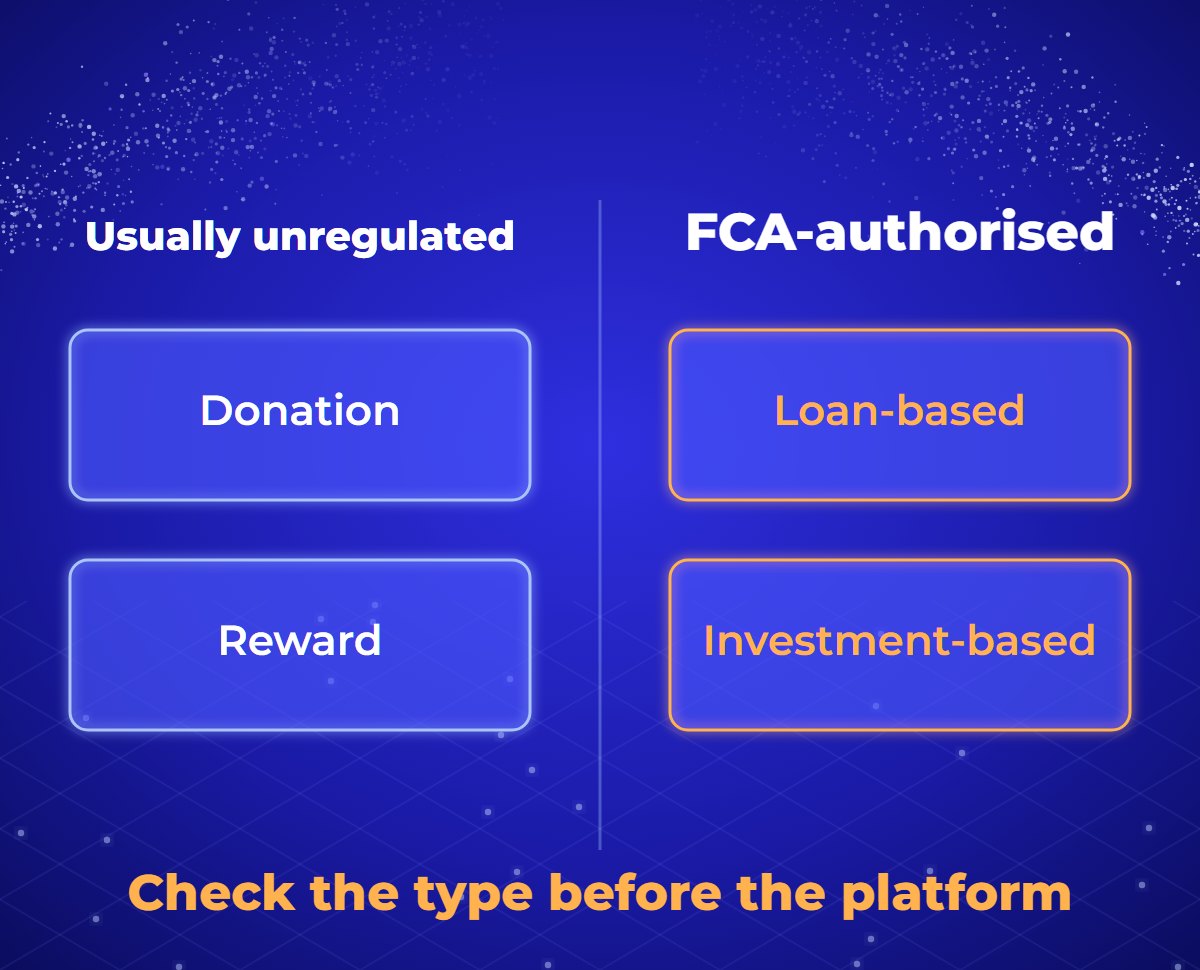
Two types need an FCA-authorised platform. Two generally do not.
This is why the type comes first: choosing a platform before the type is choosing in the wrong order. Be candid about which one you are running: a "reward" that is really a share of revenue is not a reward, and calling it one does not change how the law treats it.
How do I choose a reputable crowdfunding platform?
A reputable crowdfunding platform is one whose regulatory status you have checked yourself, and whose funding model, total cost, refund terms and data terms you have read before your campaign goes live.
1. Match the platform to the type. Reward and donation campaigns belong on platforms built for them; a lending or share campaign needs an FCA-authorised platform with the permission for that activity.
2. Check authorisation at the source. For the regulated types, look the platform up on the FCA register, as the section on checking a platform on the FCA register describes. For any platform, look up the company that operates it on Companies House and compare the name with the one in its terms.
3. Choose the funding model. All-or-nothing or keep-it-all, decided by whether partial funding would leave you better or worse off.
4. Price the whole cost. Platform fee, payment processing, currency conversion, refund costs and the date the money actually reaches you.
5. Find out where pledges sit. Who holds supporters' money between the pledge and the payout, and how refunds are made.
6. Read the data terms. What you receive about supporters and whether you may contact them after the campaign.
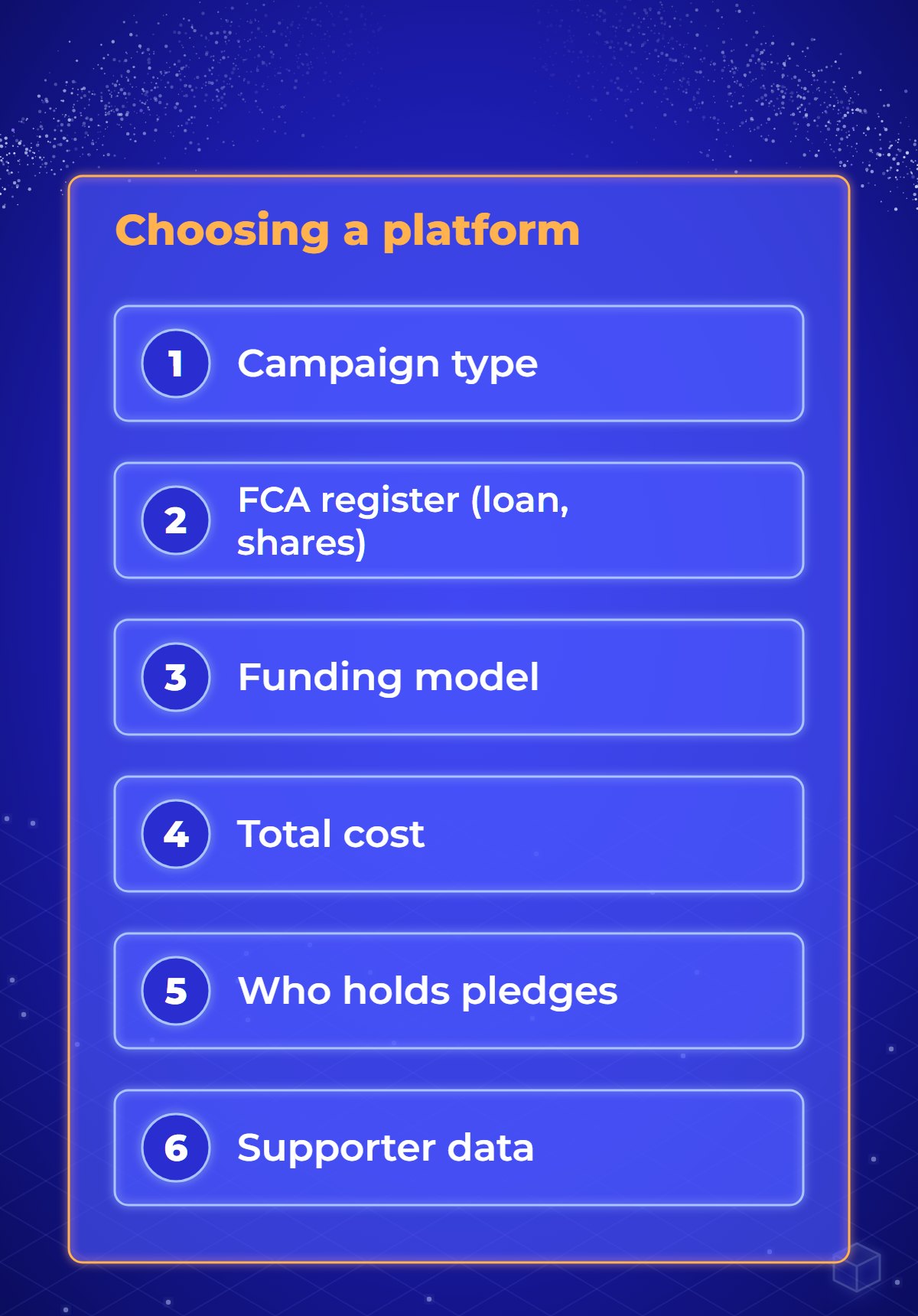
Six checks, in order. Each one rests on a document the platform should publish.
None of these checks needs a lawyer. A platform that cannot produce its register entry, fee page, terms for campaign owners and privacy notice has answered the question about its reputation.
Checking a platform on the FCA register
For loan-based and investment-based crowdfunding, check the platform yourself on the FCA's Financial Services Register at register.fca.org.uk, not through a logo or a line on its website. The register is the FCA's public record of firms and individuals it or the Prudential Regulation Authority has authorised, now or in the past (FCA, Financial Services Register, checked 3 October 2026).
Search by name and by firm reference number. Ask for the firm reference number and search both. The entry should show the firm as currently authorised, not as no longer authorised.
Compare the contact details. The register also lists firms the FCA has been told are operating without authorisation, including clone firms that copy a genuine firm's name and details. Use the contact details shown on the register, not those in an email.
Read the permissions. A firm authorised for one activity is not authorised for everything. For a loan-based platform, the regulated activity is operating an electronic system in relation to lending, defined in article 36H of the Regulated Activities Order 2001.
Check for appointed representative status. Some firms are listed as appointed representatives, acting under a principal firm that is responsible for them. The FCA warns that where an appointed representative goes beyond what its principal allows, the Financial Ombudsman Service and the Financial Services Compensation Scheme may not cover it, so ask the principal to confirm.
Then ask who approves the financial promotion for your campaign. Under section 21 of the Financial Services and Markets Act 2000, a business may not communicate an invitation or inducement to engage in investment activity unless it is authorised or an authorised firm approves the communication. Since 7 February 2024, an authorised firm needs specific FCA permission before it can approve promotions for businesses that are not authorised (FCA PS23/13). Under rules in full effect from 1 February 2023, promotions on these platforms carry prescribed risk warnings, incentives such as joining bonuses are banned, and a first-time customer of a platform must wait at least 24 hours before seeing the offer (FCA PS22/10).
Reward and donation platforms need no FCA authorisation for the crowdfunding itself, but their payment provider may be regulated; check it on the register too.
All-or-nothing or keep-it-all: which funding model?
Choose all-or-nothing when a partly funded project would leave you unable to deliver, and keep-it-all only when every pound raised is useful on its own.
All-or-nothing. You set a target and a deadline. If the target is not reached, supporters get their money back and you receive nothing. The FCA notes that platforms generally work this way, and that when the total falls short the funds are returned in full, with no fees or deductions (FCA, Understanding crowdfunding).
Keep-it-all. Also called keep-what-you-raise or flexible funding. You receive whatever is pledged, less fees, whether or not the target is met. It suits a cause or an ongoing need, and is risky for a product with a fixed cost of making the first batch.
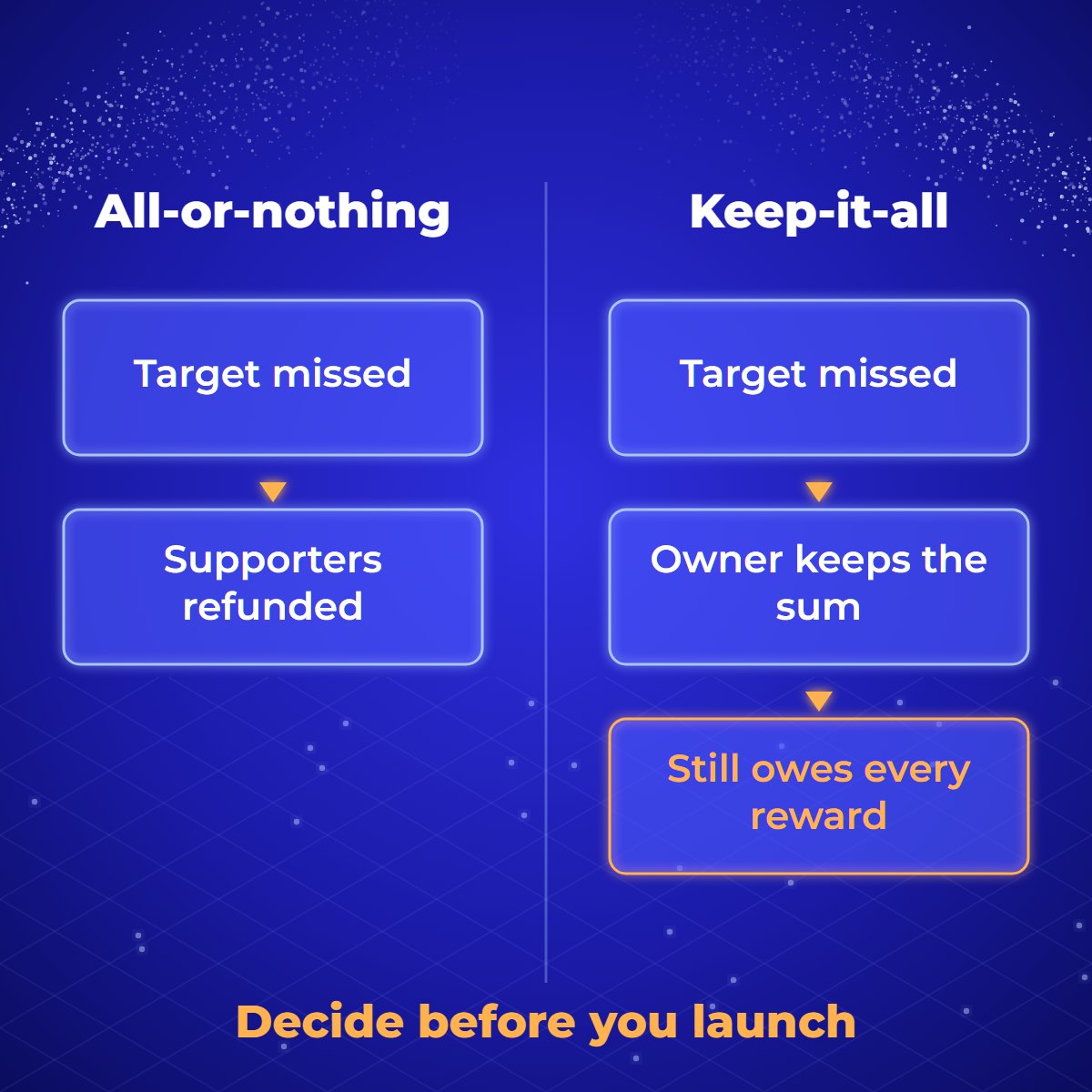
Missing the target: a refund under one model, a delivery problem under the other.
An illustrative example. A designer needs £12,000 to print a first run of 500 board games, because that is the printer's minimum order. Under keep-it-all, raising £5,000 from 200 supporters leaves 200 people owed a game that cannot be printed. Under all-or-nothing, the campaign closes, they are refunded, and the designer can try again with a smaller run.
The test is simple: would a partly funded campaign leave you better off or worse off? If worse, choose all-or-nothing even where the platform offers both. Reward-based campaigns can also record supporters' rewards on a blockchain, and there the all-or-nothing rule needs a smart contract that holds pledges until the deadline, as Atomic transfers on Algorand explained sets out.
What crowdfunding platforms charge, and where pledges sit
Most platforms charge the campaign owner a percentage of the funds raised, usually only when the campaign reaches its target (FCA, Understanding crowdfunding), but the headline percentage is rarely the whole cost. Establish each of these before committing:
- The platform fee, and whether it changes if you miss the target or use keep-it-all.
- Payment processing, often charged separately as a percentage plus a fixed amount per pledge.
- Currency conversion, often the largest unquoted cost in an international campaign.
- Payout timing, which decides when you can start work.
- Refund costs: who bears the processing cost when a pledge is returned.
- Compliance charges on regulated campaigns, for promotion approval or onboarding.
Put each platform's published fees into one table: a low headline rate with processing listed separately is not cheaper until both are added up. Model the total on a realistic raise, not on the target, and assume some pledges will fail.
Between a pledge and the payout, supporters' money is in one of two places, and the platform's terms should say which. Either the card is only authorised or stored, and is charged when the campaign succeeds; or the money is taken at once and held by the platform's payment provider until the deadline, then paid out or refunded. Ask who holds the money, whether that firm is on the FCA register, how long refunds take, and what happens to pledges whose card fails at the deadline, because those can turn a funded campaign into an unfunded one.
The protection is narrower than many supporters assume. The FCA says that where it regulates the payment but not the crowdfunding, a payment may be protected, but if the project fails or does not deliver, supporters are unlikely to be. Read the platform's rules on non-delivery before launch.
Who owns the supporter relationship, and the data?
Find out before launch what you will receive about each supporter and whether you may contact them afterwards, because a platform that keeps the relationship keeps your community when the campaign ends.
Ask what fields you receive (name, email, delivery address, country), in what format you can export them, and whether supporters have agreed to hear from you after the campaign. Ask, too, who owns the campaign page once the campaign closes.
Once you decide why and how supporters' data is used, you are a controller under UK data protection law: the person who determines the purposes and means of processing personal data (ICO, What are controllers and processors?, checked 3 October 2026). The platform is likely to be a controller of the same data for its own purposes. Under the Data Protection (Charges and Information) Regulations 2018, organisations and sole traders that use personal information must pay the Information Commissioner's Office a data protection fee unless they are exempt (ICO, Data protection fee, checked 3 October 2026).
Then look at audience. Study campaigns like yours on the platform in the last year: not the successes it features, but the typical one in your category, and whether its supporters came from the platform or from the owner. Plan as though you will bring most of your first supporters yourself. If you cannot name the first fifty, no platform will supply them.
Equity or reward crowdfunding: what to settle first
Equity crowdfunding gives people shares in your company through an FCA-authorised platform under financial promotion rules; reward crowdfunding gives them a product or benefit, sits generally outside FCA regulation, and leaves you owing them what you promised.
Settle three things first. What supporters receive fixes the type and the regulatory position. Whether partial funding helps or harms you fixes the funding model. Who your first fifty supporters are tells you whether you are ready at all.
If the campaign involves shares or lending, take advice from a solicitor who works on financial promotions before you publish anything. The rules apply from the first public statement, not from the first pledge. If the money is to be tied to an asset, such as a building, rather than to a project, the structure is different again, as Real estate tokenisation explained describes.
Questions people also ask
Is reward crowdfunding regulated by the FCA? Not as crowdfunding, although the FCA may regulate the payment service the platform uses. Data protection law and the platform's terms still apply to the campaign owner.
What fees do crowdfunding platforms charge? Usually a percentage of the funds raised, often only if the target is met, plus payment processing. Compare platforms on the total for a realistic raise, using each platform's own fee page.
How can I tell whether a crowdfunding platform is legitimate? For loan-based or investment-based crowdfunding, find the firm on the FCA register and check its permissions. For any platform, check the operating company on Companies House.
The short version
Choosing a crowdfunding platform is mostly choosing the type of crowdfunding, because loan-based and investment-based campaigns need an FCA-authorised platform and controlled promotions, while reward and donation campaigns do not. After that, a reputable platform is one you have checked rather than trusted: its register entry where one is needed, its funding model, its full cost, where it holds pledges, and what it lets you keep of your supporters. The platform supplies the mechanism; the supporters are usually yours to find.
To see what changes when supporters' rewards are recorded as tokens on a blockchain, read What is asset tokenisation?.
This article is general information, not legal, tax or investment advice.



 10 min read