An NFT, short for non-fungible token, is a token on a blockchain with its own identity, so it cannot be swapped like for like with another. It usually points to a metadata file and an image, but the same token can record a membership, a certificate or a physical item. The holder's rights depend on its terms.
What does NFT stand for, and what does it mean?
NFT stands for non-fungible token: a token on a blockchain that has its own identity, so one cannot stand in for another.
Fungible things are interchangeable. Any pound coin settles a debt as well as another. A numbered print, a seat at a concert or the title to a particular car are non-fungible: the specific item matters. Tokens work the same way. A currency token is issued as many identical units; an NFT is issued as one identifiable unit, which suits a record of one specific thing, the idea behind asset tokenisation.
The term became common with the Ethereum standard ERC-721, published in January 2018, which describes non-fungible tokens as "also known as deeds" and explains that each one is distinct (ERC-721, checked 3 October 2026). Other blockchains have their own conventions. On Algorand, the ARC-3 convention calls a token a pure NFT when its total supply is exactly one unit and it has no decimal places, so it cannot be split (ARC-3, checked 3 October 2026).
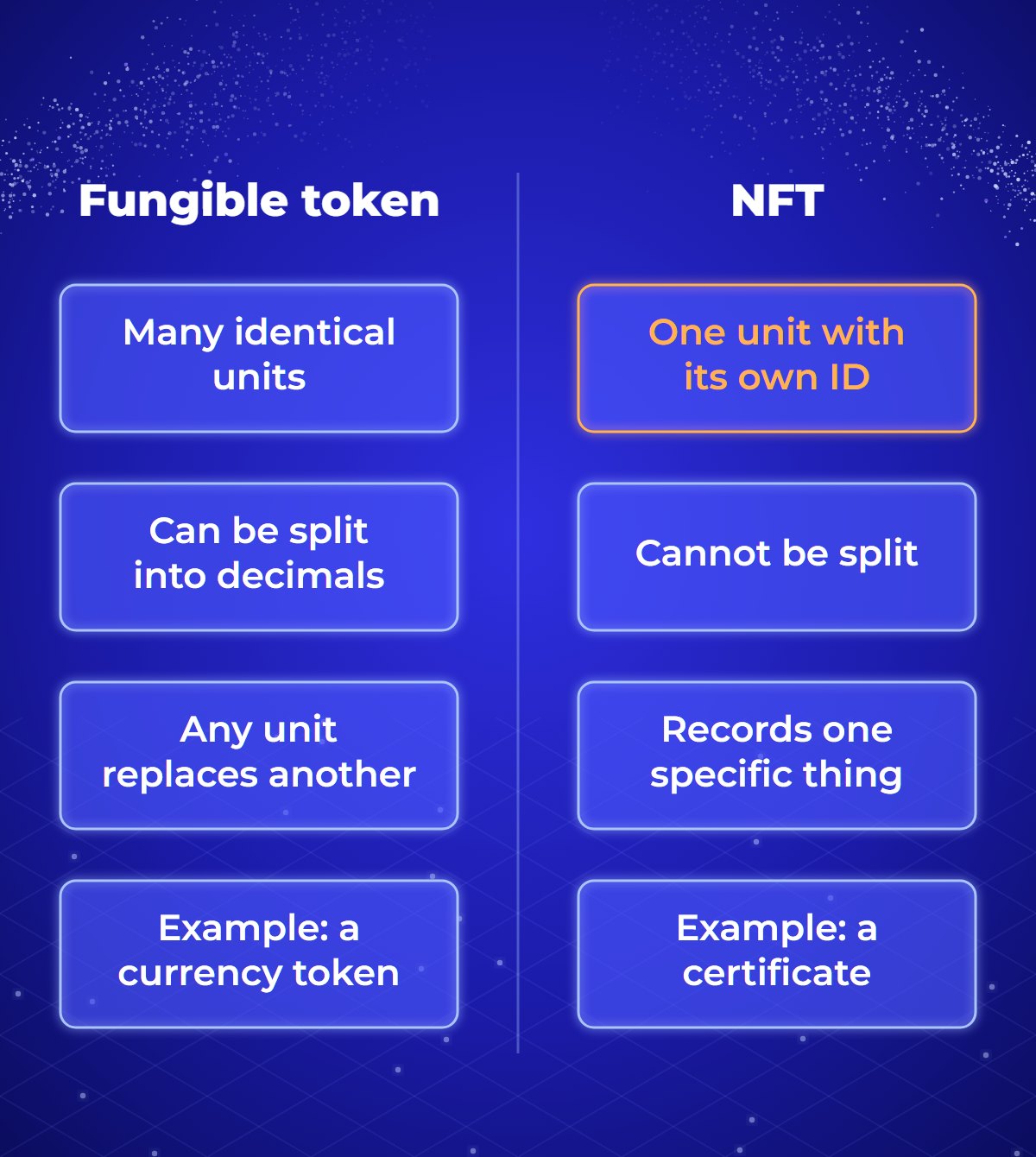
A fungible token is one of many identical units; an NFT is one unit with its own identity.
In England and Wales, the law now confirms that a token like this can be owned. Section 1 of the Property (Digital Assets etc) Act 2025, in force since 2 December 2025, provides that a digital thing is not prevented from being the object of personal property rights merely because it is neither a thing in possession nor a thing in action (Property (Digital Assets etc) Act 2025, s.1, checked 3 October 2026).
What is actually stored when you own an NFT?
An NFT has five parts, and only the first two are held on the blockchain in every case: the token record, its control accounts, a metadata file, the media, and the terms that say what the holder may do.
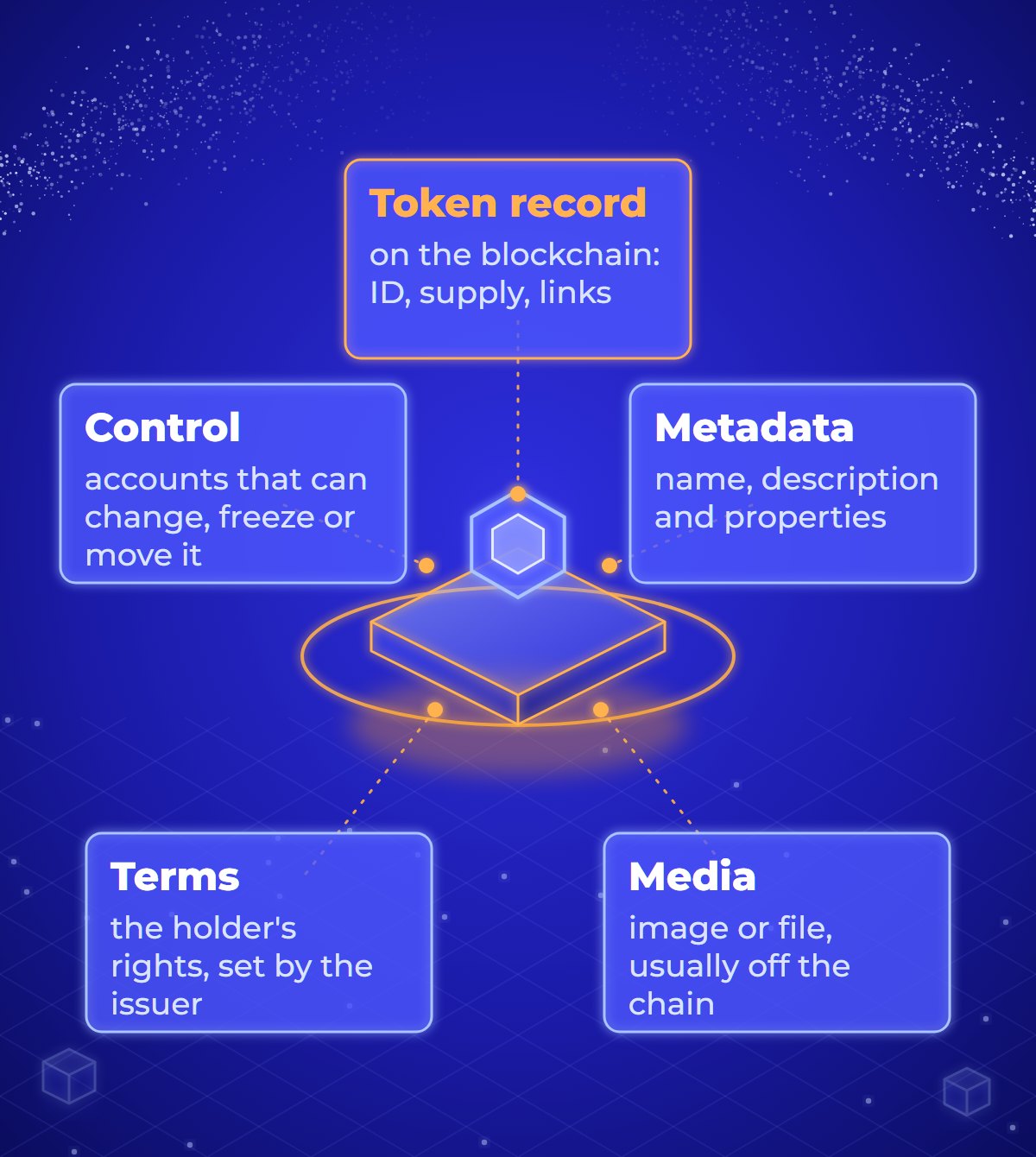
The five parts of an NFT. The token record and its control accounts are on the blockchain; the rest sits elsewhere.
The token record. This is the entry on the blockchain. On Algorand it holds the token's name, its total supply, the number of decimal places, a web address of up to 96 bytes and an optional 32-byte fingerprint of the metadata. These values are set when the token is created and cannot be changed afterwards.
The control accounts. The record can also name four control accounts: a manager, a reserve, a freeze account and a clawback account. The manager can change those accounts later, and clearing one removes that power for good (Algorand Standard Assets, checked 3 October 2026).
The metadata file. A short structured file with the token's name, a description, a link to the image and any properties, such as an edition number. Under ARC-3, the token's address points to this file and the fingerprint lets anyone confirm that the file is the one the token was created with.
The media. The image, video or document is usually too large to keep on the blockchain, so it sits on a storage network or a web server. IPFS is one such network, and the Trusty Access Key keeps its metadata there. On IPFS the address is calculated from the file's content: "any difference in the content will produce a different CID" (IPFS documentation, checked 3 October 2026). The address proves which file is meant. It says nothing about where the file is kept or whether anyone still keeps it.
The terms. The issuer sets out the holder's rights, such as a licence to display the image or access to a service, in a document or web page outside the blockchain.
You can see all five on a public page. The page for Trusty Access Key #001 shows the standard (ARC-3), the asset ID on Algorand MainNet, the metadata address on IPFS, the properties, and the control accounts read from the network, with a note that a manager can change these settings afterwards. Its rights are listed category by category on the same page.
On that token the manager, freeze and clawback roles all sit with the issuer's creator account. Trusty Digital keeps them so that it can deliver a token correctly, correct an error, help a holder who has lost access to a wallet, and act on a court order or a legal requirement. Each use is governed by the collection terms. The settings are public: anyone can read them on the item page or on a block explorer.
Why the picture is only one use of an NFT
The picture is often just the label. The same kind of token can work as a membership key, a certificate or the record of a physical object.
The Law Commission noted that an NFT project could give access rights or privileges only to the legal title holder of a particular NFT, and called this a valid structure for a project to adopt (Law Commission, Digital Assets: Final Report, 2023, para 6.112). That is how a token becomes a key: a service checks who holds it and acts on the answer.
Three examples from Trusty Digital's public pages show the range. The Trusty Access Key is a membership NFT on Algorand MainNet, with at most 80 to be issued and holder benefits provided under its own benefits terms. Gold Passport pairs one token with one identified gold bar, and when the bar arrives its serial number and photograph replace the artwork on the token. In a 2024 pilot listed on the Discovery page, a sports organisation issued each achievement certificate as a non-transferable NFT that anyone could verify without contacting the issuer.
EU law reflects the same range. The Markets in Crypto-Assets Regulation mentions digital art and collectibles, and also unique tokens that represent services or physical assets, "such as product guarantees or real estate" (Regulation (EU) 2023/1114, recital 10, checked 3 October 2026).
For more on these uses, see Tokenisation use cases beyond raising money and NFT utility explained.
What owning an NFT gives you, and what it leaves out
Owning an NFT means you hold the token. Rights in the image, the copyright or any object linked to it come only from the terms, or from a separate legal transfer.
The Law Commission concluded that digital files are not, in general, things to which personal property rights can relate (para 4.87 of the report). The token can be owned; the image file it points to usually cannot be owned in the same way. For things linked to a token, the Commission said that what passes on a transfer depends on the nature of the link, the applicable law and the intention of the parties (para 6.109).
In practice, the terms decide. On the Trusty Access Key page, ownership of the token is stated not to transfer copyright or other intellectual property, and the holder may display the media for personal, non-commercial purposes while holding it. On the Gold Passport page, ownership of the physical bar passes with the token. Two NFTs on the same blockchain, issued by the same company, carry different rights because their terms differ.
What you own when you buy an NFT covers copyright, licences and the 2025 Act in more detail.
How to check an NFT before you accept one
Check the token on the blockchain itself, using its ID, and compare what you find with what the seller or issuer tells you.
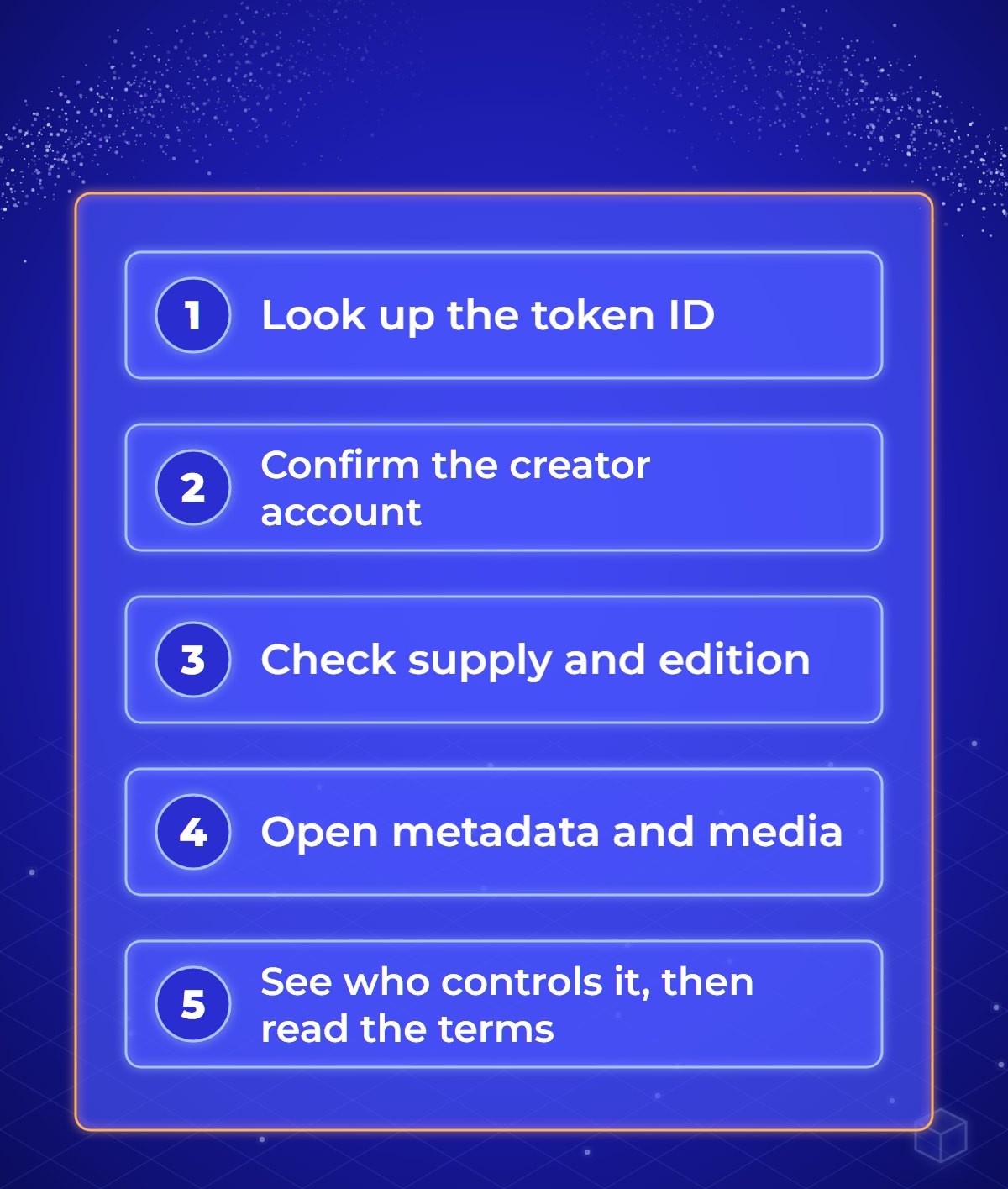
Five checks you can run with a block explorer and the issuer's terms.
1. Look up the token ID. Every NFT has one. On Algorand it is the asset ID, a number you can search on any block explorer.
2. Confirm the creator. Anyone can create a token with the same name and picture. The creator account is what identifies the issuer, so compare it with the address the issuer publishes on its own site.
3. Check the supply. A token described as one of one should have a total supply of one; a numbered edition should match its metadata.
4. Open the metadata and the media. An IPFS address is tied to the file's content; whoever runs an ordinary web server can swap the file behind its address.
5. See who keeps control, and read the terms. A manager can change the control accounts; a freeze account can stop the token moving; a clawback account can take it back from the holder. Each can have a good reason, such as recovery after an error. Know which are set before you accept the token.
An illustrative example. A design studio is offered an NFT described as "a one-of-one original with full commercial rights". The token's total supply is 10, so it is one of ten. The metadata sits on the seller's own web server, so the picture can be swapped. A clawback account belonging to the seller is still set. The terms on the seller's site allow personal display only. (The studio, the token and the figures are invented for illustration.)
Where NFTs go wrong
The weak points of an NFT are the parts that sit off the blockchain and the assumptions nobody checked.
The media disappears. IPFS nodes delete data they no longer need, and "data can be pinned" to keep it (IPFS documentation, checked 3 October 2026). If nobody pins the file, the token survives and the picture may not load.
Copies look identical. Anyone can copy an image or create a token with the same name. Only the creator account shows which collection is genuine.
Settings can change. If a manager account is still set, the token's control accounts can be changed after you buy it. The ARC-3 convention sets no requirements for these accounts, so each issuer decides.
Transfers are final. A transfer to a wrong address cannot be reversed by a marketplace. Trusty Digital's NFT pages state that a completed transfer cannot be reversed by Trusty.
The token may be regulated after all. The EU Markets in Crypto-Assets Regulation does not apply to crypto-assets that are unique and not fungible with other crypto-assets (Article 2(3)). Recital 11 adds that fractional parts of an NFT are not unique, and that issuing NFTs in a large series or collection is an indicator that they are fungible. In the UK, the classification depends on the rights the token gives. When is an NFT a cryptoasset? sets out where the UK and EU draw the line.
What does an NFT mean for a buyer?
For a buyer, an NFT is a token you can check for yourself, with rights that depend on its terms.
Questions people also ask
What does NFT stand for? Non-fungible token. "Non-fungible" means it cannot be exchanged like for like with another unit, because each token has its own identity.
Is an NFT just a picture? No. The picture is usually stored elsewhere and linked from the token's metadata. The token is the record on the blockchain, and it can stand for a membership, a certificate or a physical item as easily as an image.
Can an NFT be copied? The picture can be copied by anyone. The token itself exists once on the blockchain and moves only when its holder, or an account with clawback power, signs a transfer.
The short version
An NFT is a single token with its own identity on a blockchain. The token is the only part guaranteed to be on the chain; the metadata, the media and the terms sit elsewhere and decide most of what the holder actually gets. Before accepting one, look it up by its ID, confirm who created it, see who can still change or move it, and read the terms.
To see how collections state what ownership includes, browse Trusty NFT collections, where each collection lists its rights category by category.
This article is general information, not legal, tax or investment advice.




 10 min read