A decentralised autonomous organisation (DAO) is a group that takes decisions by votes recorded on a blockchain, usually weighted by tokens held. In England and Wales a DAO is not a legal person in itself. Without a legal wrapper, its members can be treated as partners and held personally liable, without limit, for what the group owes.
How a DAO takes decisions
A DAO takes decisions in four steps: a proposal, a vote, a count recorded on the blockchain, and execution of the result.
A member submits a proposal under published rules, usually only if they hold a minimum number of tokens. Voting runs for a fixed period, often several days, with each member's weight set by the tokens they hold or that others have delegated to them. The count is recorded on the blockchain, so anyone can check it and nobody can revise it, and every vote stays tied to a wallet address, which matters for the privacy of the people voting.
In fuller set-ups a passed proposal is carried out by a smart contract: a payment leaves the treasury or a parameter changes. In many DAOs, execution is done by named people who hold the keys to a shared wallet.
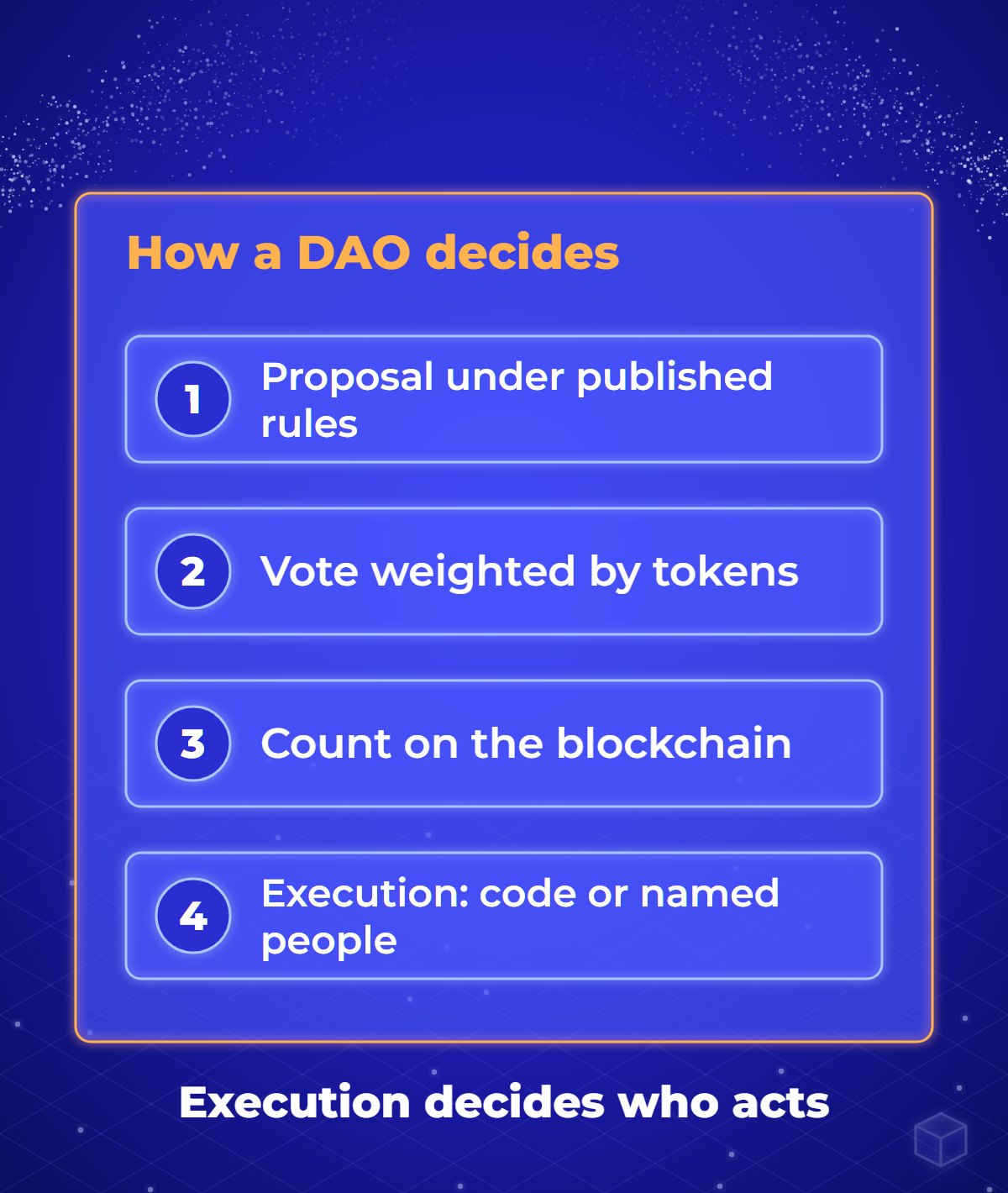
A DAO decision in four steps. Only the last one decides who actually acts.
The word "autonomous" refers to that last step. Where a vote only instructs people who then act, the organisation is coordinated on the blockchain but not autonomous, and the people who act are the obvious target if something goes wrong.
The strengths are a record of decisions nobody can edit, participation without meetings and a treasury anyone can check. The weaknesses are just as concrete. Turnout is usually low, so a small engaged group decides; voting weight follows holdings, without the protections company law gives minority shareholders; and a vote lasting days does not suit decisions that need making today.
What DAOs are used for: real examples
DAOs are used mostly to govern shared software and its treasury, and to run online communities, including learning communities.
Governing a protocol under written rules. The ENS DAO governs the Ethereum Name Service, a naming system for blockchain addresses, and its treasury. Its constitution limits what a vote may decide: names stay with their owners, and registration fees may serve only to stop the namespace being flooded and to fund the service. Amending the constitution needs a two-thirds majority with at least 1% of all tokens taking part (checked 3 October 2026). Members vote, but within rules a simple majority cannot change.
Running a learning community. Developer DAO describes itself as a community owned and governed by developers, organised around learning, building and governance (checked 3 October 2026). In a community like this, a vote can decide what a shared treasury pays for, such as a workshop or a mentoring programme. The teaching happens off the blockchain, by named people who sign whatever contracts the work needs.
Choosing a legal wrapper after years without one. Uniswap's governance voted to establish itself as "DUNI", a decentralised unincorporated nonprofit association under Wyoming law. The proposal was posted on 11 August 2025, gave limited liability protection for governance participants as one of its purposes, and was executed on-chain on 12 September 2025 (checked 3 October 2026).
To study DAOs rather than join one, the most thorough free source on UK law is the Law Commission's scoping paper: Chapter 3 covers liability, Chapter 4 the legal wrappers.
Is a DAO a legal person in the UK?
No: in England and Wales a DAO has no legal personality of its own, so the law looks through the code to the people and the arrangements behind it.
The Law Commission set out the position in "Decentralised autonomous organisations (DAOs): a scoping paper", published on 11 July 2024 (Law Commission, checked 3 October 2026). It describes a spectrum from a "pure" DAO that avoids legal forms altogether, through hybrid arrangements, to a "digital legal entity": an ordinary company that runs its governance on a blockchain.
For a pure DAO, the first candidate category is a general partnership. Under section 1 of the Partnership Act 1890, partnership is "the relation which subsists between persons carrying on a business in common with a view of profit". No registration or intention to form a partnership is needed; the relationship arises from what people do.
The Commission concluded that a pure DAO can meet that test, and that on-chain voting does not prevent it. It also found that many DAOs have features making it unlikely a court would find a partnership: governance spread across a pseudonymous and changing membership, the kind of activity a typical DAO carries on, and the way participants make any financial gain (paragraph 3.38). For some DAOs it considered an unincorporated association, a not-for-profit grouping of members, a better fit (paragraph 3.32). When the paper was published, no court in England and Wales had been asked to decide the point (paragraph 3.30).
The Commission did not recommend a bespoke DAO entity for England and Wales, because there is no agreement on what a DAO is (paragraph 1.23). It suggested further work on a limited liability, not-for-profit association with separate legal personality (paragraph 2.129).
Who is liable when a DAO has no wrapper?
If the members are partners, each of them can be pursued personally for what the group owes and for wrongs done in its business, with no cap at what they put in.
The Partnership Act 1890 makes every partner liable jointly with the others for the firm's debts and obligations (section 9), and jointly and severally for wrongs done in the ordinary course of its business (section 12). In practice, a creditor can claim the full amount from whichever partner it can find.
Membership of an unincorporated association is less exposed, but not safe. The Law Commission notes that members are not automatically liable for each other's wrongs; liability falls on those who acted, authorised the act or took responsibility for it (paragraphs 3.80 to 3.82). Its example is a sub-committee held personally liable when a football stand it was responsible for collapsed.
Either way, liability lands on identifiable people: those who signed a contract, hold treasury keys, deployed the code, or voted from a wallet linked to their name. Token holders who never vote are harder to reach, but no rule in England and Wales protects them.
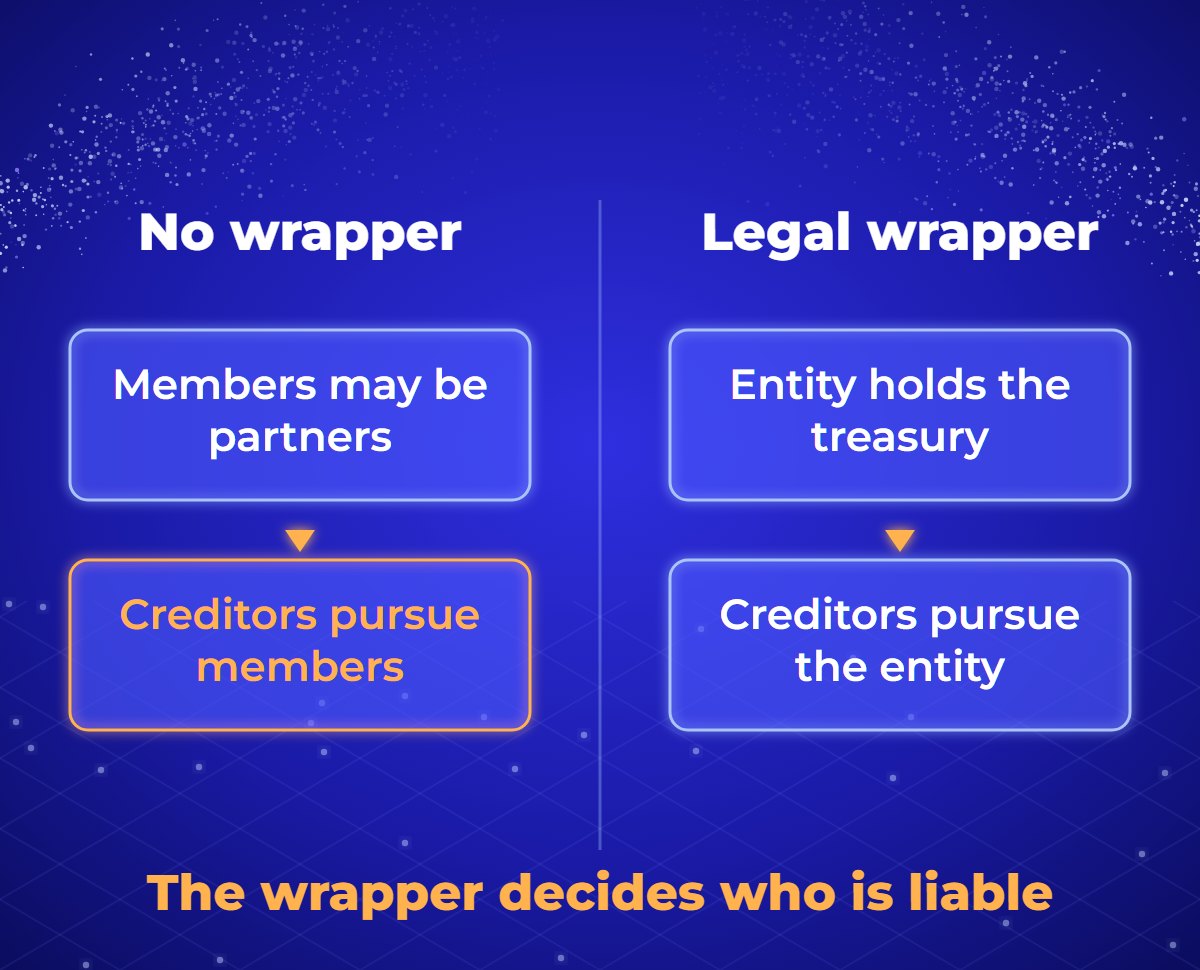
Without a wrapper, a claim can reach members. With one, it reaches the entity first.
In the United States, in a case brought by the Commodity Futures Trading Commission, a federal court's default judgment of 8 June 2023 held that Ooki DAO was a "person" that could be sued under the Commodity Exchange Act, ordered it to pay a civil penalty of $643,542, and ordered its website to be shut down (CFTC statement, checked 3 October 2026). The ruling applies US law, but shows that calling a DAO "only software" does not stop a regulator.
An illustrative example. Forty members of an unwrapped DAO vote to commission a course platform for £60,000. The developer delivers, the treasury does not hold enough to pay, and the invoice is unpaid. The developer claims against whoever contracted: the member who signed the order, the keyholders, and possibly every member who voted for it.
Legal wrappers: what they solve and what they leave
A legal wrapper is a recognised entity that holds the treasury, signs contracts and carries liability in its own name, while the on-chain vote decides what it does.
Four forms come up most often.
A UK company under the Companies Act 2006: limited by shares for a commercial venture, or limited by guarantee for a not-for-profit one. Members' votes can be built into the articles, and shares can be recorded digitally, with the company law conditions for each class still applying (see redeemable shares explained).
A Cayman Islands foundation company, which the Law Commission describes as "now one of the most used structures for DAO projects" (paragraph 4.140).
A Wyoming DAO LLC, a limited liability company under the Wyoming Decentralized Autonomous Organization Supplement (W.S. 17-31-101 onwards, checked 3 October 2026). Its name must include "DAO", "LAO" or "DAO LLC", its articles must give a public identifier for the smart contracts it uses, and they may define, reduce or eliminate members' fiduciary duties.
A Wyoming DUNA, a decentralised unincorporated nonprofit association (W.S. 17-32, same source). It needs at least 100 members joined for a common nonprofit purpose, is a legal entity separate from its members, and a member is not liable for its contracts or wrongs "merely because the person is a member" (W.S. 17-32-107). This is the form Uniswap's governance adopted in 2025.
A wrapper has limits. It does not protect a member from liability for their own acts, and someone who signs, controls keys or acts as an administrator still carries duties. A foreign entity does not change what UK regulation requires when tokens are offered here. It also brings some centralisation: someone files accounts and answers to the tax authority. Which form fits is a question for a corporate solicitor and a tax adviser in each jurisdiction involved.
When does a governance token become a regulated instrument?
A governance token becomes a regulated instrument when what it entitles the holder to, or how the DAO uses the money it raises, matches a category that financial regulation already covers; voting rights alone rarely do.
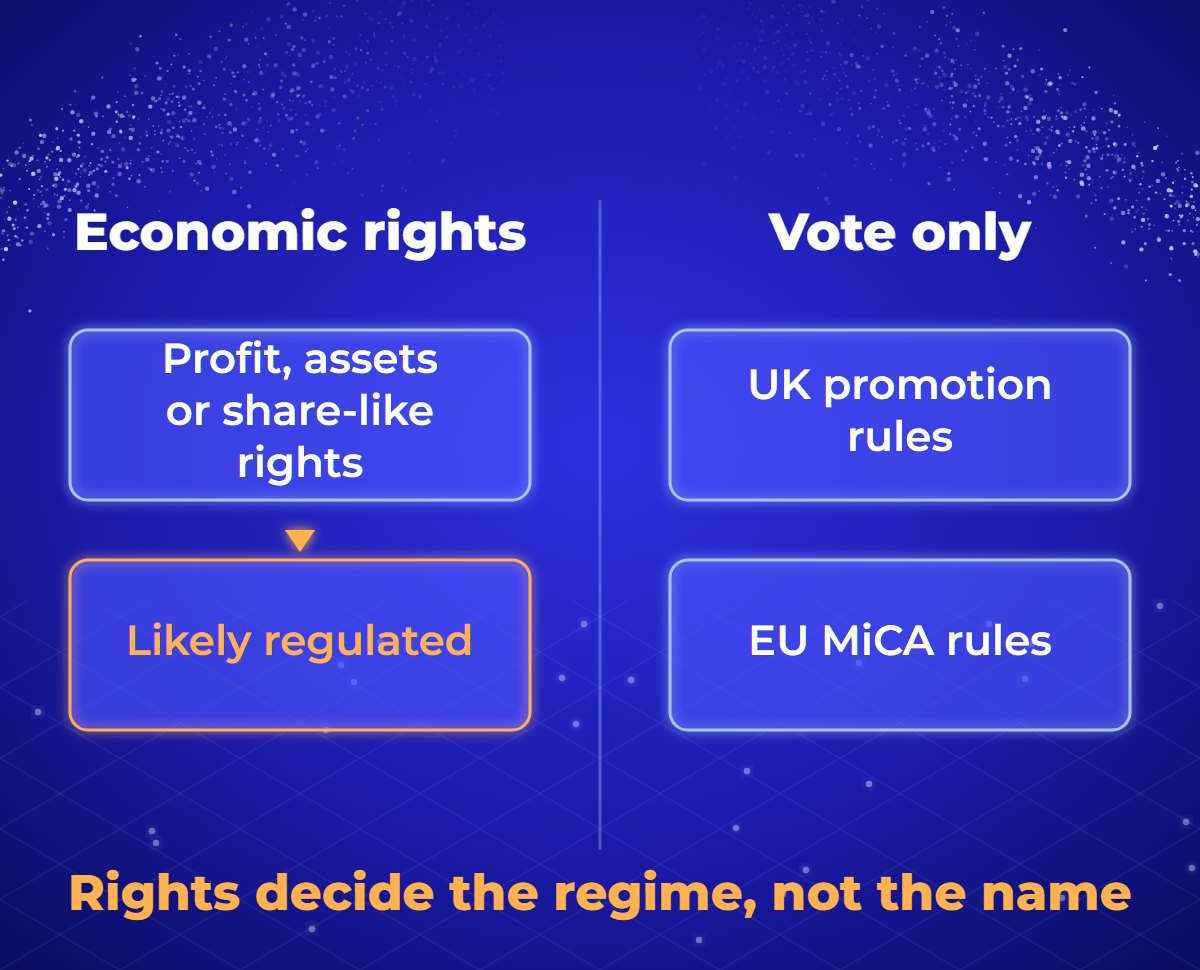
What the token confers decides the route. Voting alone does not take it outside the rules.
Profit, assets or share-like rights. In the UK, a token that represents a share in a company is a share for the purposes of article 76 of the Regulated Activities Order 2001. Where the DAO pools members' money to produce profits or income, and members do not have day-to-day control of the property, the arrangement can be a collective investment scheme under section 235 of the Financial Services and Markets Act 2000. Whether token-weighted voting counts as day-to-day control turns on the facts, including for a DAO that buys property together (see real estate tokenisation explained).
Vote only, in the UK. A token that is fungible and transferable is a "qualifying cryptoasset" under paragraph 26F of Schedule 1 to the Financial Promotion Order 2005. Since October 2023, promoting one to people in the UK is subject to the financial promotion rules, even when the token carries no economic right.
Vote only, in the EU. Regulation (EU) 2023/1114 on markets in crypto-assets (MiCA) does not apply to crypto-assets that qualify as financial instruments (Article 2(4)); those stay under the EU's financial instruments rules. For other tokens, a person offering them to the public in the EU must be a legal person and must publish a white paper (Article 4(1)), which an unwrapped DAO cannot do in its own name. The white paper duty falls away for offers to fewer than 150 persons per Member State or of no more than €1,000,000 over 12 months (Article 4(2)). Recital 22 adds that services provided "in a fully decentralised manner without any intermediary" fall outside MiCA, a test few DAOs with a founding team meet (checked 3 October 2026).
Marketing matters too. Describing a governance token as likely to rise in value, or as a way to share in a venture's success, is an economic claim whatever the token's terms say, and the claim is what a regulator reads first. Trusty Digital does not advise on token classification; the analysis belongs to a financial services lawyer in each jurisdiction where the token will be offered.
When a DAO is the right structure
A DAO fits a distributed group whose decisions are infrequent, can be specified in advance and are worth recording publicly, and whose members accept majority outcomes.
It fits less well where decisions must be quick, minority members need protection, or someone must clearly answer when things go wrong. For most tokenised asset programmes, a conventional entity with a defined decision process is the better base, with on-chain voting added where holders genuinely have decisions to make.
Questions people also ask
Can a DAO own property or open a bank account in the UK? Not in its own name, because it is not a legal person. Property has to be held by a person or an entity on its behalf, a main practical reason DAOs adopt a wrapper.
Am I liable if I hold a governance token but never vote? Less exposed than an active member, but not protected by any rule in England and Wales. If the DAO were found to be a partnership, the question would be whether you were carrying on its business in common with others, which depends on what you did and received.
Does a wrapper settle whether the token is regulated? No. The wrapper decides who is liable; the token's rights and the way it is offered decide how it is regulated.
The short version
A DAO is a reliable way to record and execute collective decisions, and some, such as the ENS DAO, add written rules that limit what a vote may do. It is not a legal person in England and Wales, and without a wrapper its active members can carry liability they never expected. A wrapper limits that exposure but does not decide how the token is regulated, which turns on what the token confers and how it is marketed. Settle the wrapper and the token's rights with a solicitor before the treasury holds anything of value.
To see how the legal structure and the token fit together in a wider project, read What is asset tokenisation?.
This article is general information, not legal, tax or investment advice.



 10 min read