An asset is suitable for tokenisation when you can prove the right the token will record and a token does something your current records cannot. You also need to know who will hold it and where, and someone with authority and a budget must own the project. The asset's type, size or value matters far less.
What makes an asset suitable for tokenisation?
Suitability depends on rights and people. A house, a share, a gold bar or an invoice can each pass the four tests, and each can fail them.
Technically, almost anything can be recorded as a token on a blockchain. The hard part is that the person holding the token must end up with a right they can enforce, offered to them in a way the law allows. That is what the four tests check.
The law of England and Wales now treats the token itself as property. Section 1 of the Property (Digital Assets etc) Act 2025, in force since 2 December 2025, provides that a thing that is digital or electronic is not prevented from being the object of personal property rights merely because it is neither a thing in possession nor a thing in action (Property (Digital Assets etc) Act 2025, s.1, checked 3 October 2026). The Act settles that the token itself can be owned. Whether the token gives its holder a right to the asset behind it depends on the documents the issuer puts in place.
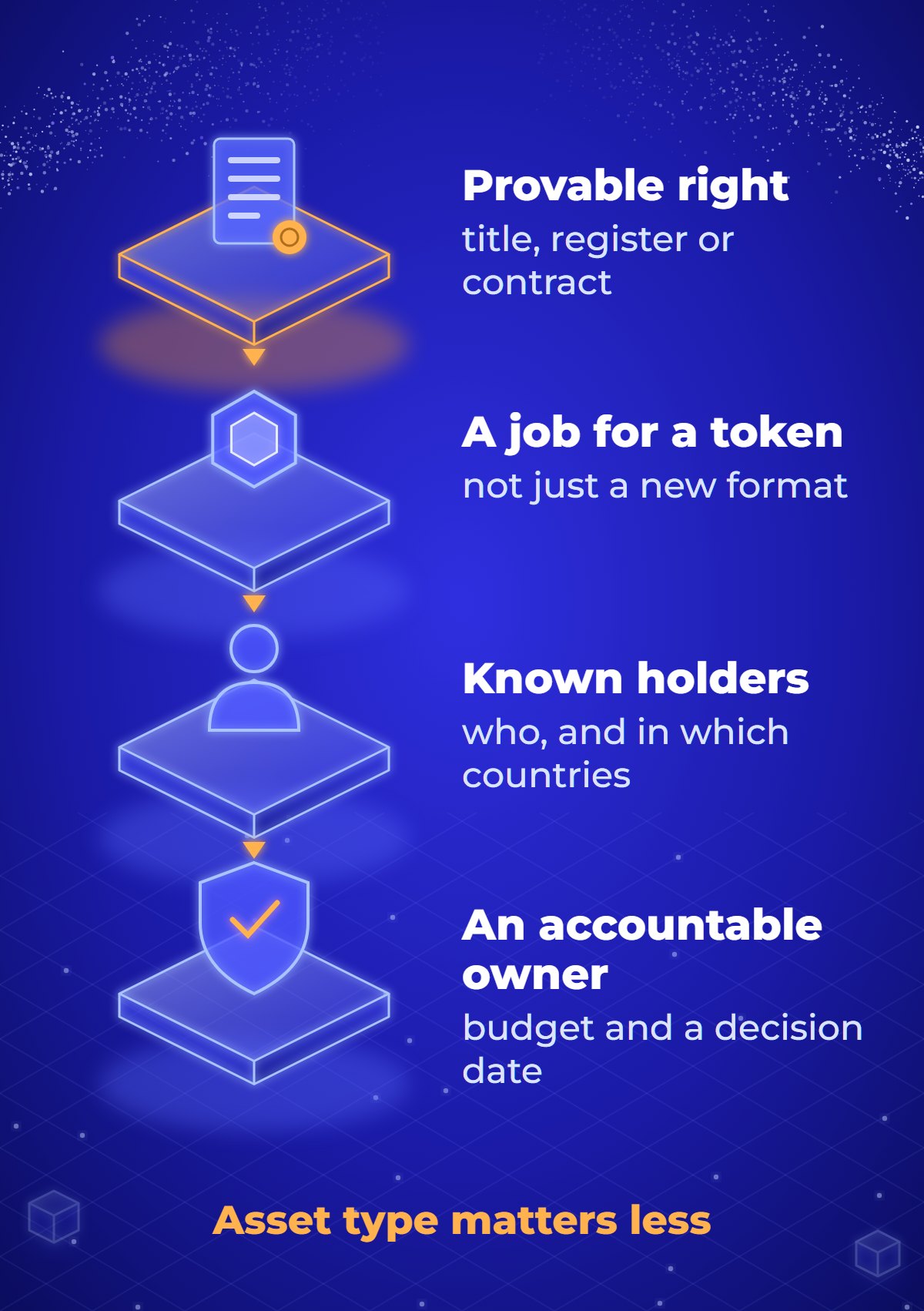
The four tests, in the order to check them.
The first test carries the most weight. In the Trusty Digital Fit Check, a free screening questionnaire, the single question with the most weight asks whether the owner can document ownership or control of the asset.
Test 1: can you prove the right the token will record?
A token records a right that already exists somewhere else. The first test is whether you can show that right in a document, such as a title register, a register of members, a signed contract, an intellectual property registration or fund documents.
Land. In England and Wales, a transfer of registered land "does not operate at law until the relevant registration requirements are met" (Land Registration Act 2002, s.27(1)). Moving a token therefore never moves legal title to a building. Property projects usually hold the land in a company and tokenise the shares or a contractual interest, as Real estate tokenisation explained sets out.
Shares. The company's register of members stays the legal record, and the token has to be kept in step with it. Redeemable shares explained shows how that works when shares are cancelled.
Anything that limits the right. A mortgage or charge, a lender's consent requirement, pre-emption rights in the articles, a co-owner without a written agreement, or a dispute. None of these automatically ends a project, but each has to be known before anyone designs a structure around it.
An illustrative example. A family company owns a warehouse, with a bank loan secured on it. Title is registered in the company's name and the shareholders are in the register, so the right looks easy to prove. The loan agreement is where the work starts: if it needs the bank's consent before shares change hands, every token transfer would need that consent too. Read the facility agreement before anyone designs the token.
Test 2: does a token do something your current records cannot?
A token is worth its cost when it does a specific job better than a spreadsheet and a share certificate. Typical jobs are administering many small holdings, settling transfers at any hour, enforcing rules that must stay with the asset, and keeping one record that several parties trust.
Two common reasons do not hold up. "To raise money faster" changes nothing about the rules for raising money. "To make it liquid" mixes up transfer and demand. A token makes a transfer possible. It does not find a buyer. If the real aim is to reach new holders, the question is how to offer the asset lawfully, which the third test covers.
The regulators take the same view. In a feedback statement of 14 September 2026, the FCA and the Bank of England wrote that they "approach tokenisation under the principle of 'same risk, same regulatory outcome'", and that "some financial markets and products are more suitable to tokenisation than others" (FCA and Bank of England, FS26/1, checked 3 October 2026). In practice, a share held as a token is still regulated as a share.
Where the asset needs rules about who may hold it or when it may move, the blockchain's own controls can enforce them. Why Trusty Digital uses Algorand describes those controls; Do you need a smart contract? covers when they are not enough.
Test 3: who will hold the token, and where are they?
The group of holders decides most of the rules: offering a token to existing shareholders or staff is a different exercise from offering it to the public, and each country involved adds its own review.
Promotion in the UK. Under section 21 of the Financial Services and Markets Act 2000, a business may not communicate an invitation or inducement to engage in investment activity unless it is authorised or an authorised firm approves the communication. That applies from the first public statement about the token.
Pooled money. Where holders' money is pooled to produce a return and they do not have day-to-day control of the asset, the arrangement can be a collective investment scheme under section 235 of the same Act, which brings its own restrictions.
Holders in the EU. The EU's Markets in Crypto-Assets Regulation does not apply to tokens that qualify as financial instruments, which stay under the EU's securities rules; for other tokens offered to the public it requires a published white paper (Regulation (EU) 2023/1114, Articles 2(4) and 4). DAO legal status and member liability walks through the same tests for governance tokens.
What is coming in the UK. The FCA's regime for cryptoasset activities expands to its full scope from 25 October 2027 (FCA, cryptoasset regime policy statements, checked 3 October 2026). A project launching after that date should check which parts apply to its token and to the firms it works with.
A small, closed group is the easiest place to start. A defined list of holders, in one or two countries, keeps the legal work proportionate and makes every later decision simpler.
Test 4: is someone accountable, with a budget and a date?
A tokenisation project needs one person with authority to take decisions, a budget for legal, compliance and technical work, and a date by which the owner will decide to go ahead, change course or stop.
Most of the cost of tokenisation sits in deciding what the holder receives, documenting it, checking who the holders are, and keeping the token record and the legal record in step after launch. The network itself is cheap: on Algorand the minimum fee per transaction is 0.001 ALGO, as the Algorand overview explains, so most of the running cost is people and professional advice.
In projects without an owner, advisers wait for instructions, documents go out of date and the asset's circumstances change underneath the plan. A named sponsor and a decision within the next twelve months turn a general interest in tokenisation into a project that can be assessed.
Which assets usually pass, and which are not ready yet
Assets with a documented owner and a defined group of holders usually pass. Assets with unclear ownership, unrecorded rights or undisclosed restrictions usually fail the first test, whatever their value.
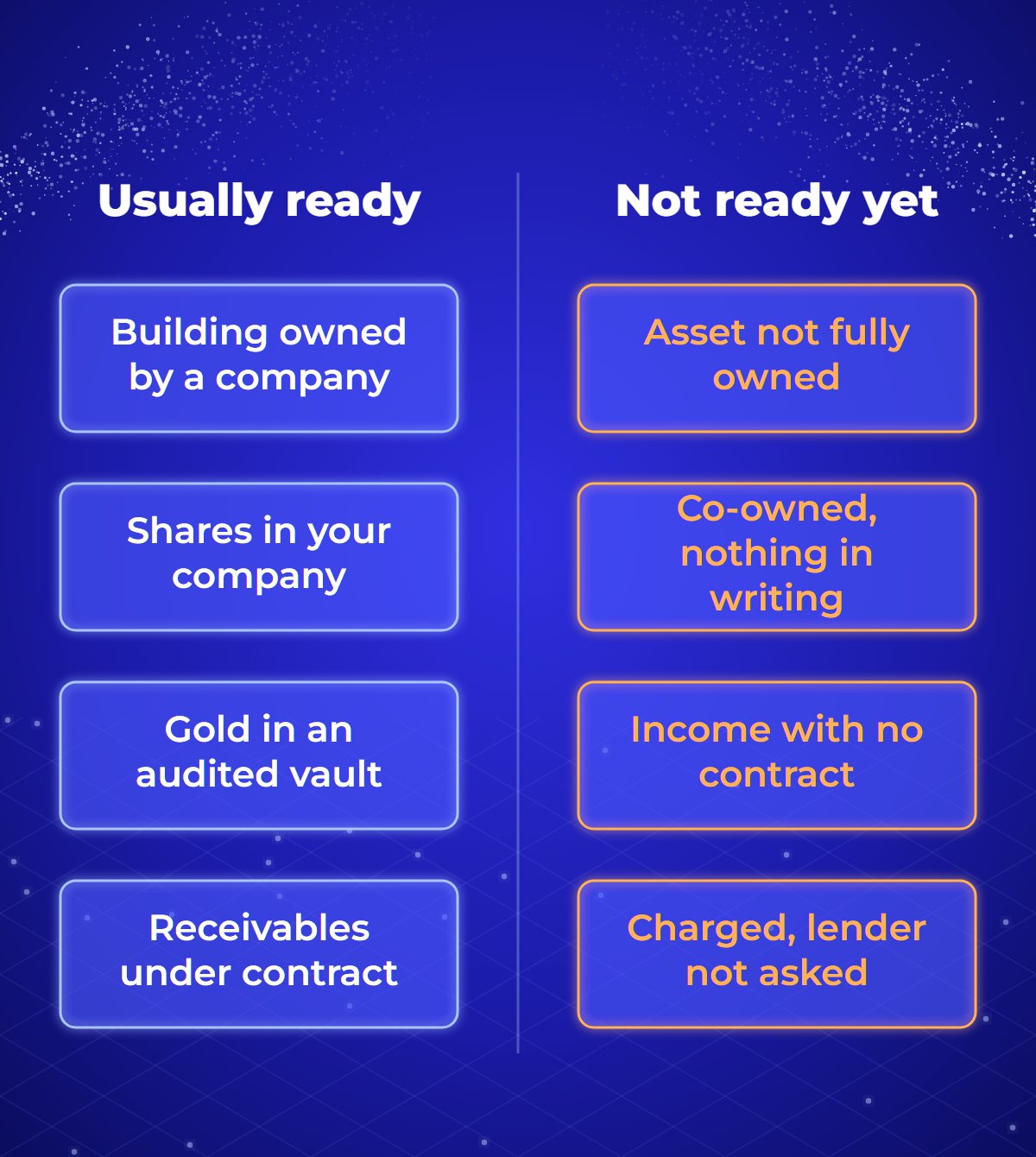
Examples of assets that usually pass and assets that need work first.
Usually ready. A building owned by a company, where the token records shares in that company. Shares in your own company, recorded in its register. Gold held in a vault that publishes bar lists and is audited, where the evidence links each token to metal. Receivables under signed contracts with identified payers.
Not ready yet. An asset you lease or only partly own. A property co-owned by relatives with nothing in writing. Future income with no contract behind it, such as hoped-for royalties. An asset under a charge where the lender has not been asked.
Most of these problems can be fixed. Co-owners can sign an agreement, a lender can be asked for consent, and future income can be put under contract. Fix them before paying for legal structure and technology.
What to settle before you spend money
Before committing a budget, write down the answers to six questions, in this order, and get each one confirmed by the person who would sign for it.
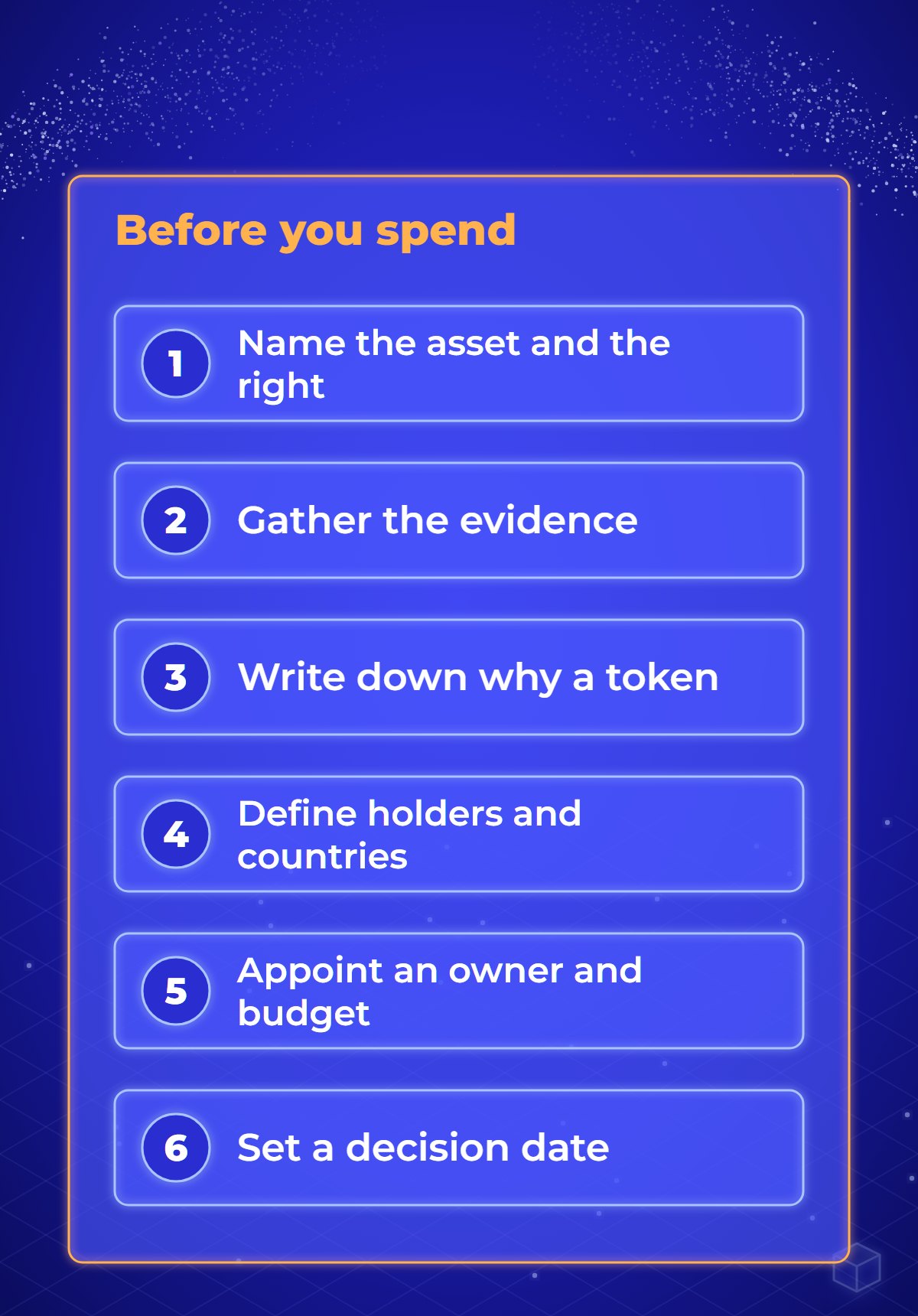
Six questions to answer before committing a budget.
If any answer is "not sure", that is the next piece of work, and it usually costs far less than the tokenisation itself.
Questions people also ask
Can any asset be tokenised? Technically, yes: any record can be written to a blockchain. Legally, only where the holder ends up with an enforceable right and the token is offered in a way the law allows.
Is there a minimum asset value for tokenisation? There is no legal minimum. The fixed cost of legal structuring, compliance and administration sets a practical floor, and that floor depends on the asset, the holders and the countries involved.
Does tokenising an asset change how it is regulated? No. The FCA and the Bank of England apply the principle of same risk, same regulatory outcome: a token that is a share is regulated as a share.
The short version
An asset is suitable for tokenisation when its owner can prove the right the token will record, the token does a job existing records cannot, the holders and their countries are known, and someone accountable has a budget and a deadline. Fix any problem with the first test before money is spent on technology.
To check your own asset against these four areas, the free Tokenisation Fit Check asks sixteen questions and takes about five minutes, with no account needed. For the wider picture, read What is asset tokenisation?.
This article is general information, not legal, tax or investment advice.



 10 min read