A gold-backed NFT can stand for one specific bar of gold. In Trusty Digital's Gold Passport collection, each token records one identified bar of 999.9 fine gold from The Royal Mint or PAMP, kept in a dedicated safe at a secure location in the United Kingdom. The holder can ask for delivery, and the token pays no income.
What is a gold-backed NFT?
A gold-backed NFT is a unique token on a blockchain that records one particular gold item, so the token and the item can be matched one to one.
A pooled gold token works differently. It is fungible: every unit is the same as every other, like pounds in a bank account, and each unit stands for a fixed weight of gold drawn from a larger stock of bars. Depending on its terms, the holder may have a share in bars held with others or a claim on the issuer for an amount of gold. Tokenised gold explained covers those structures in detail.
An NFT, short for non-fungible token, is the opposite. Each token is unique, so it can point to one thing with its own identity: a certificate, a membership, or a single bar with its own serial number. What is an NFT? explains what such a token stores.
The Gold Passport collection page describes the model plainly: it "pairs one physical bar of 999.9 fine gold with one token" (checked 3 October 2026). The rest of this article describes how that works, using only what the collection and item pages state. The same model appears among the examples in Tokenisation use cases beyond raising money.
How Gold Passport works, from order to delivery
Each token is linked to a bar bought when the token is ordered; the bar's own details replace the artwork once it arrives, and the holder can ask for the bar to be delivered at any time.
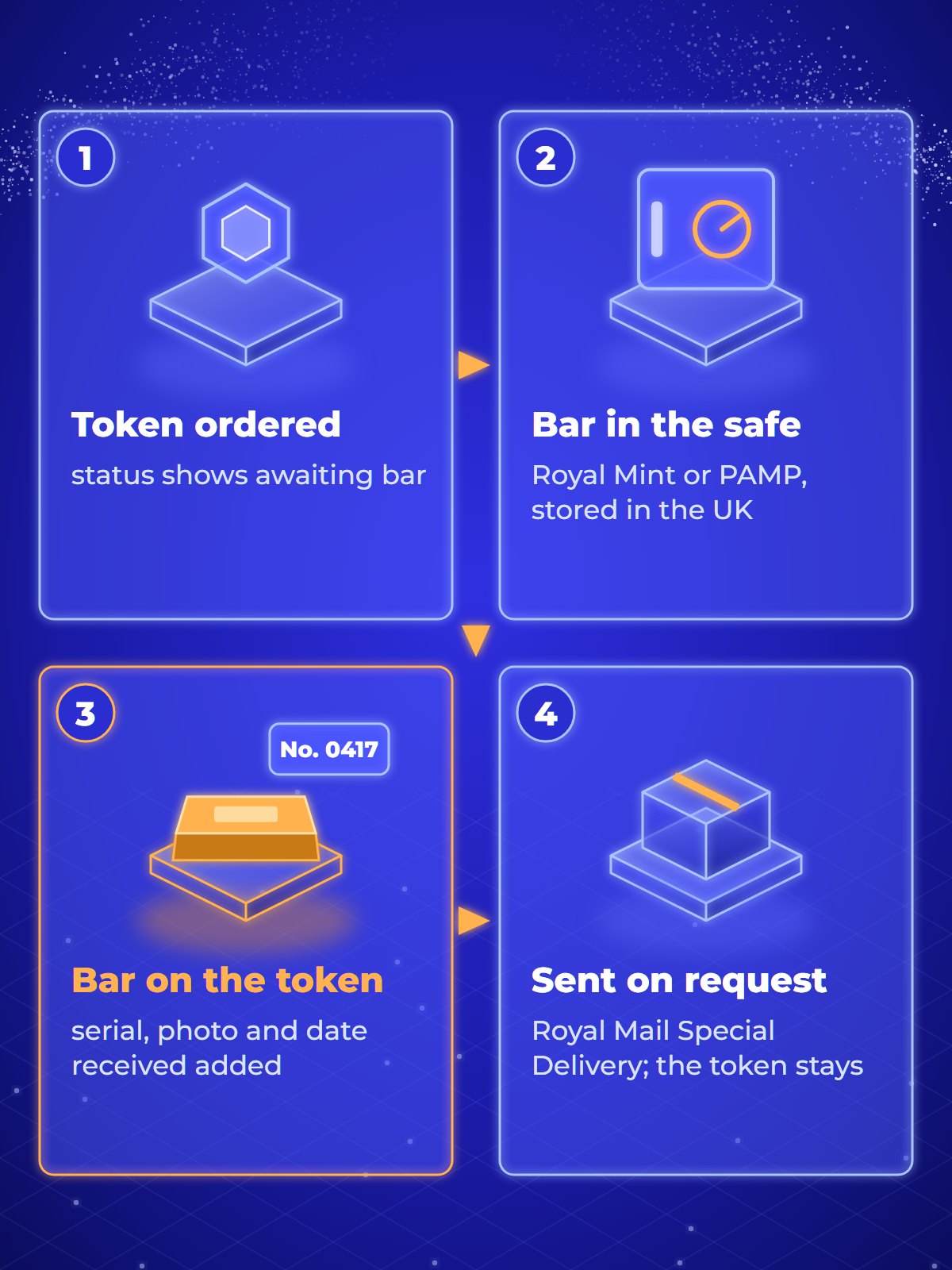
The life of one Gold Passport token, as the collection pages describe it.
The collection and item pages set out the sequence:
- Order. Each token stands for a single bar, bought when the token is ordered. Until the bar arrives, the item page shows the status "Awaiting bar".
- Storage. The bar is kept in the collection's dedicated safe, at a secure location in the United Kingdom.
- Identification. When the bar arrives, its serial number, a photograph of that bar and the date it was received are added to the token, replacing the artwork.
- Delivery. The holder can ask for the bar at any time. It is sent by Royal Mail Special Delivery, and the token records that the bar is in the holder's hands.
The first collection is open to holders of Trusty keys, such as the Access Key, the Creator Gate Pass and the Oracle Vault, and the collection page states that every key brings free storage. Bars listed on 3 October 2026 weigh 2.5, 5 or 10 grams.
What the token records about the bar
Each Gold Passport item page lists the physical facts of the bar and the token's settings on the blockchain, so a holder can check both in one place.
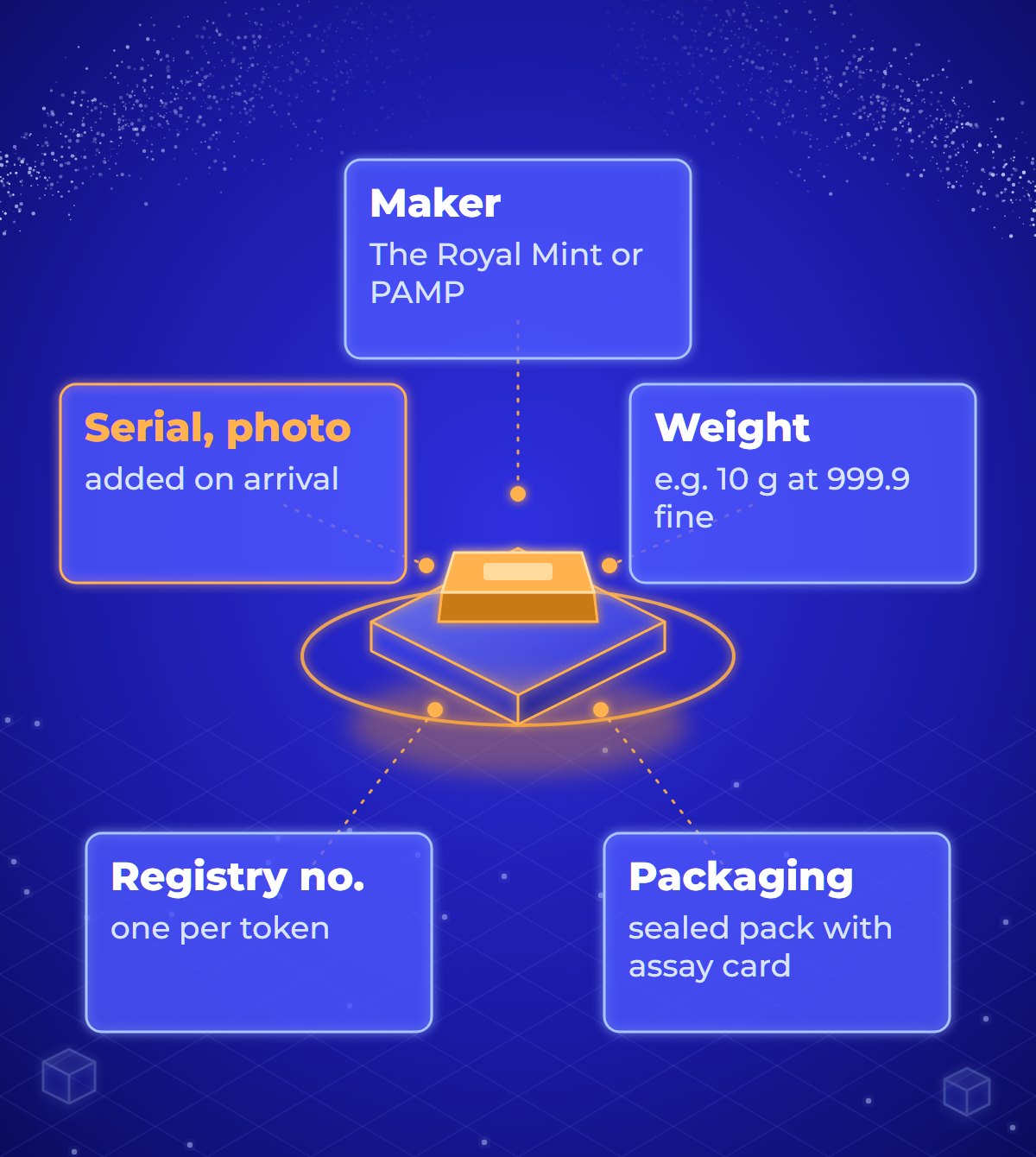
What a Gold Passport item page records about its bar.
For a 10 gram Royal Mint bar, for example, the page lists the dimensions, a fineness of 999.9, the form (a minted bar), the packaging (an original tamper-evident pack with assay card), a registry number, the storage location and the current status. A 2.5 gram PAMP bar comes in an original sealed CertiCard.
The artwork can change after issue because the tokens use ARC-19, an Algorand convention for metadata that needs to be updated. Under ARC-19, what an asset "points to" for its metadata can be changed with a single configuration transaction (ARC-19, checked 3 October 2026). That is how a photograph of the actual bar can replace the original image without issuing a new token.
The item page also shows the token's control settings, read from Algorand MainNet. In the version checked, the creator account held the manager, freeze and clawback roles. Under the Algorand rules, the manager can reconfigure the asset, the freeze account can stop a holding from moving, and the clawback account can move the asset between accounts that have opted in (Algorand developer documentation).
On a token that stands for a physical bar, these roles have practical uses. They can let the issuer deliver a token to the right account, correct an error, help a holder who has lost access to their wallet, and act on a court order or a legal requirement. Each use is governed by the collection terms. The settings are public on every item page and on any blockchain explorer, and the item page itself advises checking an explorer for the current configuration.
One bar per token compared with a pooled gold token
With one bar per token, the holder's interest is in a specific, identified bar; with a pooled token, the holder has a share of a larger stock of gold, or a claim on the issuer.
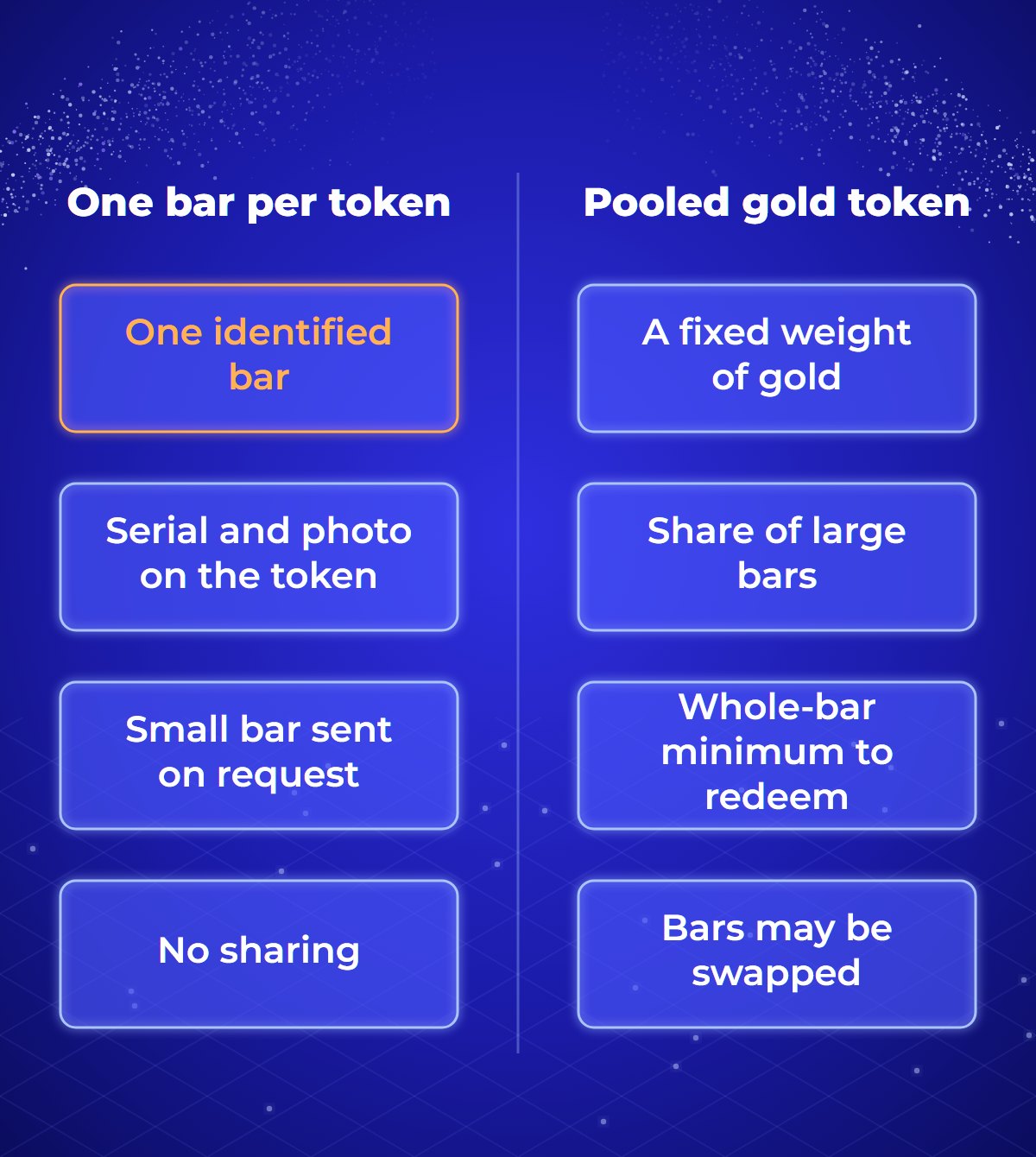
Two ways to link tokens to gold.
The London Bullion Market Association describes the same split for ordinary bullion accounts. An allocated holding is backed by specific bars, each with its own number, weight and fineness. An unallocated holding is a contractual claim on the institution, which brings credit exposure (LBMA, Precious Metal Accounts, checked 3 October 2026).
The difference also matters under UK financial regulation. In its September 2026 call for input on tokenised gold, the Financial Conduct Authority says that products which directly represent ownership of an allocated bar are "more likely to fall outside" the definitions of a collective investment scheme and an alternative investment fund, because each holder has a direct interest with no pooling. Fractions of a single bar that is managed or sold collectively point the other way (FCA call for input, paragraphs 5.11 and 5.12). These are the FCA's views in a call for input, and the classification of any product depends on its full terms.
Delivery is the practical difference a holder notices. A London Good Delivery gold bar weighs between 350 and 430 troy ounces (LBMA), and the London market's template allocated account agreement releases metal in bars that meet those rules unless another form is agreed (LPMCL template Allocated Precious Metals Accounts Agreement, clause 4.1, checked 3 October 2026). Pooled tokens backed by such bars may therefore allow physical delivery only in whole bars. The same template can let the provider swap a client's bars for others of like quality (clause 4.5), so the bars behind a pooled holding may change over time. A token for one small bar can be redeemed for that bar.
What the holder owns, and what they do not
The holder owns the token and, through it, the bar it records, with a licence to display the artwork; the token carries no financial rights.
The rights section of the collection page lists each category separately:
- Ownership. Included. The holder owns the token and, through it, the physical bar the token records. Ownership of the bar passes with the token, and the bar is delivered on request under the collection rules.
- Licence to the media. Included. Trusty Digital owns the artwork; the holder may display it, and later photographs of the bar, for personal, non-commercial purposes.
- Commercial use. Not included.
- Participation and governance. Not included: no voting right.
- Financial rights. Not included. There is no revenue share or dividend, and the token pays no income.
The page adds that the NFT is not a security, a share or a claim on Trusty Digital, that rights are enforced by the issuer, and that a completed transfer on the blockchain cannot be reversed by Trusty. The collection describes itself as a physical item and not an investment.
In England and Wales, the token itself can be property. Section 1 of the Property (Digital Assets etc) Act 2025, in force since 2 December 2025, provides that a thing that is digital or electronic is not prevented from being the object of personal property rights merely because it is neither a thing in possession nor a thing in action (Property (Digital Assets etc) Act 2025, s.1, checked 3 October 2026). What the token says about the bar comes from the collection terms. What you own when you buy an NFT explains the difference between owning a token and owning the rights it describes.
What to check before relying on a gold-backed NFT
Before relying on any token that claims to stand for a gold item, check that the item is identified, that the terms say who owns it, and how you can get it out.
These checks apply to any gold-backed NFT, including Gold Passport:
- Identification. Look for a serial number and a photograph of the actual item, and the date they were added. A status such as "Awaiting bar" means the bar has not yet been recorded.
- Ownership wording. Check whether the terms say you own the item itself or only the token.
- Storage. Find out where the item is kept and on what terms.
- Delivery. Read how to ask for it, how it is sent and whether there is a minimum.
- Control settings. See which accounts hold the manager, freeze and clawback roles, and what the terms say about their use.
- Enforcement. Note who enforces the rights: the issuer named on the page, a platform, or both.
An illustrative example. Anna holds a token for a 5 gram bar. For the first days the item page shows "Awaiting bar". When the bar arrives, the page adds its serial number, say AB 123456, a photograph and the date received, and the token's image changes to that photograph. Two years later Anna asks for delivery. The bar arrives by Royal Mail Special Delivery in its original pack, she checks the serial number against the token, and the token now records that the bar is in her hands. The name and serial number are invented for illustration.
Gold-backed NFTs in short
A gold-backed NFT ties one token to one identified item, which is easier to check than a share of a pool and comes with its own limits.
Questions people also ask
Is a gold-backed NFT the same as owning gold? It depends on the terms. On the Gold Passport pages, the holder owns the token and, through it, the bar it records, and can ask for the bar to be delivered.
Can I get the physical gold bar? For Gold Passport, yes: the holder can request delivery at any time, and the bar is sent by Royal Mail Special Delivery. Other gold tokens may set high minimums for physical delivery.
Does a gold NFT pay anything? Gold Passport does not. The collection page states that the token pays no income and grants no revenue share or dividend.
The short version
Gold Passport links one NFT to one identified bar of 999.9 fine gold from The Royal Mint or PAMP, kept in a dedicated safe at a secure location in the United Kingdom, with the bar's serial number and photograph on the token. The holder can ask for the bar at any time. That makes the link between token and gold visible bar by bar. As with any token, the item page, the rights wording and the control settings are what to read first.
To read the rights stated for each Trusty collection, visit NFT collections.
This article is general information, not legal, tax or investment advice.





 10 min read