Tokenised gold is a token on a blockchain that records a holder's interest in physical gold kept in a vault. What you own depends on the issuer's terms: title to specific bars, a share of pooled bars, or a claim against the issuer. The vault, the bar list, redemption rules and independent checks show what stands behind it.
What is tokenised gold?
Tokenised gold is physical gold in a vault whose ownership, or a claim to it, is recorded as tokens on a blockchain, so that it can change hands by a transfer between accounts instead of by moving metal.
The basic idea is the one behind all asset tokenisation. An issuer buys gold, places it with a vault and issues tokens that refer to it. The blockchain records who holds each token. The legal terms say what holding a token means, and the vault's records show which bars exist.
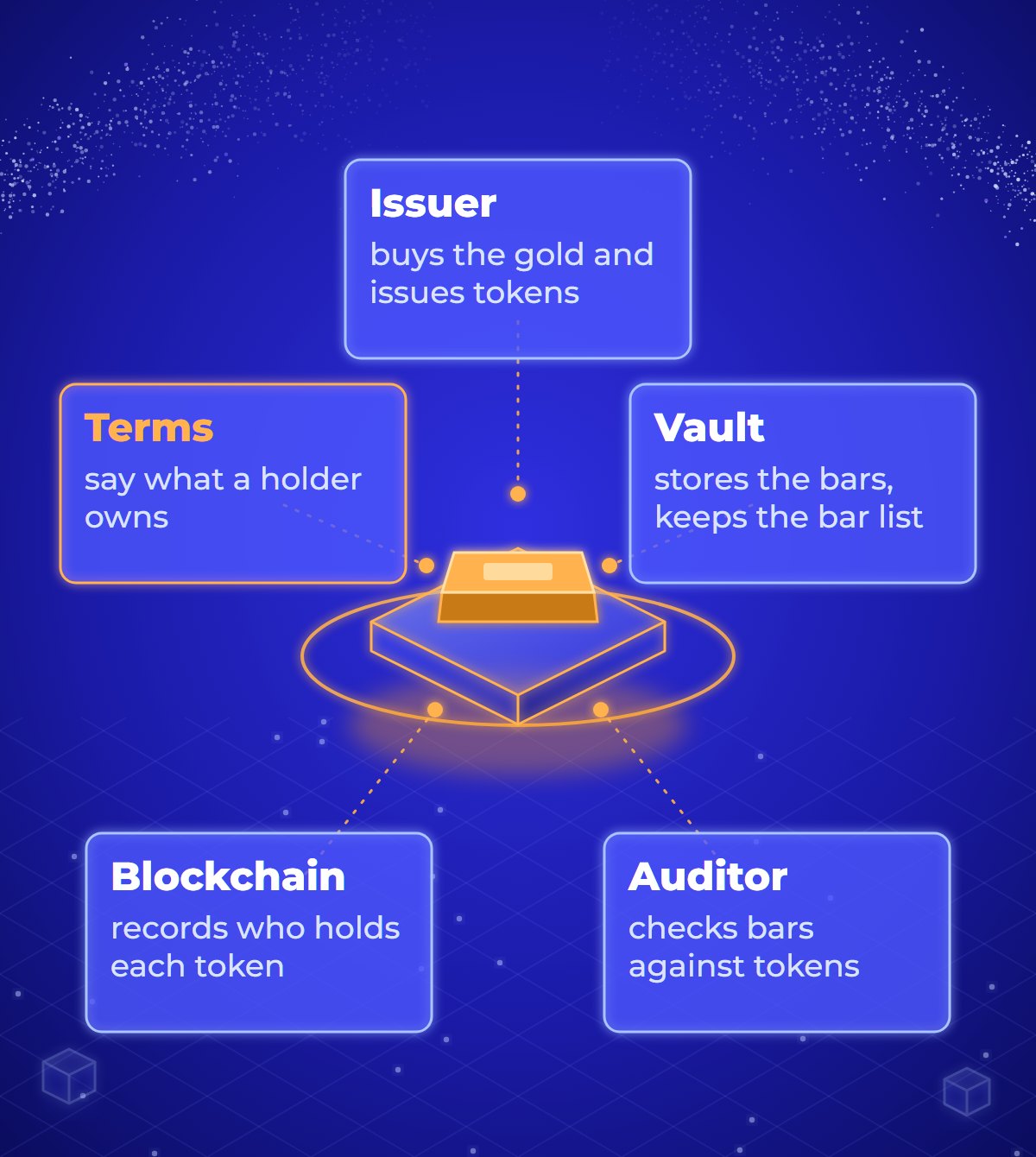
Five parts of a tokenised gold arrangement.
On 14 September 2026 the Financial Conduct Authority published a call for input asking whether tokenisation could improve how gold is "traded, transferred, pledged and held" in UK markets, with comments due by 23 October 2026 (FCA, Call for Input: Tokenised gold, checked 3 October 2026). The paper notes that different structures "can create materially different rights and risks", and it covers only products that give ownership of the underlying gold, with evidenced backing and reliable redemption (FCA call for input, paragraph 2.4).
Allocated, pooled or unallocated: what the token gives you
A gold token gives you one of three things: title to specific bars, a share in specific bars held with others, or a contractual claim on an institution for an amount of gold.
The London Bullion Market Association, which sets standards for the London gold market, explains the two account types that sit underneath. In an unallocated account, the holder "has a contractual claim against the clearer" and so has credit exposure to the institution, much like money in a current account. In an allocated account, the holding is backed by specific bars, listed by bar number, gross weight, fineness and fine weight. The holder then has no credit exposure to the institution keeping the account (LBMA, The OTC Guide: Precious Metal Accounts, checked 3 October 2026).
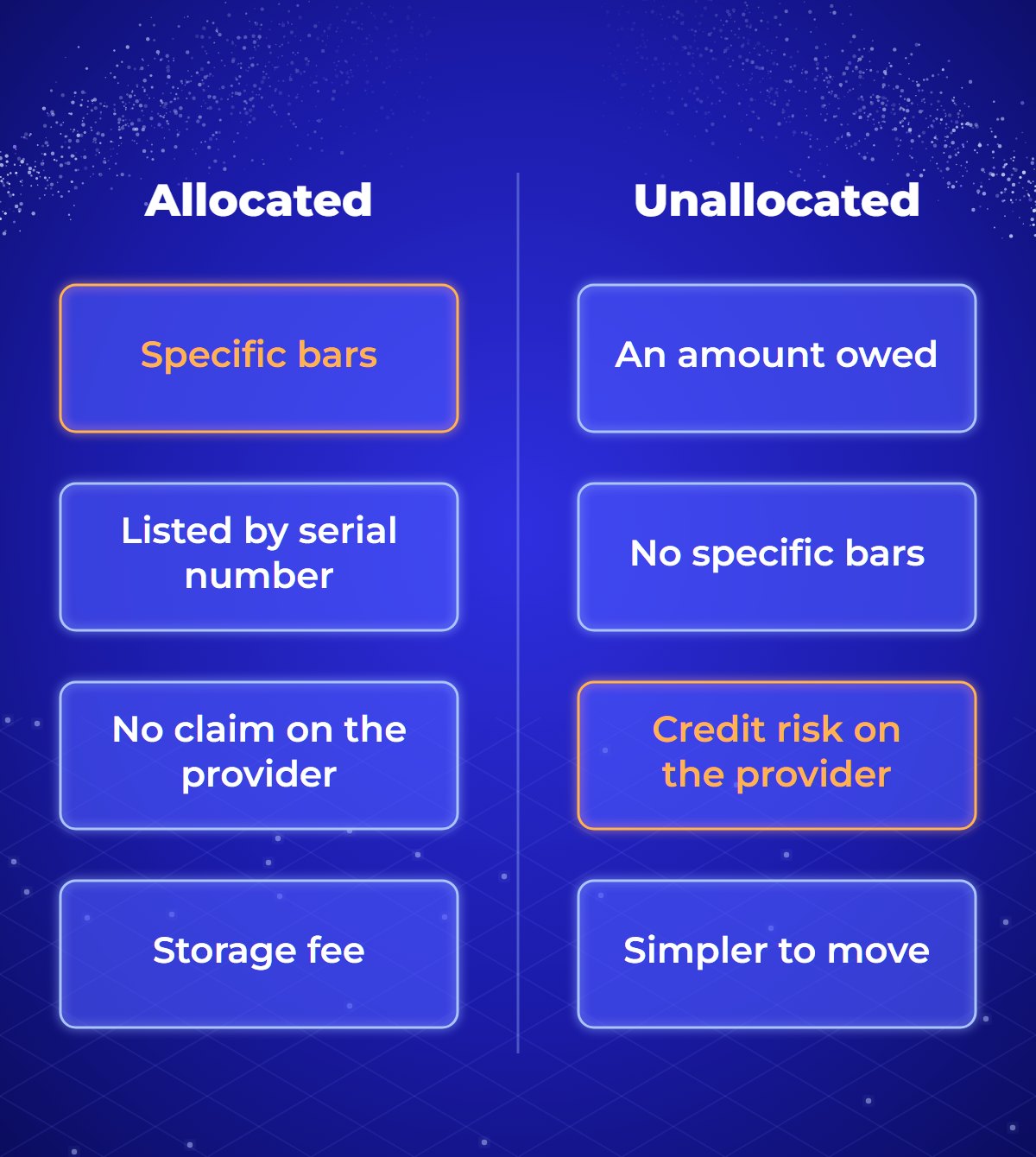
The two ways gold is held behind a token, as the London market defines them.
The FCA draws the same line. Allocated gold "gives stronger certainty of ownership" but is slower and more costly to move. Unallocated gold is easier to transfer but "represents a claim on an account provider" (FCA call for input, paragraph 2.9).
A token can sit between the two. In a pooled design, each unit stands for a fixed weight of gold, such as one troy ounce, drawn from a stock of large bars held for all holders together. The FCA reports that industry groups have proposed tokens giving "a direct co-ownership interest" in an allocated bar, and it asks why such arrangements would fall outside the fund definitions (FCA call for input, paragraph 5.13).
The London market's standard contracts show what happens to a holding that does not fill whole bars. The template allocated account agreement that the LBMA publishes for members of London Precious Metals Clearing Limited (LPMCL) records the nearest whole number of bars for a client. Any remainder too small for a whole bar is held as unallocated metal under a separate agreement. The same template can let the provider replace a client's bars with "the same number of substitute bars of like quality" (LPMCL template Allocated Precious Metals Accounts Agreement, clauses 4.5 and 7.2, checked 3 October 2026). A token built this way may give you part bars and part claim, and the bar numbers behind it can change.
A token can also stand for one whole, identified bar, as described in Gold Passport: one token, one bar.
Redemption: getting the gold out
Redemption is the holder's right to exchange tokens for gold or cash, and its minimum size, fees and location decide whether a small holder can ever take delivery of metal.
The wholesale market trades in large bars. A standard London Good Delivery gold bar weighs between 350 and 430 troy ounces, with a minimum purity of 99.5% (LBMA). Where tokens are backed by such bars, physical redemption may be possible only in whole bars. The London market's template allocated agreement works on the same basis: metal is withdrawn in bars that meet the good delivery rules, unless another form is agreed, and the client collects it "at your expense and risk" (LPMCL template agreement, clause 4.1).
The terms should answer four practical points: the smallest amount you can redeem, where the gold is handed over, who pays for delivery and insurance, and when the issuer can refuse or delay redemption. The LBMA template shows the limits to look for. Where the provider has agreed to deliver, it need not do so if delivery would breach the law or a court order, if the cost would be excessive and the client has not confirmed it will pay, or if delivery is not reasonably practicable. It may also refuse a withdrawal it reasonably suspects could fund a sanctioned person (clauses 4.4 and 10.2).
Trusty Digital's 2024 commodities pilot, listed on our Discovery page, tokenised physical coins held by an independent vault, one token per coin, with redemption rules, transfer restrictions and controls over the vault records.
How to check the gold is there: bar lists and attestations
The evidence that gold backs a token is a bar list from the vault, matched against the number of tokens on the blockchain and checked by an independent accountant.
The bar list. Each bar has a unique number, a gross weight and a fineness. The fine weight is the gold content after allowing for impurity. A bar list should add up to at least the gold that the tokens in circulation claim.
The token supply. The number of tokens in issue is visible on the blockchain at any moment. The FCA lists how "on-chain records can be reconciled with custody and vault records" among the questions tokenised gold must answer (FCA call for input, paragraph 3.4).
The accountant's report. Reports on gold backing are usually assurance engagements, and their wording matters. The Institute of Chartered Accountants in England and Wales explains that a reasonable assurance conclusion is positive ("in our opinion" the statement is reasonably stated), while a limited assurance conclusion is negative: "nothing came to our attention" to suggest it is wrong. Limited assurance involves fewer or different tests (ICAEW, Limited assurance vs reasonable assurance, checked 3 October 2026). Read which kind you are looking at, the date it covers and who signed it. Proving what backs a token goes through these reports in more detail.
An illustrative example. An issuer has 10,000 tokens in circulation, each for one fine troy ounce. Its latest report lists 25 bars with a total fine weight of 10,012 ounces, as at 30 June, under limited assurance. The backing covered the tokens on that date. The report says nothing about the weeks since, and a limited assurance conclusion rests on fewer tests than a full opinion. These figures are invented for illustration.
How UK and EU rules treat gold tokens
In the UK a gold token can fall under different rules depending on its structure, and the FCA is consulting on whether to clarify them; in the EU, a token that aims to keep a stable value by referring to gold may be an asset-referenced token under MiCA.
Collective investment schemes. Under section 235 of the Financial Services and Markets Act 2000, a collective investment scheme is an arrangement that lets participants share in what a property produces, where they do not have day-to-day control of its management and their contributions are pooled or the property is managed as a whole. The FCA says a product that directly represents ownership of an allocated bar is "more likely to fall outside" the scheme and fund definitions. Where customers hold fractions of one bar that is managed or sold collectively, that indicates pooling (FCA call for input, paragraphs 5.11 and 5.12). The classification matters because a scheme brings authorisation and marketing restrictions.
Cryptoassets. The FCA also notes that firms must consider whether a gold token is a "qualifying cryptoasset" under article 88F of the Regulated Activities Order. Among its possible responses, the paper mentions guidance, an "eligible gold token" classification and a bespoke regime, none of them yet proposed as rules.
The European Union. The Markets in Crypto-Assets Regulation defines an asset-referenced token as a cryptoasset, other than an e-money token, that "purports to maintain a stable value by referencing another value or right" (Article 3(1)(6)). Holders of such tokens have a right of redemption "at all times" against the issuer (Article 39(1)) (Regulation (EU) 2023/1114, checked 3 October 2026). Whether a particular gold token meets the definition depends on its terms.
Risks and the questions to ask before holding a gold token
The main risks sit off the blockchain: the issuer, the vault, the terms and the honesty of the records that link them.
The FCA sets out the disclosures it expects products sold to consumers to make, so that holders can compare them. They cover how the gold is kept and insured, whether redemption is available, how far the product is regulated, fees and minimum amounts, and what happens if the issuer, vault, technology provider or an intermediary fails (FCA call for input, paragraph 3.9).
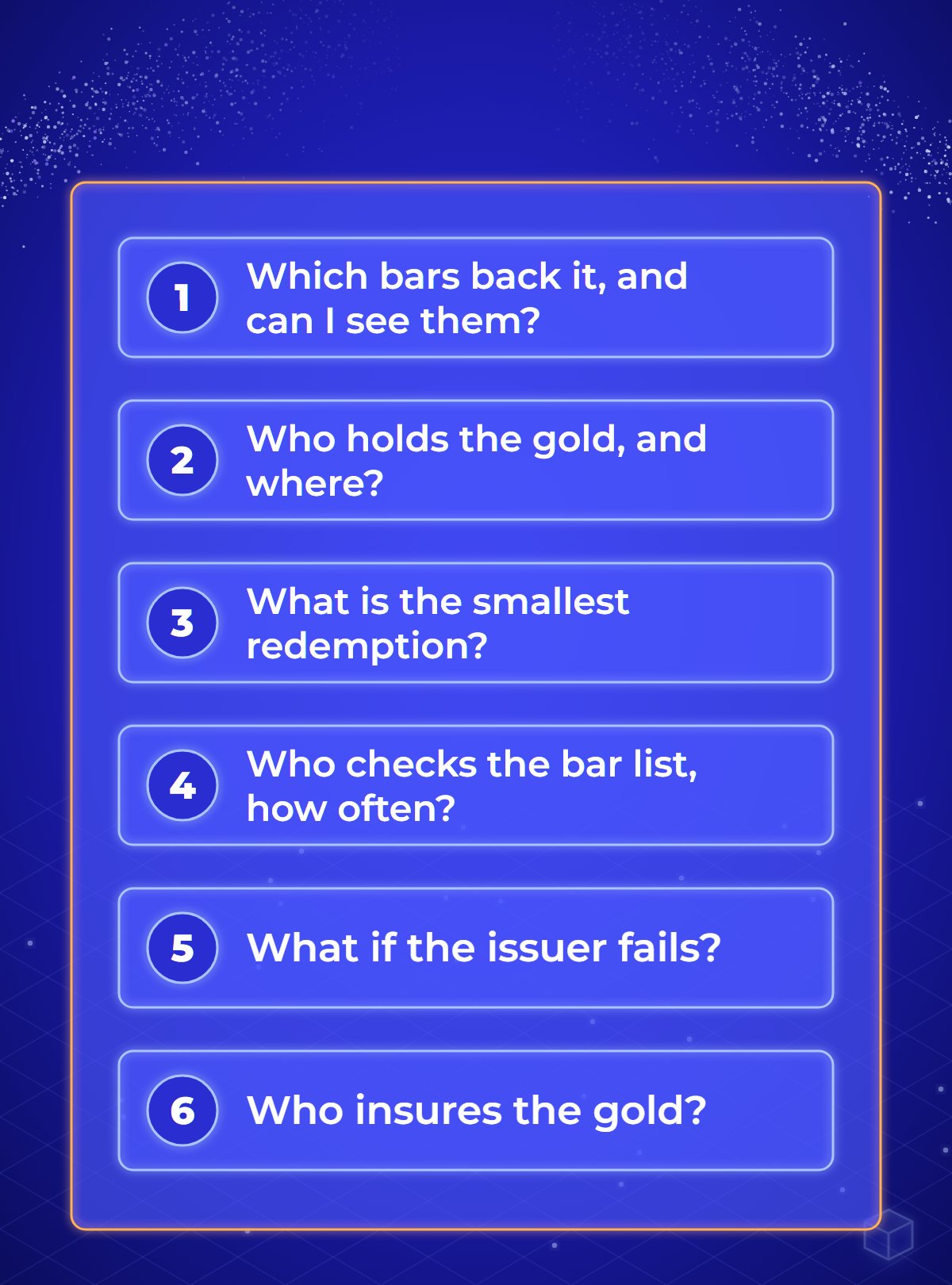
Six questions for any gold token, based on the FCA's list of expected disclosures.
The LBMA notes that the owner of allocated metal arranges its own insurance unless agreed otherwise, and the template agreement puts the provider under no duty to insure unless its schedule says so (clause 12.3). A token's terms should say who insures the bars and up to what amount.
The FCA lists the treatment of gold tokens in insolvency among the questions that still need legal clarity (paragraph 3.4). For ordinary accounts the LBMA describes the difference: an unallocated holder has credit exposure to the institution, and an allocated holder does not. Which side a token puts you on depends on its terms. What happens to tokens if the issuer fails sets out the wider position.
Tokenised gold in short
Tokenised gold is a record on a blockchain that refers to gold in a vault, and everything a holder can rely on comes from the terms, the vault and the checks behind it.
Questions people also ask
Is tokenised gold real gold? The token is a digital record. It refers to real gold if the issuer holds bars in a vault and the terms give holders a right to them. The bar list and an independent report are the evidence.
Can I swap a gold token for a physical bar? Often, if you meet the issuer's minimum and pay its fees. Where the gold is held in wholesale bars of 350 to 430 ounces, the minimum may be a whole bar. The redemption section of the terms gives the amount, the place and the cost.
What is the difference between allocated and unallocated gold? Allocated gold is specific bars recorded as yours. Unallocated gold is an amount owed to you by an institution, so you depend on that institution's solvency. Allocated vs unallocated gold explains the difference in more detail.
The short version
A gold token can give you title to specific bars, a share of bars, or only a claim on the issuer, and the name of the token does not tell you which. Read the terms, look for a bar list you can match to the token supply, and check who reports on it and how often. Find out the smallest amount you can redeem, and what happens if the issuer fails. UK rules for these products are still being shaped.
To see how a single identified bar can be tied to a single token, read Gold Passport: one token, one bar.
This article is general information, not legal, tax or investment advice.





 10 min read