A blockchain certificate is a credential whose issue is recorded on a blockchain, so anyone shown it can check who issued it and that it has not been altered, without contacting the issuer. The record proves origin and integrity. Whether the achievement is real still depends on the issuer's own checks, and personal data belongs off the chain.
What is a blockchain certificate?
A blockchain certificate is a diploma, licence, training record or award whose issue the issuer has written to a blockchain, so that the record outlives the issuer's own systems and cannot be edited after the event.
The World Wide Web Consortium describes the general model in its Verifiable Credentials standard, a W3C Recommendation since 15 May 2025. A verifiable credential is "a specific way to express a set of claims made by an issuer", and the standard gives an education certificate as one example (W3C Verifiable Credentials Data Model 2.0, checked 3 October 2026). Three parties take part. The issuer makes the claim, the holder keeps it and shows it, and the verifier checks it.
The standard leaves open where the supporting records live. Its list of possible registries includes "trusted databases", government databases and "distributed ledgers". A blockchain is one of those options. That matters later, when we look at whether you need one at all.
In practice a blockchain certificate takes one of two shapes:
- A fingerprint on the chain. The certificate itself is a file. The issuer computes a short code from it, called a hash, and records that code on the blockchain. Change one character in the file and the code no longer matches.
- A token in the holder's account. The certificate is issued as an NFT, a unique token, to an account the holder controls. The token carries or points to the certificate details.
Both shapes rely on the same thing: a record written by an account that verifiers can link to the issuer.
How a certificate is checked without contacting the issuer
The verifier compares what the holder shows with the record on the blockchain and with the issuer's published account, so no email or phone call to the issuer is needed.
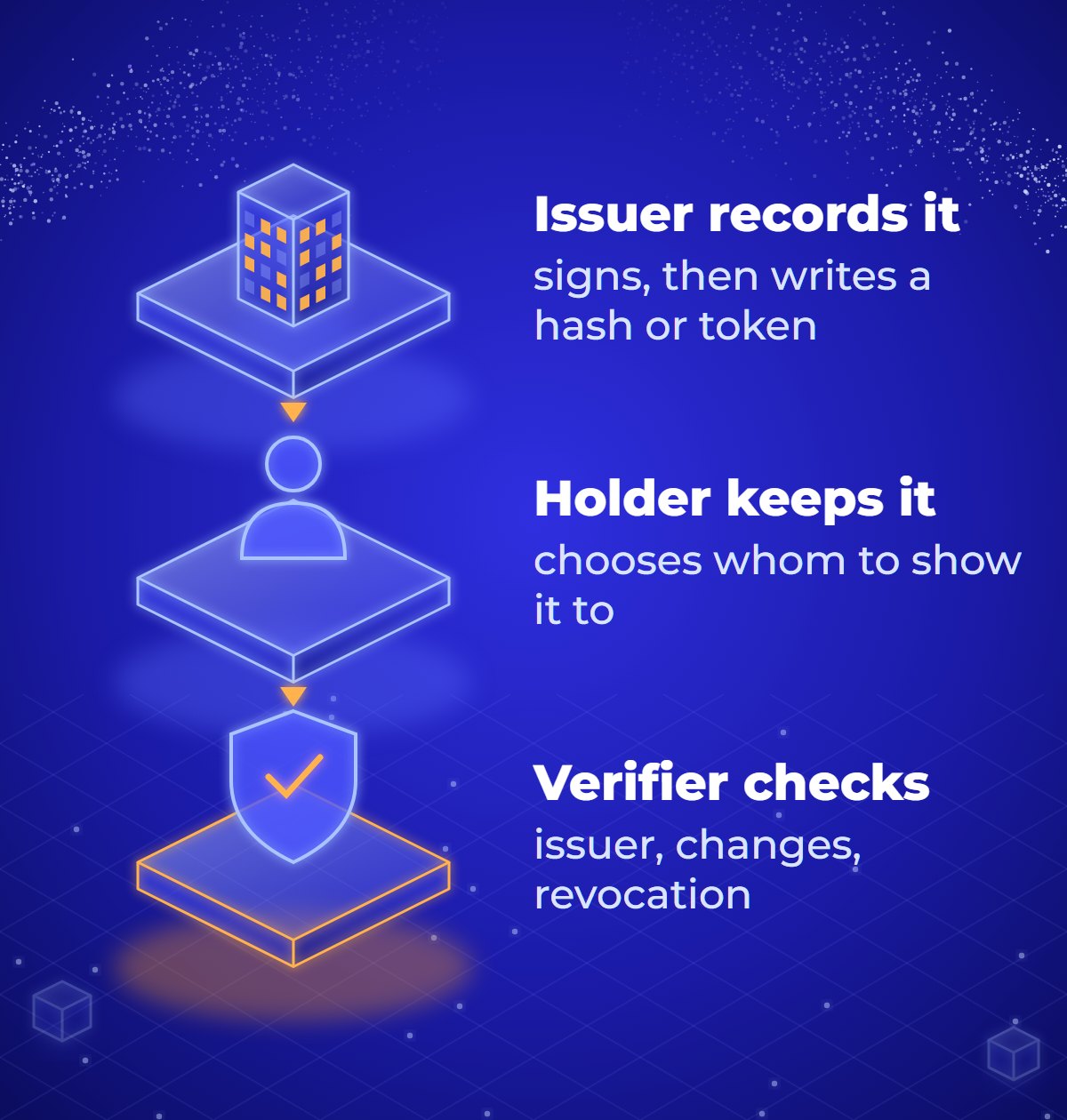
Three parties and one shared record.
The check runs in four steps:
- The holder shares the certificate, as a file, a link or a token in their wallet.
- The verifier's software finds the matching record on the blockchain and confirms that the content has not changed since it was recorded.
- It confirms that the record was written by the issuer's known account, usually one the issuer lists on its own website.
- It checks whether the issuer has since revoked the certificate.
The Massachusetts Institute of Technology ran this pattern in 2017. It offered 111 graduates the option of receiving their diploma on their smartphones through an app called Blockcerts Wallet, alongside the paper version. MIT described the verification portal as using "the blockchain as a notary", and said an employer could check the diploma without having to contact the Registrar's Office (MIT News, 17 October 2017, checked 3 October 2026).
The time saved falls on the issuer as much as the verifier.
An illustrative example. A training company issues 2,000 safety certificates a year. Employers and site managers contact it about 400 times a year to confirm that a certificate is genuine, and each request takes a member of staff 15 minutes to find, check and answer. That is 100 hours a year spent answering one question. With a recorded certificate, the employer answers it alone. These figures are invented for illustration.
Why certificates are issued as non-transferable tokens
A certificate belongs to one person, so when it is issued as a token, the token is set up so that the holder cannot sell or give it to anyone else.
On Algorand, the network Trusty Digital uses, every asset has optional control roles set when it is created. The freeze account "can freeze or unfreeze asset holdings", and frozen accounts cannot send or receive the asset. An asset can also be created frozen by default in every account (Algorand developer documentation, Algorand Standard Assets, checked 3 October 2026). A certificate token frozen in its holder's account stays there.
A community standard, ARC-71, describes non-transferable assets for exactly this purpose: identities, credentials, memberships and similar records. Under ARC-71 the issuer can revoke a token but cannot take it back from the holder, and the holder keeps the right to close the token out of their account back to the creator (ARC-71, Non-Transferable ASA, checked 3 October 2026). A revoked token stays visible, so a verifier can see both that it was issued and that it was withdrawn.
Algorand adds one more step that suits certificates. An account must opt in to an asset before it can receive it. The holder has to accept the certificate token, so nothing lands in their account without an act of their own.
Trusty Digital used this approach in a 2024 pilot for a sports organisation, described on our Discovery page. Each achievement certificate was minted as one non-transferable NFT under the issuer's control, with holder consent for access and public verification without contacting the issuer. The certificates are records of achievement and have no investment value. If you are new to tokens of this kind, What is an NFT? explains what an NFT stores.
Privacy and consent: what UK GDPR means for blockchain certificates
A certificate is personal data, and a public blockchain cannot delete what is written to it, so the safe design keeps names, grades and dates of birth off the chain.
The UK General Data Protection Regulation gives people a right to have their personal data erased in certain circumstances, for example when they withdraw consent or the data is no longer needed. The Information Commissioner's Office says the right "is not absolute", and an organisation has one month to respond to a request (ICO, Right to erasure, checked 3 October 2026). An issuer that has written a learner's name to a public ledger may be unable to comply.
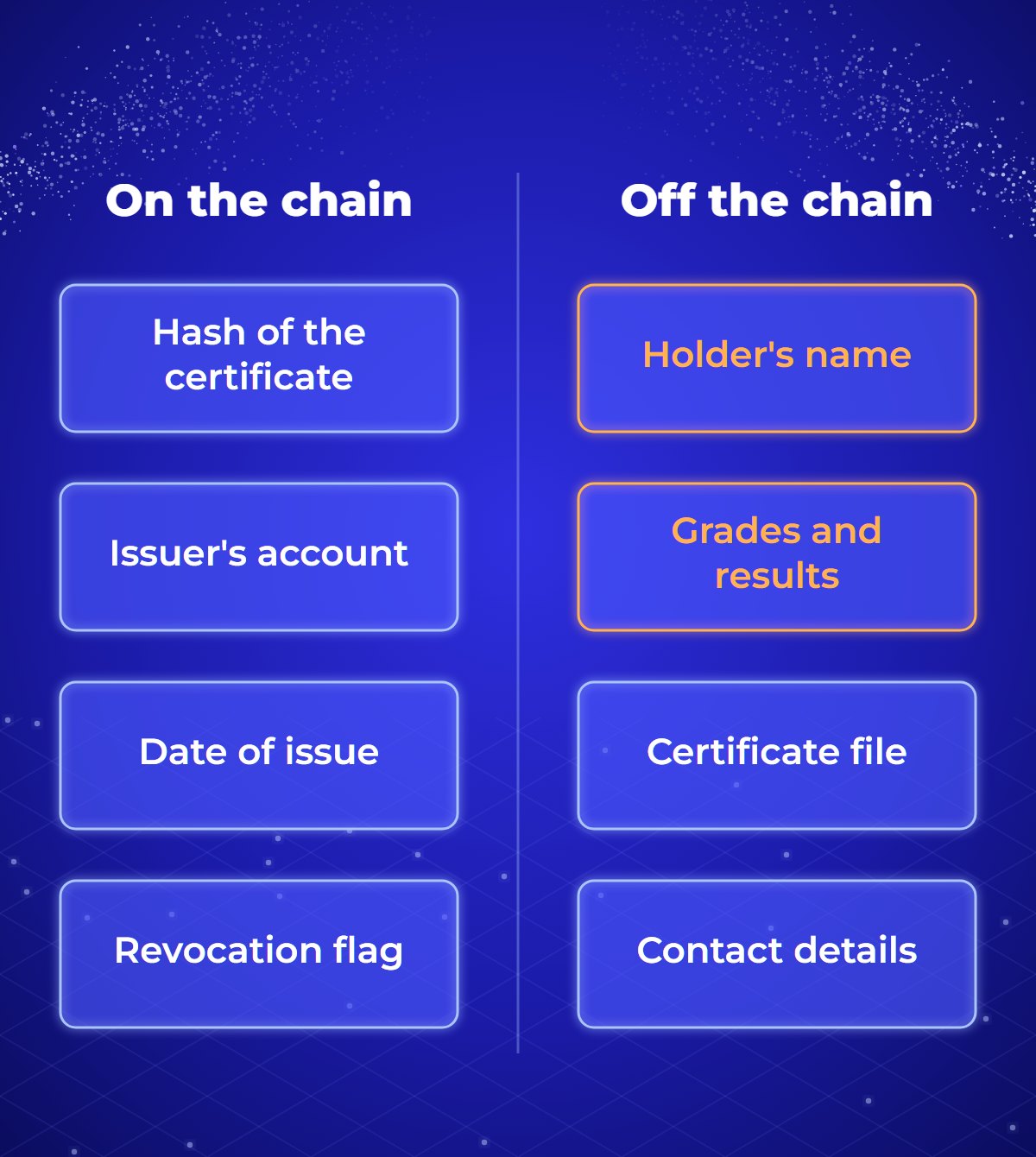
A typical split between the shared record and the issuer's own systems.
A hash on the chain is safer, though it can still be personal data. The ICO's guidance on pseudonymisation answers the question directly: pseudonymised data "is personal data in the hands of someone who holds the additional information". It also advises against hashing methods that add no extra secret data, because a short or predictable input can be guessed (ICO, Pseudonymisation, checked 3 October 2026). The ICO notes that this guidance is under review after the Data (Use and Access) Act.
Consent needs care too. Every processing of personal data needs a lawful basis under Article 6 of the UK GDPR, and consent is one of six. Valid consent must be freely given, specific, informed and unambiguous, and people must be able to withdraw it (ICO, What is valid consent?). The ICO warns that consent is hard to rely on where there is a clear imbalance of power, such as between an employer and staff. A certificate scheme run by an employer may need another lawful basis, and the choice depends on the facts.
The wider question of what a public ledger reveals about its users is covered in Is a blockchain private?.
What a blockchain certificate cannot prove
A blockchain certificate cannot prove that a claim is true: it proves who recorded the claim and when.
The issuer's checks. If an issuer awards a certificate after a careless assessment, the record will faithfully preserve a careless certificate. The value of the record rests on the issuer's process.
The link between account and institution. Anyone can create an account and call it "University of Somewhere". A verifier needs a reliable way to know that the issuing account belongs to the real institution, usually a list the institution publishes on its own website or in a trusted register.
Lost keys. The issuer's signing keys must be protected for years. If they are stolen, someone can issue convincing fakes until the theft is noticed and the account is replaced. Holders can lose access to their wallet, so the issuer needs a way to reissue.
The file behind the fingerprint. If the certificate file is hosted on the issuer's server and the server goes, the record on the chain proves that a document once existed and cannot show what it said. Holders should keep their own copy.
Revocation. Some certificates expire or are withdrawn. A scheme needs a published way to mark them, and verifiers need to check it each time.
Do you need a blockchain for digital certificates?
Often you do not: a digitally sealed certificate file gives tamper evidence and a known issuer, and a blockchain adds value mainly when the record must outlive the issuer or be shared by several issuers.
The European Union's own scheme shows the alternative. A European Digital Credential for Learning is "a verifiable, digital version of a credential", signed with the issuing organisation's electronic seal under the eIDAS rules. If anyone edits the file, the seal breaks and the verification checks fail (Europass, European Digital Credentials for Learning, checked 3 October 2026). No blockchain is involved.
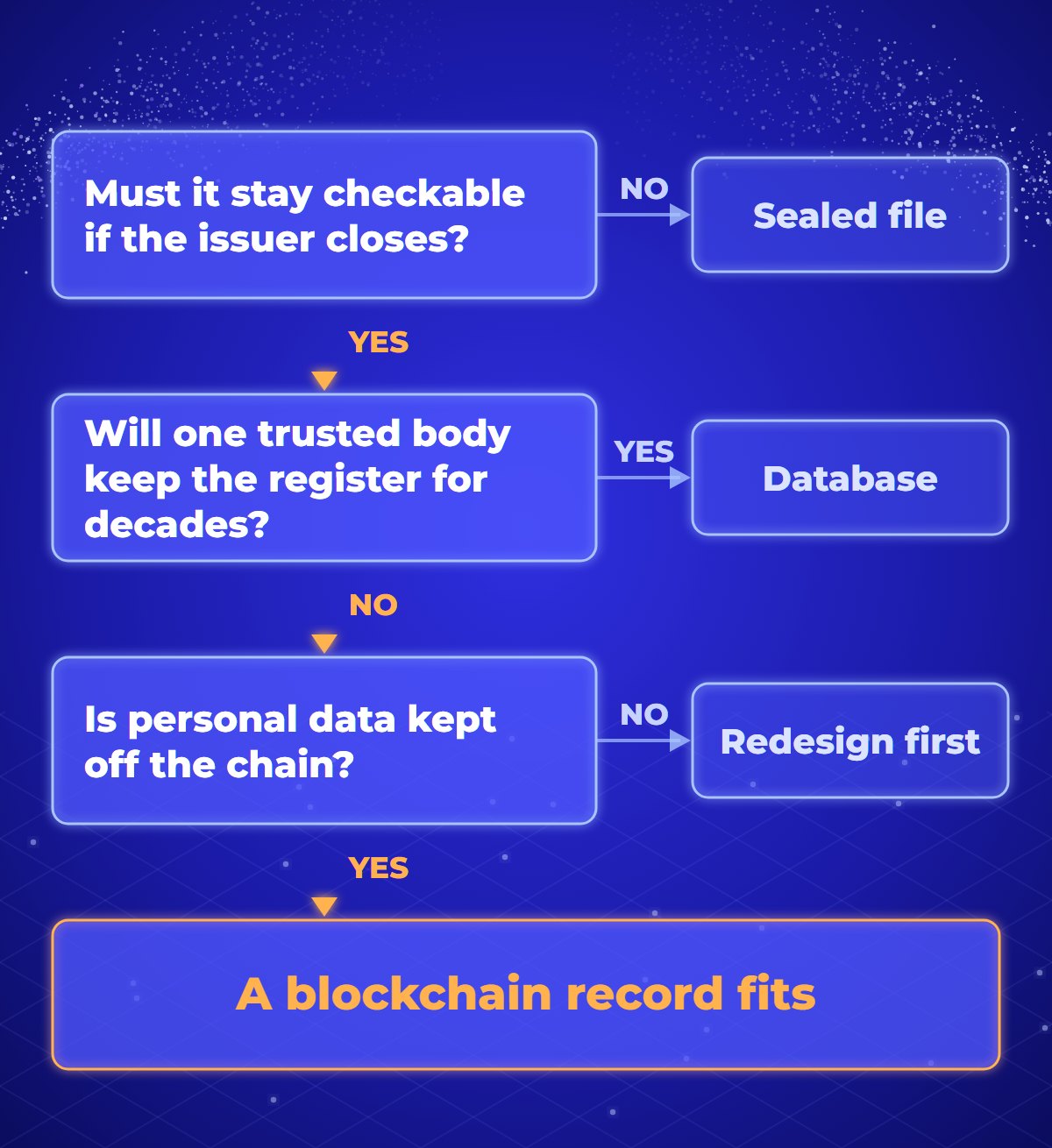
Three questions to answer before choosing a blockchain record.
A blockchain record starts to justify itself in a few situations:
- the certificate must stay checkable for decades, after a course provider or event organiser may have closed;
- several issuers, such as clubs in one league or colleges in one group, want a single place where verifiers look;
- verifiers want a timestamp that no single organisation controls;
- the certificate should work as a key elsewhere, for example to enter an event or claim a membership, which NFT utility explained covers.
Certificates are one of several uses of the same record. Tokenisation use cases beyond raising money sets them side by side.
Setting up a certificate scheme: the first decisions
Before choosing technology, an issuer should settle what the certificate says, who may check it, how long it must last and how it can be withdrawn.
- Content. Decide the minimum the certificate must state. Every extra field is more personal data to protect.
- Lawful basis. Record which basis under the UK GDPR the scheme relies on, and what holders are told.
- Issuer identity. Publish the issuing account on your own website so verifiers can match it.
- Key protection. Decide who can sign, how keys are stored and what happens when a person leaves.
- Revocation and reissue. Write down when a certificate is withdrawn and how a holder who loses access gets a replacement.
- Lifetime. Decide how long the certificate must remain checkable, and where holders keep their copy.
Questions people also ask
Can a blockchain certificate be faked? The record cannot be edited, so a copied or altered certificate fails the check. A fake issued from a stolen issuer key, or from an account that only pretends to be the issuer, can pass until the verifier checks the issuer's published account.
Is a blockchain certificate legally valid? Validity comes from the issuer's authority to award the qualification, for example a university's degree-awarding powers. The blockchain record is evidence of what the issuer awarded and when.
What happens if the issuer closes down? The record on the blockchain remains, so a verifier can still see that the certificate was issued and by which account. The holder should keep the certificate file, because a closed issuer's website and hosted files may disappear.
The short version
A blockchain certificate lets anyone check who issued a credential and that it has not been changed, without asking the issuer. Keep personal data off the chain and record only a fingerprint or a non-transferable token. For one issuer whose systems will stay online, a sealed file is usually enough. A blockchain is worth the extra work when records must outlive the issuer or several issuers share them.
To see how credential verification fits alongside property and commodity pilots, visit the Discovery page.
This article is general information, not legal, tax or investment advice.




 10 min read