Tokenised stock is a company's shares recorded as tokens on a blockchain. In the UK the register of members stays the legal record of who owns them, so the token is a copy the company must keep in step. Some products sold as stock tokens only track a share price and give their holder no rights as a shareholder.
What is tokenised stock?
"Tokenised stock" is used for three different things: a company's own shares recorded as tokens, securities issued and settled on a blockchain inside regulated market infrastructure, and tokens that track a listed share's price without being shares at all.
The first is the one most UK directors ask about. A private company keeps its shares exactly as before, with the same articles, the same classes and the same register, and issues one token for each share so that holdings and transfers can be recorded on a blockchain.
The second is the business of exchanges and settlement systems. In the UK it is being tested in the Digital Securities Sandbox, described in its own section below.
The third is a financial product sold by a third party. It can look like a share in a wallet, and it may give no rights against the company whose name it carries.
The general case for recording rights as tokens is set out in What is asset tokenisation?. This article covers shares.
The register of members stays the legal record
Under the Companies Act 2006, a person becomes a member of a company when they agree to and their name is entered in the register of members, so a token moving between wallets does not by itself change who the shareholders are.
Every company must keep a register of its members, with the shares each one holds (s.113). A person who agrees to become a member "and whose name is entered in its register of members, is a member of the company" (s.112(2)). The register is "prima facie evidence" of the matters the Act requires it to contain (s.127).
The route to the register has its own rules. A company may not register a transfer of shares unless a proper instrument of transfer has been delivered to it, or the transfer falls within one of the statutory exceptions (s.770). Once a transfer is lodged, the company must register it or give notice of refusal, with reasons, within two months (s.771). Under the model articles for private companies, "the transferor remains the holder of a share until the transferee's name is entered in the register", and the directors may refuse to register a transfer (Model Articles, para. 26, all checked 3 October 2026).
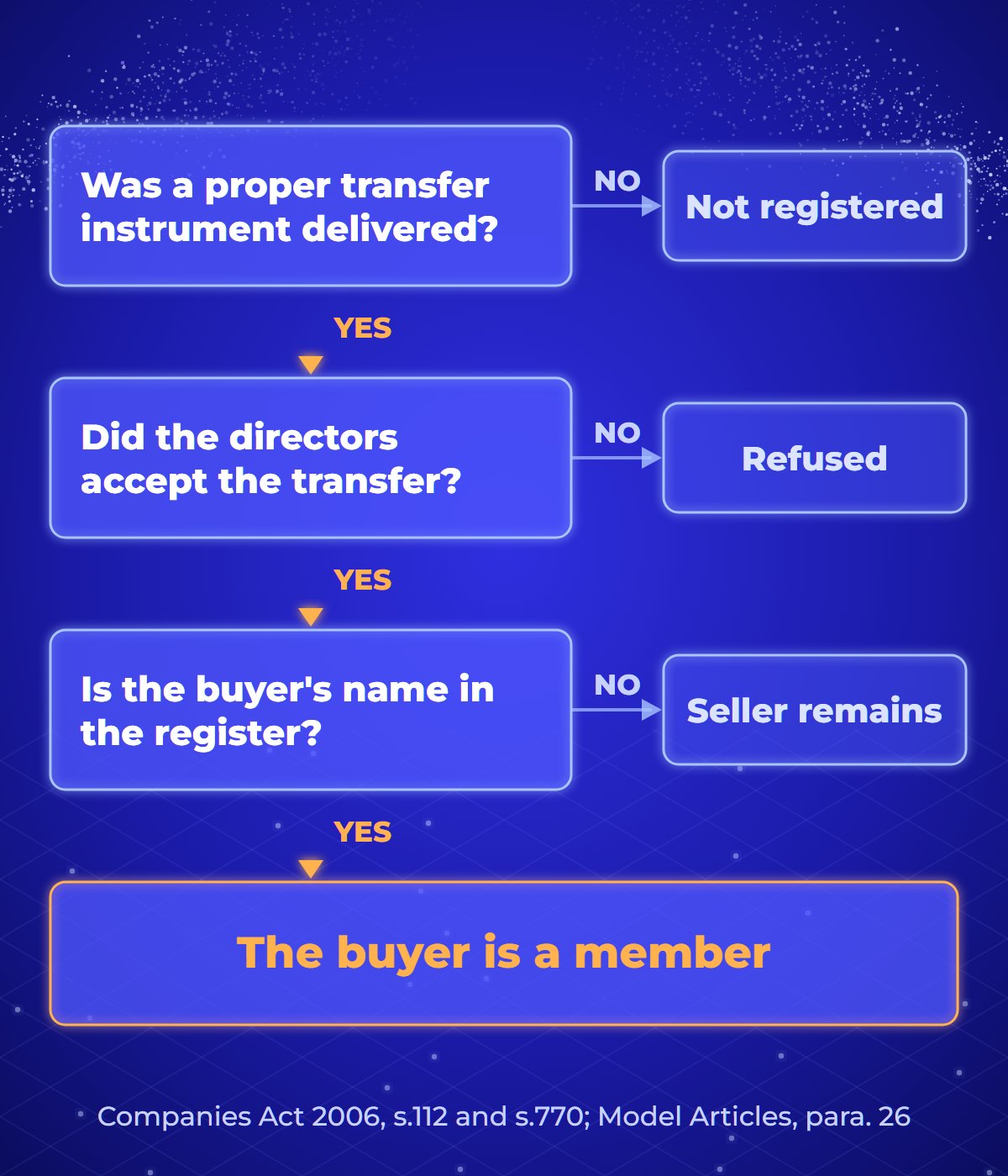
Who is the member after a token transfer, under the Companies Act 2006 and the model articles.
A token system works with these rules. The transfer documents can be signed electronically, the articles can provide that transfers between approved holders are accepted in advance, and the register can be updated from the ledger. Someone at the company still has to make the register entry. Redeemable shares explained shows what keeping the two records in step involves when shares are cancelled.
What the token changes for a company and its shareholders
A token changes how quickly transfers are recorded, how the company enforces its rules on who may hold shares, and who can see the record. The share and the rights attached to it stay the same.
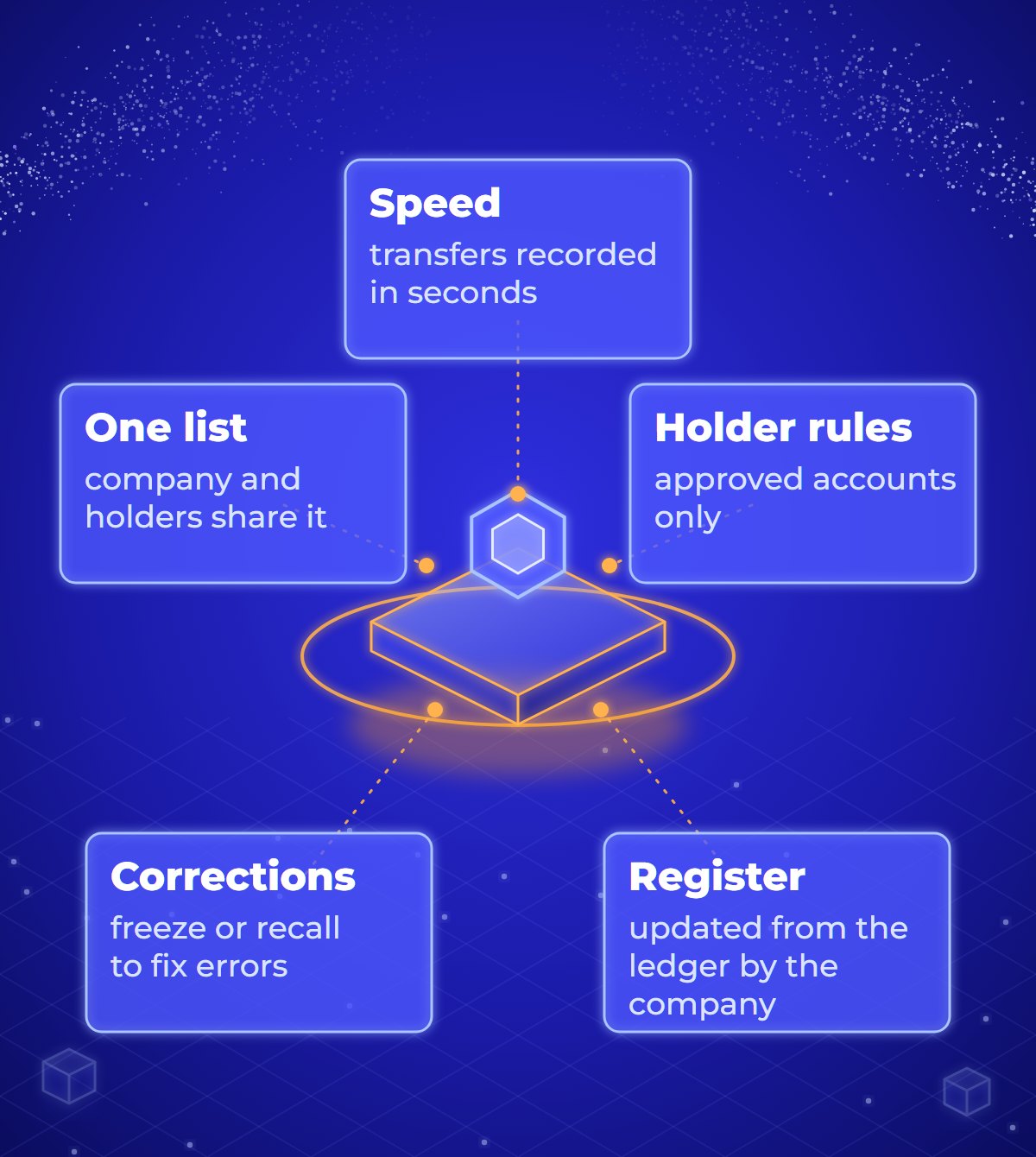
What a token adds to a company's shares. The rights attached to the shares stay in the articles.
Speed of record. On Algorand a transfer is final within seconds, at any hour. The company then has one up-to-date source from which to update its register.
Rules on holders. On Algorand, an account must opt in to receive an asset, and the issuer can keep the power to freeze a holding or move tokens back, as Why Trusty Digital uses Algorand explains. A company can use these controls to keep its shares among approved holders, in line with its articles and any shareholders' agreement.
One shared record. The company, its shareholders and its advisers can check the same list of holdings without exchanging spreadsheets.
Things the token leaves unchanged. Voting and dividend rights come from the articles and the share class. Pre-emption rights and drag-along clauses still apply. The tax on buying shares is not removed: HMRC says that when you buy shares "you usually pay a tax or duty of 0.5%" (GOV.UK, Tax when you buy shares, checked 3 October 2026). How that applies to a particular token transfer is a question for a tax adviser.
The Digital Securities Sandbox: shares settled on a blockchain
The Digital Securities Sandbox is a live, regulated environment run by the Bank of England and the FCA in which firms can issue, trade and settle real securities, including shares, on distributed ledgers.
The Bank describes it as a place to test new technology for "notary, maintenance and settlement" of securities, alone or together with running a trading venue (Bank of England, Digital Securities Sandbox, checked 3 October 2026). It runs under a temporarily modified legal framework, with limits that rise as firms meet the requirements at each stage. It is due to run until 8 January 2029, and HM Treasury may extend it by legislation.
The FCA opened it for applications on 30 September 2024. It can cover equities, corporate and government bonds, money market instruments, fund units and emissions allowances. Derivatives and unbacked cryptoassets such as bitcoin are outside its scope (FCA, Digital Securities Sandbox opens for applications).
The sandbox is for firms that run market infrastructure. A private company tokenising its own shares does not need to join it, and the sandbox does not change the Companies Act rules on the register for that company.
Stock tokens that only track a price
Some tokens sold as tokenised stock are contracts that follow the price of a listed share, and their holder is not a shareholder of the company named on the token.
The Executive Director of the European Securities and Markets Authority, Natasha Cazenave, described offerings that give exposure to listed shares through special purpose vehicles and noted that they "typically do not confer shareholder rights" (ESMA, keynote speech, 1 September 2025). The FCA and the Bank of England call such products synthetic or economic exposure tokens and say they are usually structured as derivatives or debt instruments (FS26/1, September 2026).
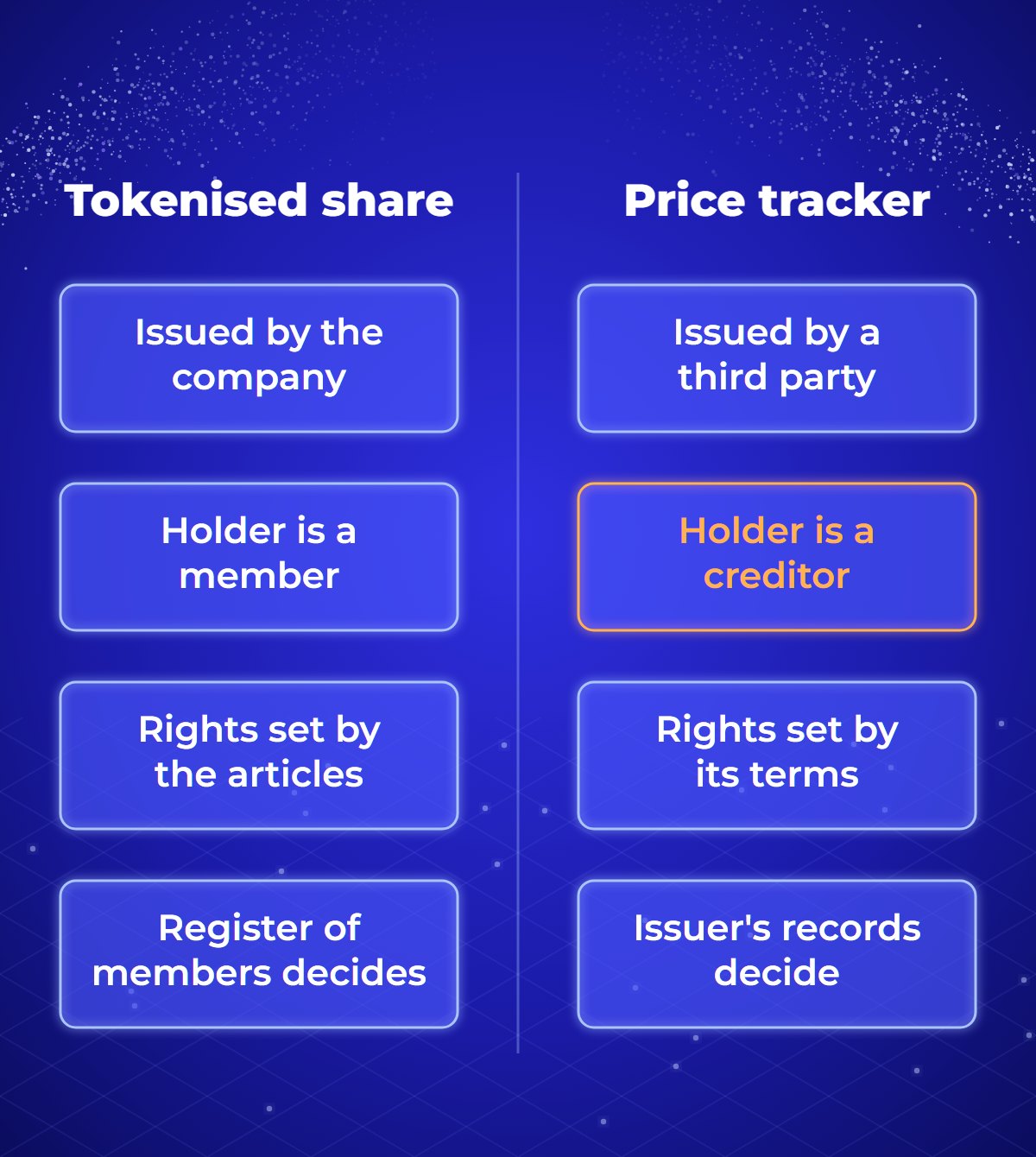
A tokenised share and a price-tracking token can look the same in a wallet.
The holder of a price-tracking token relies on the issuer: that it holds what it says it holds, that it pays what the terms promise, and that it stays solvent. The terms decide whether the holder can ever receive the underlying shares. Check who issued the token before anything else.
Where tokenised shares go wrong
Trouble starts when the ledger and the register say different things, or when a company treats the token as if it were the share.
The two records drift apart. A token can move without a transfer the directors would accept, or the register can be updated without the token moving. Where the register is wrong, a person aggrieved, a member or the company can ask the court to rectify it, and the court can decide questions of title (Companies Act 2006, s.125). That is slow and costly compared with designing the rules so the records cannot drift.
A holder loses access to their wallet. The shares still exist and the register still names the holder. Whether the company can cancel the stranded tokens and issue new ones depends on the powers it reserved before issue and disclosed to holders.
Shares are offered more widely than planned. A token makes transfers easy. Offering shares to people outside the existing group engages the financial promotion rules, which Is my asset suitable for tokenisation? outlines.
The company changes its capital. Every allotment, buy-back, redemption or consolidation has to be matched on the ledger, and the company's filing duties at Companies House do not change.
Before you tokenise your company's shares
Settle four points with your company secretary and solicitor before any token is issued.
- Which record governs, and who updates the register of members from the ledger, how often.
- Whether the articles or the shareholders' agreement need amending, for example to approve transfers between approved wallets in advance.
- Which controls the company keeps over the tokens, such as freezing and recall, and how they are disclosed to shareholders.
- What happens when a shareholder dies, loses their wallet or leaves the company.
An illustrative example. A private company has 40 shareholders, most of them current or former staff. It issues one token per ordinary share and sets the token so that only wallets of approved holders can receive it. On a Friday evening a former employee sends 500 tokens to a colleague. The ledger shows the move at once. Under the company's articles the seller remains the shareholder until the directors approve the transfer and the company secretary enters the buyer's name in the register on Monday. The figures are illustrative.
Questions people also ask
Can a UK company issue its shares as tokens? A company can record its existing shares as tokens. The shares are still created and transferred under the Companies Act 2006 and the company's articles, and the register of members remains the legal record.
Do tokenised stock holders get dividends and votes? Holders of tokenised shares in a company get the rights of their share class. Holders of price-tracking tokens get only what the token issuer's terms promise.
Is tokenised stock legal in the UK? A company can keep a token record of its shares within existing company law, as long as the register of members is kept as the Act requires. The Bank of England and the FCA also run the Digital Securities Sandbox for settling securities on distributed ledgers, and the usual rules on offering shares still apply.
The short version
A tokenised share is a share with a faster, shared record attached. The register of members still decides who owns it, so the real work is keeping the register and the ledger in step. Before relying on any "stock token", find out who issued it, because a token from the company and a token that tracks the company's price give very different rights.
For the step-by-step mechanics of keeping the two records aligned when shares are cancelled, read Redeemable shares explained.
This article is general information, not legal, tax or investment advice.




 10 min read